
The Metaverse isn’t just a buzzword—it’s fast becoming a practical tool for businesses looking to modernize how they showcase products and train their teams. With the rise of extended reality (XR), companies now have access to virtual spaces where training and product demos feel more real, engaging, and effective than traditional methods.
In this article, we explore how businesses can tap into the Metaverse for product demos and training, using real-world examples and insights to guide implementation.
Why Use the Metaverse for Business Applications?
Traditional product demos and corporate training methods—whether through in-person sessions, webinars, or pre-recorded videos—have their limitations. They're often passive, hard to scale, and fail to replicate real-world experiences. The Metaverse, however, changes that with interactive 3D environments, real-time collaboration, and immersive VR/AR technology.
By combining virtual product demonstration with immersive training with VR/AR, businesses can create engaging experiences that boost knowledge retention, improve understanding of complex products, and reduce training costs over time.
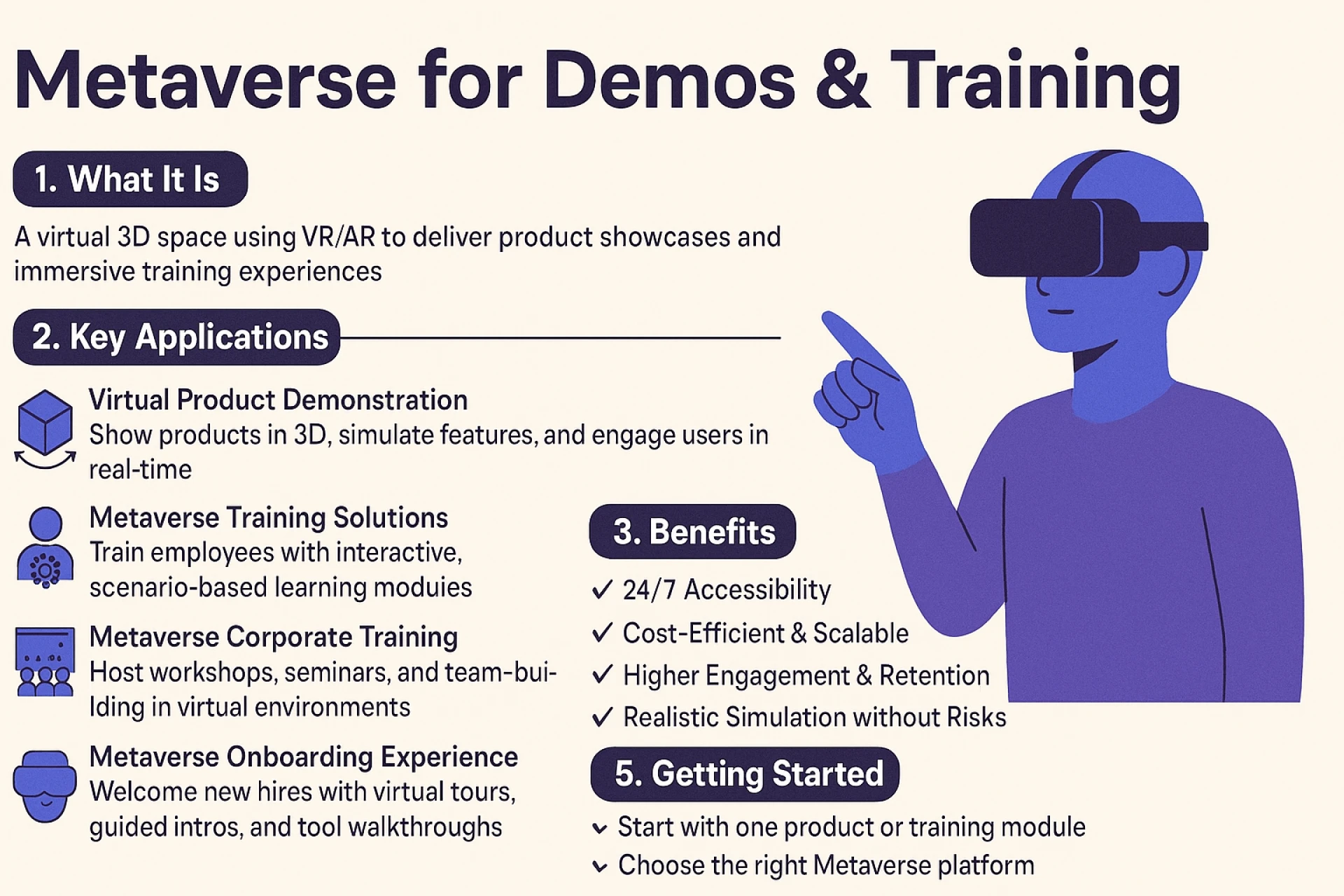
1. Virtual Product Demonstration: Beyond the Brochure
Virtual product demonstrations in the Metaverse offer a hands-on experience without the physical logistics. Instead of showing slides or 2D videos, companies can invite potential clients or partners into a 3D immersive product demo environment.
Example:
A manufacturing firm can showcase heavy machinery in a virtual showroom, allowing prospects to “walk around” the equipment, zoom in on components, and even simulate usage—without shipping the actual hardware.
Benefits:
- Eliminates geographic and logistical limitations
- Engages customers with interactive features
- Allows real-time Q&A within the virtual space
This approach works especially well for industries like automotive, consumer electronics, healthcare devices, and industrial equipment.
2. Immersive Metaverse Training Solutions
Metaverse training solutions replace boring training manuals and passive video tutorials with interactive scenarios. Trainees enter a virtual training environment where they can simulate tasks, experience real-time feedback, and collaborate with others.
Use Cases:
- Retail staff learning how to use new POS systems
- Healthcare workers practicing procedures in a simulated ER
- Field engineers getting virtual hands-on training with complex machinery
This style of immersive training with VR/AR increases retention by allowing users to do rather than just watch or listen. It's especially powerful in situations where safety, cost, or complexity make real-world training impractical.
3. Metaverse Corporate Training: Engaging Remote Teams
Corporate training in the Metaverse isn’t limited to simulations. Companies can host entire workshops, seminars, and team-building activities in a virtual training environment.
Advantages:
- Enables global teams to participate from anywhere
- Encourages real-time collaboration through avatars and voice chat
- Makes sessions more engaging than static video calls or webinars
For example, a tech company might run a multi-day leadership workshop where managers attend breakout sessions, roleplay scenarios, and take part in virtual group activities—all within a Metaverse campus.
4. Enhancing Onboarding with Metaverse Experiences
First impressions matter. A strong Metaverse onboarding experience can help new hires feel welcome and prepared, especially in remote or hybrid work environments.
What's Possible:
- Virtual office tours guided by avatars
- Meet-and-greet sessions with teams across departments
- Interactive walkthroughs of tools, company culture, and workflows
This modern take on onboarding helps new employees feel connected and confident from day one, even if they never step foot in a physical office.
5. Building Interactive Product Showcases
Some products shine when users can explore them in detail. Interactive product showcases in the Metaverse let users experience your product in action—customize options, test features, and even simulate real-world use cases.
This is especially valuable for:
- SaaS platforms with complex user interfaces
- Smart home products
- High-end consumer goods like vehicles or wearables
A VR/AR-based interactive experience can help customers understand value faster and make more confident purchase decisions.
Real-World Implementation Tips
If you're considering using the Metaverse for product demos and training, here are some practical tips to get started:
- Start Small – Pilot a single demo or training module before scaling.
- Choose the Right Platform – Select a Metaverse environment that supports the level of interactivity and scalability you need.
- Invest in Content Design – Work with 3D designers and instructional designers to ensure the experience is both engaging and educational.
- Offer Multi-Device Support – Ensure your experience works across VR headsets, desktops, and mobile where possible.
- Track Engagement – Use analytics to measure how users interact with the content and where improvements can be made.
Final Thoughts
The Metaverse for product demos and training isn’t science fiction—it’s a practical, scalable solution that forward-thinking businesses are already adopting. From virtual product demonstrations to Metaverse corporate training, the possibilities are growing fast.
By creating immersive training with VR/AR, businesses can reduce costs, speed up onboarding, and deliver deeper, more memorable learning experiences. It’s not about replacing human interaction—it’s about enhancing it with tools that match the digital age.