
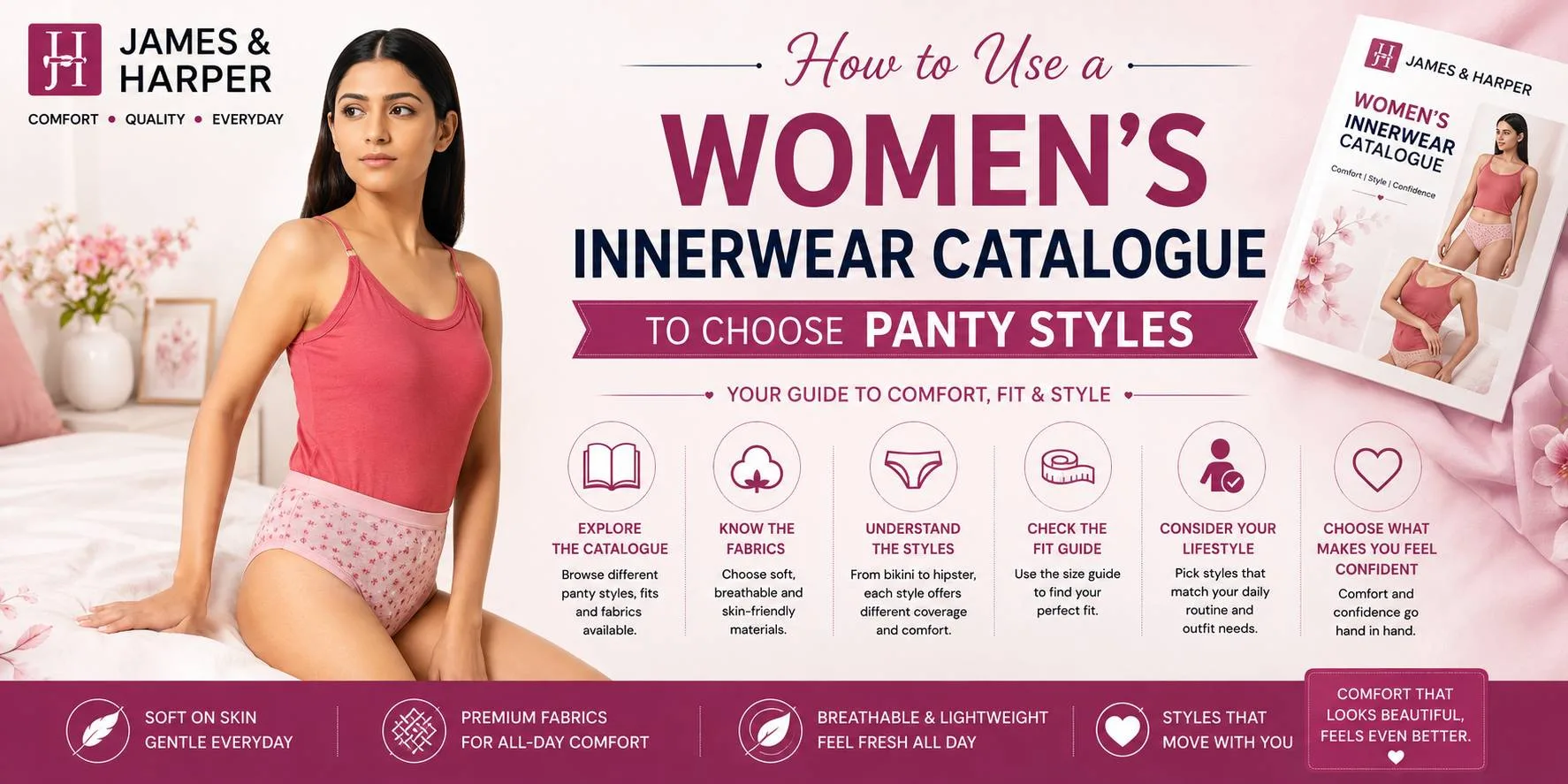
Have you ever chosen a panty that looked right in the picture, then felt uncomfortable by lunchtime? This usually happens because color and shape get attention first. Fit details come later. A women's inner wear catalogue can prevent that mistake when it explains rise, coverage, fabric, waistbands, and intended use. A women's thermal catalogue works in much the same way, though warmth and layering need separate attention.
Begin With the Coverage You Actually Wear
Panty coverage changes how a garment feels under clothing and during movement. A bikini cut may suit low-rise jeans, yet it may not feel secure through a long commute. A mid-rise brief often works better with office pants, kurtis, and day dresses. Full briefs cover more of the lower abdomen and back. Boy-leg styles extend farther across the upper thigh.
Look at the front and back images together. Product copy should state the coverage level instead of leaving the buyer to guess from one photograph.
James & Harper lists plain panties, frilled options, inner panties, and a boy-leg design. That gives buyers more choice than one standard brief offered in several colors.
Check the Rise Against Your Usual Clothes
Rise tells you where the waistband will rest. It also affects whether the panty remains hidden beneath trousers, skirts, or fitted dresses.
Low-rise panties stay below the natural waist. Mid-rise designs come closer to the navel and often feel more secure for daily wear. High-rise styles give broader support, but they may appear above lower waistbands. The best choice depends on the clothes worn most often.
The same check belongs in a women's thermal catalogue. Thermal bottoms that rise too high can fold beneath pants. A waistband that falls too low may leave a gap when the wearer bends or sits.
Read Fabric Descriptions With Some Caution
Fabric names sound simple, yet construction changes the result. Cotton-rich panties often feel breathable and soft through long hours. Blended fabrics can add stretch, shape recovery, or a closer fit. Lycra-based inner layers move with the body, though they feel different from a looser cotton brief.
A women's inner wear catalogue should explain whether a fabric feels light, stretchable, close-fitting, or easy to wash. Do not assume every product uses the same material because it appears in one collection.
James & Harper uses cotton-rich fabrics, stretch blends, and Lycra across selected women’s products. The range focuses on daily comfort, secure fits, and inner layers worn beneath dresses, kurtis, workwear, and casual clothing.
Study the Small Construction Details
Most fit problems come from details that buyers skip:
- A soft waistband should hold the panty without leaving deep marks.
- Covered or flatter seams can reduce rubbing beneath fitted clothes.
- Leg openings need enough stretch to move without becoming loose.
- A broader gusset can improve comfort during walking and sitting.
- Good stretch recovery helps the garment return to shape after wear.
- Fuller back coverage can reduce shifting during travel or office hours.
A description that only says “comfortable” explains very little. Useful information lies in how the waistband feels, where the seams fall, and whether the cut supports movement.
Think About Movement, Not Just Standing Fit
A panty may look fine while standing. The real test starts when someone sits, climbs stairs, drives, or walks for an hour.
If the garment shifts, the back may be too narrow. If the leg opening digs in, the elastic may feel too firm or the size may be too small. If the waistband rolls, the rise may not suit the body shape or outer clothing. Boy-leg panties suit women who prefer more upper-thigh coverage. Mid-rise briefs often work well for long days because they balance support and flexibility.
Movement also needs attention in a women's thermal catalogue. Tops require room across the shoulders, while thermal trousers should bend at the knee without pulling at the waist. Side slits, ankle openings, and stretch panels may improve comfort under winter clothing.
Use the Size Chart as a Starting Point
Size labels differ between brands. Check waist and hip measurements first, then read the product notes for stretch and coverage.
One panty may stop at XXL, while another may extend to 3XL or 4XL. Thermal camisoles, tops, and trousers may follow separate measurements. A women inner wear catalogue should therefore show sizing for each product, not only one general chart.
When measurements fall between sizes, consider the fabric. A stretch-heavy style allows more flexibility. A firmer cotton-rich brief may need the larger option, especially when fuller coverage is preferred. A women's thermal catalogue also needs product-specific measurements because extra layers can change the required fit.
Conclusion
Panty selection becomes easier when the buyer checks coverage, rise, fabric, seam placement, waistband pressure, movement, and sizing in that order. A women inner wear catalogue should support those decisions rather than function as a simple product list. A women's thermal catalogue should do the same for warmth, stretch, and layering.
Careful comparison will not remove every fit issue, but it can reduce poor choices and make everyday innerwear more dependable.