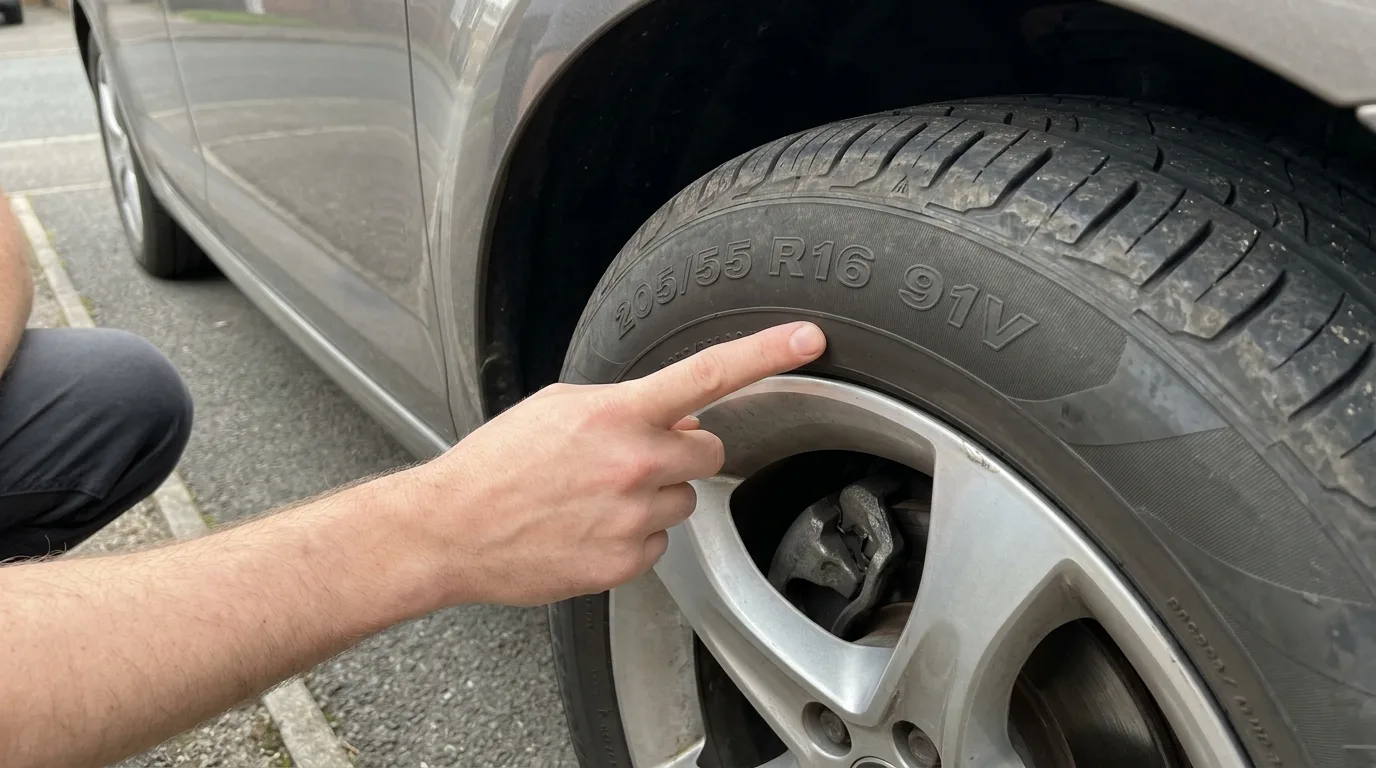
Look at the side of any tyre, and you will find a string of numbers and letters that looks more like a lock code than useful information. Learning how to read tyre size takes about five minutes, and it pays off every time you buy replacements, compare quotes or check whether a tyre suits your car.
The good news is that nearly every manufacturer uses the same system. Once you can decode one tyre, you can decode them all. This guide works through a common example, 205/55 R16 91V, then covers the other sidewall markings worth knowing.
Where to Find Your Tyre Size
Most drivers never need to look further than the tyre itself, but a few backup options exist.
On the tyre sidewall
The size is moulded into the sidewall, the smooth outer face of the tyre. Crouch beside a wheel and follow the curve near the rim, and you will spot the sequence quickly. Brake dust can hide the lettering, so a quick wipe with a damp cloth often helps.
Door jamb, glovebox, fuel flap and owner’s manual
Many cars carry a placard in the driver’s door jamb, inside the glovebox or under the fuel flap. It lists the size the manufacturer recommends, plus the correct tyre pressures. Your owner’s manual holds the same details.
One caution: the placard shows what the car left the factory with. If a previous owner changed the tyres, the sidewall tells you what is actually fitted now.
Using your registration number or a tyre finder
If the markings are worn, scuffed or simply hard to reach, many tyre retailers offer online finders that search by registration number or car model. A workshop can also read the size for you in seconds.
What Do the Numbers on a Tyre Mean? (205/55 R16 91V)
Here is the whole sequence broken down at a glance, followed by a closer look at each part.
| Marking | What it tells you | In this example |
| 205 | Tyre width in millimetres | 205 mm |
| 55 | Aspect ratio (profile) | Sidewall height is 55% of the width |
| R | Construction type | Radial |
| 16 | Rim diameter in inches | 16 inches |
| 91 | Load index | 615 kg per tyre |
| V | Speed rating | Up to 240 km/h |
Tyre width (205)
The first number is the nominal width in millimetres, measured from one sidewall to the other. A wider tyre puts more rubber on the road, which can help dry grip. It can also change road noise, fuel use and how the tyre copes with standing water, so wider is not automatically better.
Aspect ratio (55)
The number after the slash is often misunderstood. It is not a measurement. It is the sidewall height expressed as a percentage of the width, so here the sidewall is 55% of 205 mm, or 112.75 mm.
A lower number means a shorter sidewall, which usually brings sharper steering response and a firmer ride. A higher number gives more cushioning over bumps. That is why family cars often sit in the 55 to 65 range while sportier cars go lower.
Construction type (R)
R stands for radial, where the internal cords run across the tyre at right angles to the direction of travel. Virtually every modern passenger car tyre is radial, so you will see this letter almost everywhere. Occasionally ZR appears on performance tyres, a marking that traditionally points to higher speed capability.
Rim diameter (16)
This is the diameter of the wheel the tyre fits, measured in inches. It trips people up because the width is in millimetres while the rim is in inches. A 16 tyre fits a 16 inch rim, and nothing else.
Load index (91)
The load index is a code, not a weight. Index 91 corresponds to 615 kg per tyre. Never fit a tyre with a lower load index than the manufacturer specifies. Heavier vehicles such as SUVs and many EVs often need higher figures, sometimes with a reinforced tyre.
Speed rating (V)
The letter shows the maximum speed the tyre is designed to sustain when carrying its rated load. Common ratings include T (190 km/h), H (210 km/h), V (240 km/h), W (270 km/h) and Y (300 km/h).
Singapore’s speed limits are far below these figures, so you will rarely test them. Even so, the rating tends to reflect how the tyre is built and how it handles, and it should match or exceed what your car requires.
Other Tyre Sidewall Markings You Should Know
The size is the headline, but several smaller markings carry useful information.
Manufacture date (DOT code)
Look for the letters DOT followed by a mix of characters. The last four digits show when the tyre was made: the first two give the week, the last two give the year. A code ending in 2325 means week 23 of 2025.
This matters more than most people expect. Rubber hardens with age even when the tread looks healthy, and a tyre that has sat in a warehouse for years is not the same as a fresh one. Many manufacturers advise a professional inspection once tyres pass about five years, and replacement at around ten. If the code still looks confusing, this step-by-step guide on how to check your car tyre’s manufacturing date shows exactly where to look and how to read it.
XL, run-flat, M+S and 3PMSF symbols
XL or Reinforced means the tyre has a higher load capacity than a standard version of the same size. Run-flat markings (such as RFT) indicate a tyre that can travel a limited distance at reduced speed after a puncture. M+S stands for mud and snow, while a snowflake inside a mountain outline (3PMSF) marks a certified winter tyre. You will see the last two mostly on imported or SUV tyres, since snow is not a concern here.
Maximum load and maximum inflation pressure
The sidewall states the highest pressure the tyre can safely hold, and this catches many drivers out. It is a limit, not a target. The pressure you should actually run is listed on the door placard or in the manual.
Manufacturer approval marks
Some tyres carry marks such as N0 (Porsche) or T0 (Tesla). These show the tyre was developed with that carmaker for their models. If your car has one on the original tyres, it is worth looking for the same mark on replacements.
P and LT prefixes
A letter before the width, as in P215/60R16, signals the US-market system. P is for passenger and LT is for light truck. You may meet these on imported cars. Load calculations differ slightly between systems, so ask a specialist before swapping between the two.
Why Tyre Size Matters
Your tyres are the only part of the car that touches the road, so size affects almost everything about how the car behaves. The wrong size can alter braking distances, steering feel and clearance around the wheel arches and suspension.
The speedometer is another casualty. A tyre with a larger overall diameter makes the speedometer read lower than your true speed, while a smaller one makes it read higher. That affects fuel economy readings and, more importantly, how fast you really are going.
Ride comfort comes down largely to the aspect ratio. Low profile tyres look sharp and respond quickly, but they pass more of the road surface into the cabin. Running costs shift too, because size influences rolling resistance and how evenly the tyres wear.
Can You Change Your Tyre Size?
Sometimes, yes, though it needs care. The usual approach is plus sizing, where you fit a larger rim and a lower profile tyre so the overall diameter stays close to the original. A common rule of thumb is to stay within about 3 per cent, which keeps the speedometer and gearing reasonably accurate.
Three other points matter. The rim width must suit the new tyre width, and tyre makers publish an approved rim width range for each size. The tyre must clear the arches and suspension on full lock and over bumps. And the load index should never drop below the original.
If you are unsure, stay with the manufacturer’s size. Changes may also affect your insurance, so it is worth a quick call to your insurer before you commit. Have a tyre specialist check the fitment in person.
Common Mistakes When Reading or Buying Tyre Size
Buying on width alone is the classic error. A 205 tyre in the wrong profile or rim size simply will not fit, and a near match can be unsafe.
Another is ignoring the load index and speed rating because they look like minor details. They are part of the specification, and a lower figure than your car requires is a safety issue.
Mixing sizes on the same axle is a third. Both tyres on an axle should match, otherwise the car can handle unpredictably.
Finally, many people forget to check the date. A tyre can look brand new and still be several years old.
How to Choose the Right Tyre Size for Your Car
Start with the size the manufacturer recommends, found on the placard or in the manual. From there, think about how you drive. Singapore means heavy downpours, short trips and plenty of stop-start traffic, so wet grip and comfort deserve as much attention as the numbers on the sidewall.
Before ordering, take a clear photo of your current tyre’s sidewall and share it with the workshop. It removes guesswork, and a good tyre specialist will confirm the size, load index and speed rating match your car before anything is fitted.
Conclusion
A tyre size looks like code, but it is really six short facts in a row: width, profile, construction, rim, load and speed. Once you know that, the sidewall stops being a puzzle and becomes a handy checklist, whether you are buying new tyres or simply checking what is on your car. If you are ever unsure, ask a tyre specialist to confirm the size before you buy.
FAQs
What do the three numbers on a tyre mean?
They show the width in millimetres, the aspect ratio as a percentage of width, and the rim diameter in inches.
How do I find my tyre size without looking at the tyre?
Check the driver’s door jamb, glovebox, fuel flap or owner’s manual, or use a retailer’s registration search.
What does R mean in a tyre size?
R stands for radial, the construction type used on almost all modern car tyres.
What is the difference between load index and speed rating?
Load index shows how much weight each tyre can carry, while speed rating shows the maximum speed it is designed for.
Can I fit a different tyre size on my car?
Often yes within limits, but the overall diameter, rim width, clearance and load index must all suit your car.
How do I know how old my tyre is?
Read the last four digits of the DOT code, which give the production week and year.
Are tyre sizes the same on front and rear tyres?
Usually yes, but some performance cars use wider tyres at the rear, so always check each axle