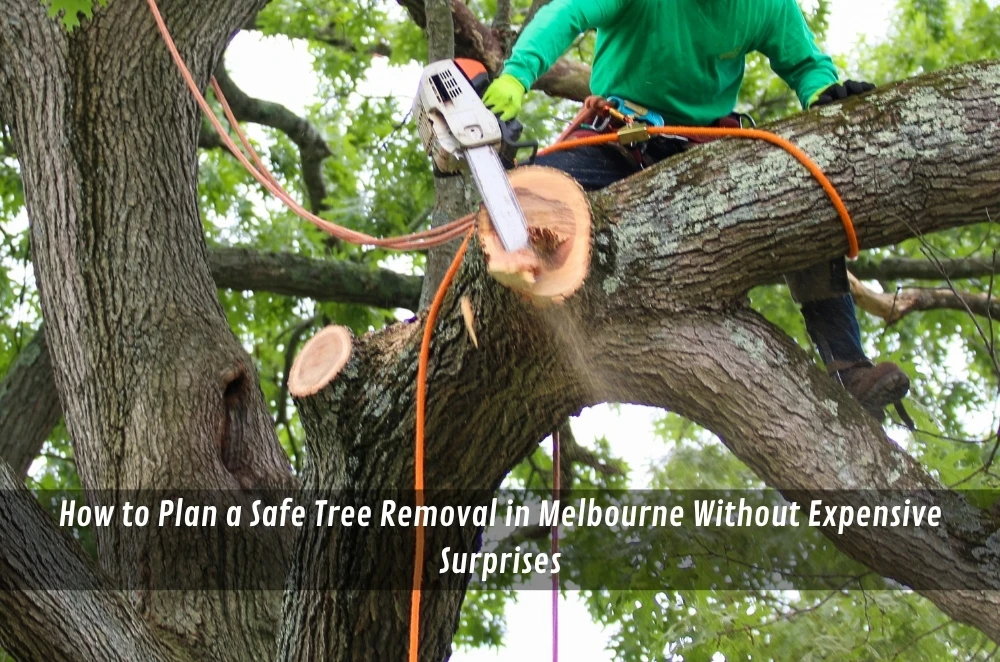
Tree removal is one of those jobs that seems simple until you’re actually standing under the canopy, looking up, and realising just how many things can go wrong.
On a typical Melbourne block, there’s rarely a clean, empty drop zone. There’s a fence that’s older than it looks, a pergola right where you don’t want it, a neighbour’s prized lemon tree, or a driveway that narrows to a “maybe” the moment a truck arrives.
The good news is that most expensive surprises are avoidable if the job is treated like a small project instead of a quick call-out.
When removal is the right call (and when it isn’t)
Removal makes sense when the tree is no longer a safe fit for the site, not when it’s merely annoying.
If there’s obvious decline (large dead sections, repeated limb drop, severe storm damage) or visible structural issues (splits, cavities, movement at the base, a lean that seems to be worsening), it’s usually time to stop “patching” the problem and plan an exit.
It can also be the right call when the tree has simply outgrown the available space and is now threatening roofs, gutters, solar panels, or overhead services.
But plenty of removals get requested for reasons that pruning can solve: dense shade, minor branch litter, leaf drop, or a canopy that’s got away from regular maintenance.
A useful test is this: if money and effort were no object, would the goal be “keep the tree safely for years” or “this site is wrong for this tree”? The answer often clarifies whether expert tree removal help is truly the best option.
What actually drives the price (and why quotes can be miles apart)
People naturally think “bigger tree = higher cost”, and that’s partly true, but it’s rarely the whole story.
Access is often the biggest variable. If crews can’t get equipment close, the work becomes slower, more manual, and more complicated to keep safe.
Then there’s what’s underneath and around the canopy: fences, tiled roofs, garden beds, sheds, decks, glass, retaining walls, and tight side passages all change the method.
Overhead constraints matter too. A tree near service lines, eaves, or neighbouring roofs usually means smaller cuts and controlled lowering rather than letting sections fall into a clear space.
Finally, disposal preferences can shift the scope: keep timber for firewood, chip on site, remove everything, or split it between stockpiling and cart-away.
Two quotes can both be “tree removal” and still describe completely different jobs.
Common mistakes that create risk or add cost later
The first mistake is comparing quotes that don’t match on scope.
One provider may be pricing for careful lowering, full cleanup, and removal of all green waste, while another has assumed easy access, minimal protection, and a quicker tidy.
The second mistake is leaving boundaries and permissions vague. If a tree is close to a fence line, or the easiest access is through a neighbour’s gate, that needs to be clear early , not argued about on the morning trucks arrive.
The third is underestimating how much “small stuff” slows a job down: narrow gates, pot plants that block the path, outdoor furniture that needs shifting, kids’ play equipment under the canopy, or pets that can’t be safely kept inside.
A more serious mistake is trying to “help” by removing a few big limbs first. Partial DIY can create unstable loads or awkward cuts, and the remaining job may become more dangerous (and sometimes more expensive) than if it had been left intact.
And finally: silence with neighbours is rarely your friend. A simple heads-up about timing, noise, and access usually prevents a minor inconvenience becoming a dispute.
Choosing the right help: what to ask, what to listen for
Very small trees in open space can be manageable for confident DIY, but the risk threshold arrives quickly once height and targets are involved.
If you’d need a ladder, if the tree is above head-height with weight over a fence/roof, if it leans toward something expensive, or if you’re unsure about what’s under tension, it’s generally smarter to get qualified help.
When you’re speaking with a provider, pay attention to how they explain the method. The best conversations are calm and plain: what comes down first, how drop zones are managed, what needs protection, and what they need from the site to do it safely.
Ask what the quote includes in everyday terms:
- cleanup standard (what “tidy” means in practice)
- green waste and timber handling
- protection of fences/rooflines/garden features
- whether stump handling is included or separate
- access assumptions (and what happens if access is tighter than expected)
If a simple benchmark helps when you’re preparing site notes and comparing like-for-like scopes, the The Yard removal planning checklist can be a useful reference.
Practical Opinions: If it’s near a roof, fence, or power, prioritise a clear method over a cheap number.
Practical Opinions: On tight Melbourne blocks, access details matter more than most people expect.
Practical Opinions: If two quotes are close, choose the one that’s clearer about protection and cleanup.
A simple 7–14 day plan that prevents last-minute stress
Take photos from multiple angles: the full tree, the base, the canopy, and anything nearby that would be costly to damage.
Do a slow walk from the street to the tree and note every “pinch point”: narrow gates, steps, low eaves, tight turns, soft ground, and garden beds you don’t want crushed.
Mark what’s inside the likely work zone: fences, pergolas, sheds, pool fencing, veggie beds, and clotheslines are all common trip points.
Decide what you want done with debris before anyone quotes. “Remove everything” and “chip on site” are very different jobs, and firewood piles need space that many homes don’t actually have.
If the tree is near a boundary, decide what needs a neighbour conversation (access through a side gate, working above their fence, temporary vehicle parking).
Then share the same photos and access notes to each provider so you’re not unknowingly asking for three different scopes.
Finally, plan day-of basics: move cars, keep pets secure, clear the side passage, and keep the work zone empty so crews aren’t stepping around obstacles with heavy material.
Operator Experience Moment
The tricky part is rarely the first cut , it’s everything around it.
On narrow suburban sites, a “simple” removal becomes complex when there’s no clean landing area and every section has to be lowered and carried out by hand.
The jobs that run smoothly are almost always the ones where access is cleared, fragile spots are flagged early, and everyone knows what’s happening before the first truck arrives.
Local SMB mini-walkthrough: Melbourne, VIC
A common Melbourne setup is a backyard tree with tight side access, older timber fences on both sides, and a roofline sitting right under a section of canopy.
Start by confirming how crews and material will move in and out , side gate width can change the whole plan.
Look up as well as down: eaves, gutters, solar panels, and service lines often dictate controlled lowering rather than free-fall sections.
Check the ground after rain; soft turf and sloped yards can limit where equipment can safely sit.
Think about street logistics: where will trucks park, and will they block driveways or narrow roads in busier suburbs?
If tenants, neighbours, or an owners’ corp are involved, get the timing and access agreed early, not on the day.
Treat it like a one-day project with a shortlist of known constraints, and most of the stress disappears.
Key Takeaways
- Access and nearby targets often drive cost more than “tree size” alone.
- Quotes are only comparable if the scope is truly the same.
- Partial DIY can make the remaining job riskier and harder to price.
- A short prep plan (photos, access notes, neighbour comms) prevents blow-outs.
Common questions we hear from businesses in Melbourne, VIC, Australia
Q1: Do we need council approval before removing a tree?
It depends… overlays, species, and local rules vary between councils. A practical next step is to check the property address against council tree controls (or call the council and ask what applies); Melbourne requirements can differ noticeably from one suburb to the next.
Q2: How do we reduce disruption for tenants or neighbours?
In most cases… disruption drops when timing, access, and parking are planned up front. A practical next step is to send a brief notice with the date, a time window, and where vehicles may be parked; on tighter Melbourne streets, parking and driveway access can be the real flashpoint.
Q3: What should we request so quotes are apples-to-apples?
Usually… the easiest way is to specify inclusions: method assumptions (controlled lowering vs open drop zone), cleanup level, green waste/timber handling, access constraints, and whether stump work is included. A practical next step is to provide the same photos and access notes to each provider; many Melbourne sites have side access that changes labour and equipment needs.
Q4: Is stump removal always necessary after the tree is down?
It depends… leaving a stump can be fine if the area won’t be replanted, paved, or used, but it can also become a long-term nuisance for mowing, landscaping, or future works. A practical next step is to decide what the space will be used for next; in Melbourne yards where usable area is limited, stump handling is often chosen to reclaim the footprint.