Quick Answer: To make a sourdough starter, mix equal weights of flour and water in a jar, then feed it once a day for 5 to 7 days until it reliably doubles in size and smells pleasantly tangy. That's the whole sourdough starter recipe, no yeast packets, no additives. If you'd rather skip the week-long wait, a dehydrated organic sourdough starter can be reactivated and ready to bake with in just 2 to 3 days.
Sourdough starter confuses a lot of beginners before it clicks. It looks like a jar of paste, it doesn't behave on a fixed schedule, and half the advice online contradicts the other half. This guide strips that back to what actually matters: what a starter is, how to build one, how to keep it alive, and what to do when it isn't cooperating.
What Is a Sourdough Starter, Really?
A sourdough starter is a living culture of wild yeast and lactic acid bacteria suspended in a simple mixture of flour and water. Nothing is added to create it; the yeast and bacteria come from the flour itself and the air in your kitchen.
A sourdough starter isn't an ingredient you buy off a shelf; it's a living ecosystem you grow, feed, and keep alive. Once established, it ferments the natural sugars in flour, producing the carbon dioxide that makes bread rise and the organic acids that give sourdough its signature tang.
This is also why sourdough needs no commercial yeast at all. The starter does both jobs at once: leavening the dough and building flavor as it ferments.
How Do You Make a Starter for Sourdough Bread? (Step-by-Step)
This is the traditional, from-scratch method. It takes patience more than skill, and it costs nothing but flour, water, and about a week of daily attention.
Day 1: Combine Flour and Water
In a clean glass jar, mix equal weights of flour and water, for example, 50g of flour to 50g of water. Stir until no dry flour remains, cover loosely (not airtight), and leave it at room temperature, ideally between 21°C and 27°C, for 24 hours.
Day 2-3: Watch and Wait
You likely won't see much happening on day two, and that's completely normal. Small bubbles may start appearing as wild yeast begins multiplying. Resist the urge to feed more than once a day; overfeeding this early starves the culture of the time it needs to establish itself.
Day 4-7: Feed Daily Until It's Active
From day four onward, discard roughly half the starter, then feed it fresh equal parts flour and water once daily. By day five to seven, a healthy starter should double in size within 4-8 hours of feeding and smell pleasantly tangy, not sour like nail polish remover.
A starter is ready to bake with when it reliably doubles in size within a few hours of feeding, not simply because the calendar says day seven. Every kitchen ferments at a different pace depending on temperature, flour type, and water quality, so let the starter's behavior guide you, not the date.
Is There a Faster Way to Make a Sourdough Starter?
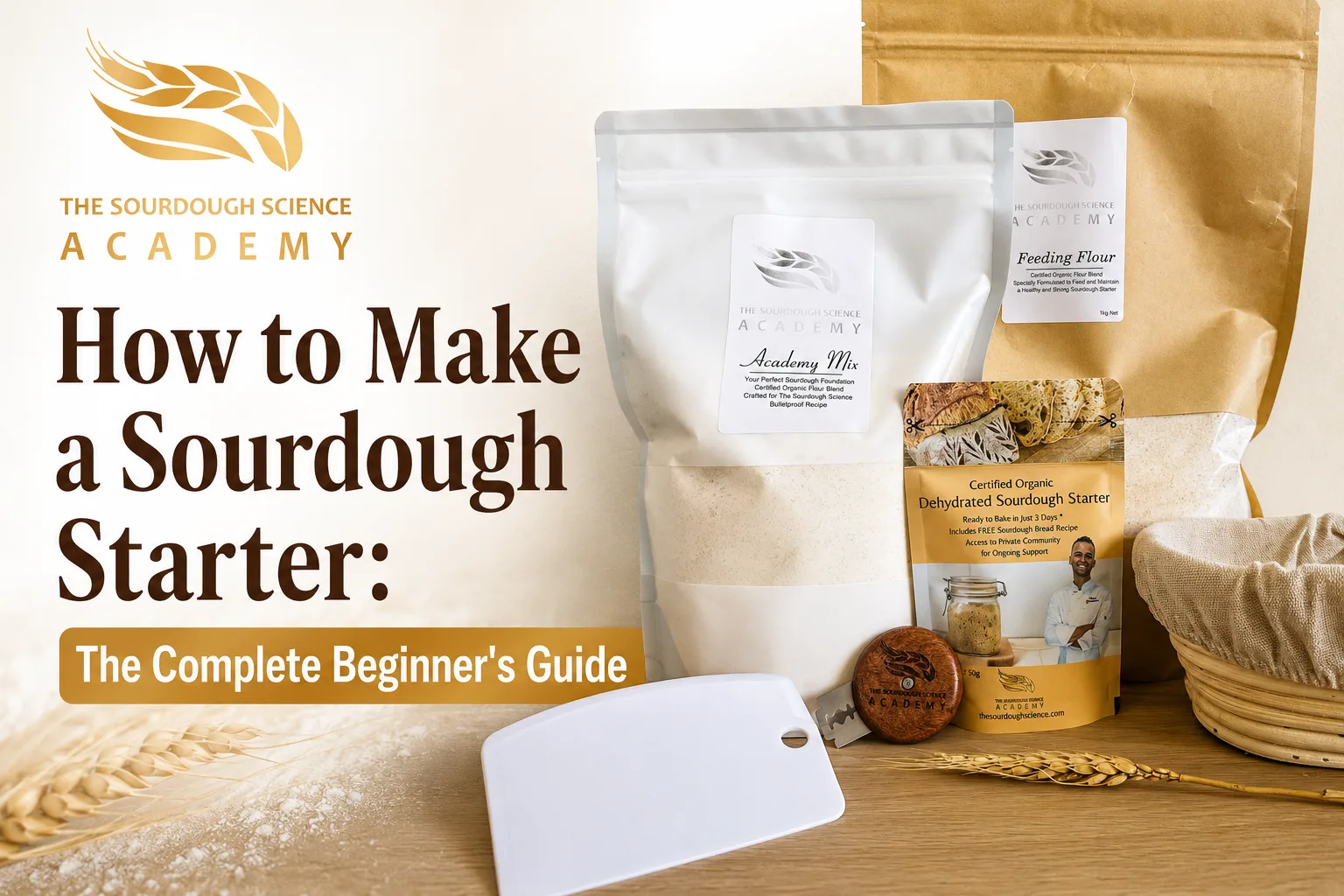
Yes. If you'd rather skip a week of daily discarding and second-guessing, a dehydrated organic sourdough starter shortcuts the entire process. The Dehydrated Organic Sourdough Starter from The Sourdough Science Academy arrives as a 50g pack and typically springs back to life within 2 to 3 days of rehydration.
This starter is dehydrated at a gentle 35°C, a temperature specifically chosen to keep beneficial bacteria and yeast strains alive rather than destroying them with excess heat. It's made exclusively from certified organic flour, a 50/50 blend of whole wheat and high-extraction baker's flour.
Every pack includes written and video guidance for reactivation, including a full walkthrough video showing exactly what your starter should look like at each stage of coming back to life.
For bakers who'd prefer everything bundled together, jars, tools, and the starter itself, the Essential Sourdough Starter Kit and the Sourdough Starter Kit put the basics in one box, so beginners aren't guessing what equipment they actually need on day one.
What Does a Sourdough Starter Actually Need to Thrive?
According to Chef Roberto Giammellucca of The Sourdough Science Academy, a starter is a living system that needs three things to thrive: regular food, consistent warmth, and attentive care. In this video, he breaks down how bacteria and yeast actually work together to drive fermentation.
Your starter is alive, filled with invisible bacteria and yeast that breathe, eat, and grow just like we do. Treating it that way, rather than as a static kitchen ingredient, is usually what separates a thriving starter from one that stalls out after a few days.
If you want a structured, guided path to your first strong starter, Chef Roberto's free sourdough starter course walks through the entire build-from-scratch process step by step.
Actionable Tips for a Strong, Active Sourdough Starter
These are practical fixes for the problems that actually derail beginners , not generic advice.
- Use filtered or dechlorinated water. Chlorine in tap water can suppress the very wild yeast you're trying to cultivate, slowing fermentation for no obvious reason.
- Keep the jar somewhere consistently warm, ideally 21°C-27°C. A cold kitchen can stall fermentation almost completely, even if everything else is done right.
- Feed at roughly the same time each day once your starter is established. Consistency matters more than hitting an exact hour.
- Judge readiness by doubling and bubbles, not by the day count. Every kitchen environment ferments at a different speed depending on temperature and flour.
- Never seal the lid airtight. Fermentation produces gas that needs to escape, or pressure can build up and push the lid off.
- Discard roughly half the starter at each feeding once it's established, to keep the ratio of fresh food to existing culture balanced.
- If time is tight, start with a dehydrated organic starter instead of building from scratch , it removes most of the guesswork from the first week.
Why Does Sourdough Bread Come Out Dense?
Once your starter is active, the next common hurdle is dense bread instead of an open, airy crumb. In this video, Chef Roberto explains that the real culprit is usually gluten development , the network formed by gliadin and glutenin proteins when flour, water, and time work together.
Following the dough, not the clock, is the difference between bread that rises and bread that doesn't. Water absorption, mixing, and resting all shape how strong and elastic that gluten network becomes, which is what ultimately determines whether your loaf turns out light and airy or flat and tight.
For a deeper breakdown of that balance, the companion resource Why Your Dough Doesn't Rise (and How to Fix It) walks through the gluten science in more detail.
What Is the Biggest Mistake Beginners Make with Sourdough Bread?
The most common mistake beginners make is treating their starter and dough like a fixed recipe instead of a living process , following a printed timeline instead of watching the actual signs of fermentation.
Size, bubbles, smell, and texture all tell you more about where your starter or dough actually is than any clock does. Beginners who chase exact hours from a recipe, rather than reading these signals, tend to end up with inconsistent results even when they follow every step correctly.
How to Make a Sourdough Starter in Australia
The process of making a sourdough starter is identical no matter where you live , flour, water, time, and warmth. What changes is climate: Australia's conditions vary enormously between a humid Queensland summer and a cool Victorian winter, which directly affects how quickly a starter ferments and how often it needs feeding.
The Sourdough Science Academy is based in Australia and runs the country's highest-rated sourdough workshop, founded by Chef Roberto Giammellucca , an Italian-born chef whose stated mission is to teach 1 million Australians to bake real sourdough bread at home using the 2 Hour Sourdough Method™.
For a look at what hands-on, in-person learning looks like, this Sourdough Bread Workshop video gives a glimpse of a live session with Chef Roberto.
How to Make Your Own Sourdough for Beginners
For someone starting completely from zero, the path is straightforward: build or reactivate a starter, feed it until it reliably doubles, mix it into a basic dough of flour, water, and salt, then bake. Every skill after that, shaping, scoring, and timing the oven, builds on that one reliable starter.
Beginners consistently do better with some guided structure rather than trial and error alone. That's the thinking behind The Sourdough Science Academy's full library of resources and its YouTube channel, where Chef Roberto has already taught more than 3,000 students in person.
How Do You Keep a Sourdough Starter Alive Long-Term?
Once your starter is active, keeping it alive is far less demanding than building it. If you bake often, every day or two, leave it at room temperature and feed it once daily. If you bake weekly or less, store it in the refrigerator and feed it once a week instead.
Cold temperatures slow fermentation right down, which is exactly why refrigeration works for infrequent bakers: the yeast and bacteria go dormant rather than starving between feedings. Before baking, simply take it out, feed it, and let it come back to full activity at room temperature for a few hours.
A starter that's been neglected for a while isn't necessarily dead. A layer of dark liquid on top, often called "hooch", is a normal sign it's hungry, not spoiled. Pour it off, feed the starter as usual, and give it a day or two of regular feeding to bounce back before writing it off.
Key Takeaways
- A sourdough starter is just flour, water, wild yeast, and bacteria, no commercial yeast needed.
- Building one from scratch takes 5-7 days of daily feeding; a dehydrated organic starter can be ready in 2-3 days.
- Judge readiness by doubling the size and smell, not by a fixed number of days.
- Warmth, consistent feeding, and attentive care are the three things a starter needs to thrive.
- Dense bread usually comes down to gluten development, not the starter itself.
- The biggest beginner mistake is following the clock instead of watching the dough.
Frequently Asked Questions
How do you make sourdough starter?
Mix equal weights of flour and water in a jar, cover loosely, and leave it at room temperature. From day four, discard about half and feed it fresh flour and water daily until it doubles in size within a few hours, usually by day 5-7.
How to make a sourdough starter in Australia?
The method is the same as anywhere: flour, water, warmth, and daily feeding. Australia's varied climate, from tropical humidity to cold winters, means fermentation speed differs by region, so watch the starter's behavior rather than a fixed schedule.
What is the biggest mistake beginners make with sourdough bread?
Following a recipe's timeline exactly instead of reading the starter or dough's actual signs, size, bubbles, and smell. Fermentation speed changes with temperature and flour, so a strict clock-based approach often produces inconsistent bread.
How to make your own sourdough for beginners?
Start by building or reactivating a starter, feed it until it doubles reliably, then mix it into a simple dough of flour, water, and salt. A dehydrated organic starter, guided videos, or a structured course can shortcut the learning curve considerably.
Can I use a dehydrated starter instead of making one from scratch?
Yes. A dehydrated organic sourdough starter is rehydrated rather than cultivated from raw flour, and typically becomes active within 2-3 days instead of the usual week, with written and video instructions included.
About the Author
Chef Roberto Giammellucca is the Italian-born founder of The Sourdough Science Academy, where he has spent 15+ years teaching sourdough baking and has personally taught more than 3,000 students. His workshop holds 383+ five-star reviews and is rated the highest-reviewed sourdough workshop in Australia. Roberto created the 2 Hour Sourdough Method™ and shares free tutorials through The Sourdough Science Academy YouTube channel, with a stated mission to teach 1 million Australians how to bake real sourdough bread at home. A portion of every sale from The Sourdough Science Academy supports Greenpeace and the InnerScience Research Fund.