How to Get Kosher Certification in the UK: A Business Guide

For UK food manufacturers, producers, importers and retailers, obtaining kosher certification can involve more than checking whether a product's ingredients appear suitable. The source of ingredients, processing aids, production equipment, suppliers and manufacturing processes can all be relevant when determining whether a product meets kosher requirements.
If you are researching how to get kosher certification, it helps to understand what the process involves before approaching a certification authority. This can make it easier to prepare product information, identify relevant manufacturing details and understand what may be required during the certification process.
So, what is kosher certification? In simple terms, it is a process through which a recognised kosher certification authority assesses a product and, where applicable, its ingredients, suppliers, production methods and equipment against the requirements of Jewish dietary law.
For businesses working with KLBD, the process can involve reviewing ingredients and manufacturing arrangements, as well as ongoing supervision where certification is granted.
KLBD explains that certified companies are subject to regular factory audits and agree to use specified suppliers and processes.
What Is Kosher Certification?
Before looking at how to get kosher certification, it is useful to understand what kosher certification actually covers.
Kosher refers to food that complies with the requirements of Jewish dietary law, known as kashrut. These requirements can relate to the types and sources of ingredients, how certain foods are prepared, and how food is processed or handled.
For a modern food manufacturer, this can become more complex because many products contain ingredients and processing aids that are not immediately obvious from the finished product. KLBD notes that ingredients such as gelatine, glycerine, certain emulsifiers, stearates and other additives may require investigation because their sources can affect kosher status.
Manufacturing equipment can also matter. A product may contain ingredients that appear acceptable but still require further assessment if the same equipment is used to manufacture other products.
This is why kosher certification is not necessarily just an ingredient checklist. It can involve looking at the wider manufacturing environment.
For example, KLBD explains that even when ingredients are kosher, shared equipment or processing aids used during production can affect a product's kosher status.
Why Does Kosher Certification Matter for UK Food Businesses?
Kosher certification can be relevant to a wide range of UK food businesses, including manufacturers, ingredient suppliers, bakeries, retailers, importers, caterers and food service businesses.
For a manufacturer, the certification process can help establish whether specific products and production arrangements meet the requirements of the certifying authority. For retailers and importers, certification can help identify products that have been formally certified or approved.
It is also important to understand that kosher certification is separate from general UK food safety and legal requirements. A UK food business still needs to meet applicable food safety, hygiene, labelling and traceability obligations.
GOV.UK states that food businesses must ensure food is safe, register where required, manage food safety risks and label and market food accurately.
Therefore, obtaining kosher certification should be viewed as an additional certification process rather than a replacement for existing food safety or legal compliance requirements.
How to Get Kosher Certification in the UK
The exact process can vary depending on the products, ingredients, facilities and manufacturing arrangements involved. However, businesses considering how to get kosher certification can generally expect several stages.
1. Contact a Kosher Certification Authority
The first step is to contact a certification authority and provide information about your business.
For businesses considering KLBD, an application can be started through its online kosher licence application. The application asks for details including the business, establishment, address and type of business.
At this stage, it is useful to have a clear understanding of which products you want to certify and where they are manufactured.
A manufacturer with several production sites or a large product range may need to provide more detailed information than a business with a small number of straightforward products.
2. Provide Product and Ingredient Information
Once the process begins, ingredient information becomes an important part of the assessment.
A business should be prepared to provide information about the ingredients used in its products, including ingredients that may appear in relatively small quantities.
This can include:
- Main ingredients and raw materials
- Additives and flavourings
- Processing aids
- Fats and oils
- Emulsifiers and stabilisers
- Ingredient suppliers
- Relevant technical or product specifications
KLBD's guidance highlights why this level of review can be necessary. Some ingredients can have different sources, and their kosher status may depend on how and where they are produced.
This is particularly relevant for processed foods. An ingredient name on a specification may not provide enough information to determine its kosher status without understanding its source and manufacturing process.
3. Review Your Manufacturing Process
The next consideration is how your products are actually made.
This is one of the areas where businesses sometimes underestimate the scope of kosher certification.
A certification review may need to consider the production line, equipment, cleaning procedures and other aspects of manufacturing.
KLBD explains that shared manufacturing equipment can be relevant even when the ingredients in a particular product appear suitable.
For example, consider a production line that is used for multiple products.
The certification assessment may need to establish what else is manufactured on that equipment and how the equipment is cleaned between production runs.
The purpose is to understand the complete manufacturing environment rather than assessing the finished product in isolation.
4. Arrange the Necessary Inspection or Assessment
Depending on the business and certification requirements, a site assessment or inspection may be required.
This allows the certification authority to understand how the information provided relates to actual production.
Areas that may need to be reviewed can include:
- Ingredient storage
- Production areas
- Manufacturing equipment
- Production sequences
- Cleaning arrangements
- Processing methods
- Other products made on shared equipment
The exact assessment will depend on the nature of the business and products involved.
This is different from a standard local authority food hygiene inspection.
UK food safety inspections focus on matters such as hygienic food handling, premises condition, cleanliness, processes and food safety systems.
A kosher assessment has a different purpose and considers the requirements relevant to kashrut.
5. Address Any Requirements Identified During the Review
The assessment may identify ingredients, suppliers, processes or equipment that require further investigation or changes before certification can be completed.
For example, a business may need to provide additional information about an ingredient's source or clarify how a particular processing aid is used.
In other cases, the manufacturing arrangement may need to be reviewed.
This is why preparing accurate information at the beginning can make the certification process easier. It gives the certification authority a clearer picture of the products and manufacturing environment from the outset.
Businesses should avoid making assumptions about whether an ingredient or process is acceptable simply because it appears vegetarian, plant-based or otherwise suitable.
KLBD specifically notes that vegan products can still have kosher concerns because of ingredients such as grape-derived components or shared production equipment.
6. Finalise the Certification Arrangement
Once the relevant ingredients, suppliers and production arrangements have been reviewed, the certification arrangements can be established.
For KLBD, certified companies operate under an agreement covering agreed suppliers and manufacturing processes, with regular factory audits carried out by trained rabbinical inspectors.
This is an important distinction between simply having a product reviewed and operating under an ongoing certification arrangement.
Where certification is granted, businesses can then follow the requirements established by the certification authority for their products and operations.
7. Maintain Kosher Compliance
Getting kosher certification is not necessarily the end of the process.
Food manufacturers regularly make changes to formulations, suppliers, equipment and production methods. However, a change that seems minor from a commercial or technical perspective can potentially affect kosher status.
Businesses should therefore consult their certification authority before making relevant changes to:
- Ingredients
- Ingredient suppliers
- Product formulations
- Manufacturing equipment
- Production processes
- Production locations
KLBD states that certified companies are required to conform to suppliers and processes agreed with KLBD and undergo regular factory audits.
This ongoing approach helps ensure that the certification continues to reflect the way products are actually manufactured.
What Does Kosher Certification Cover?
A common misconception is that kosher certification only concerns the ingredients printed on a product label.
In reality, the assessment can extend further.
Ingredients and Raw Materials
The source and production of ingredients can be important. An ingredient with the same name can have different sources or manufacturing processes, which is why certification authorities may need supplier information and supporting documentation.
Additives and Processing Aids
Food additives can present particular questions because some can be derived from animal or vegetable sources. KLBD's guidance identifies various additives that may require investigation, including certain emulsifiers, glycerol derivatives, stearates and stabilisers.
Processing aids can also matter even when they do not appear prominently on the finished-product label.
Manufacturing Equipment
Shared equipment is another important consideration. A product can have suitable ingredients but still require assessment because of the products previously manufactured on the same equipment.
KLBD specifically highlights shared equipment and release agents as factors that can affect kosher status.
Cleaning and Production Procedures
How equipment is cleaned and how different products are scheduled can form part of understanding the production environment.
For this reason, manufacturers should be prepared to explain their processes clearly rather than focusing solely on the final recipe.
What Should a Business Prepare Before Applying?
If you are considering how to get kosher certification, preparing the right information in advance can make the initial discussion more productive.
Before contacting KLBD, it can be useful to organise:
- A complete list of products for certification
- Full ingredient lists
- Supplier details
- Information on additives and processing aids
- Production site details
- Manufacturing processes
- Equipment and shared production arrangements
- Cleaning procedures
- Current product labels and specifications
This preparation also helps identify gaps in your own documentation.
It is worth keeping kosher certification separate from UK regulatory documentation, while ensuring that both are properly maintained.
UK food businesses have their own responsibilities around ingredients, labelling, food safety and traceability.
For example, GOV.UK requires prepacked foods with two or more ingredients to carry an ingredients list, with ingredients listed in order of weight and allergens appropriately highlighted.
How Long Does Kosher Certification Take?
There is no single timeframe that applies to every application.
The process can depend on the number and complexity of products, the ingredients involved, the availability of supplier information, the manufacturing setup and whether shared equipment requires additional assessment.
A business with a straightforward product and well-documented ingredients may have a different process from a manufacturer with multiple production lines and a large number of formulations.
For this reason, businesses should discuss their individual circumstances with KLBD Kosher rather than relying on a generic certification timeline.
Providing complete and accurate information at the beginning can also help avoid unnecessary delays caused by missing documentation or unanswered questions.
Kosher Certification vs Kosher Approval: What's the Difference?
Understanding the difference between certification and approval can be useful for businesses researching what is kosher certification.
According to KLBD, companies that are kosher certified have regular factory audits by trained rabbinical inspectors and are bound by an agreement to follow suppliers and processes agreed with KLBD.
Products that are approved by KLBD are investigated by food technologists and rabbinically approved based on information provided by manufacturers. KLBD says these investigations can cover ingredients, processing aids and shared manufacturing equipment.
These are therefore different arrangements, and businesses should establish which type of assessment is appropriate for their particular products.
It is also worth noting that the presence or absence of a logo on packaging does not, by itself, tell the entire story.
KLBD explains that some certified products do not carry its logo because this is a decision taken by the company, and the absence of the logo does not undermine the certification.
How KLBD Supports Businesses Seeking Kosher Certification
For UK businesses researching kosher certification, understanding what a certification authority actually assesses is just as important as understanding the application process.
KLBD works with food businesses across different areas and provides kosher certification and approval services covering ingredients, products and manufacturing arrangements.
Its published guidance shows the breadth of considerations involved, from individual ingredients and additives through to processing aids and shared equipment.
KLBD also provides a product search service that distinguishes between products that are certified and those that have been approved based on information supplied by manufacturers.
Certified products are subject to regular factory audits, while approved products are investigated based on the information available.
For a business considering certification, this means the first conversation should focus on the actual products and manufacturing setup rather than assuming that every business follows an identical route.
Final Thoughts on How to Get Kosher Certification in the UK
Understanding how to get kosher certification starts with recognising that kosher assessment can extend beyond the ingredients listed on a finished product.
For UK food manufacturers, producers, importers and retailers, the process can involve reviewing ingredients and suppliers, understanding manufacturing processes, assessing shared equipment and addressing any requirements identified during the review.
The process can be summarised as:
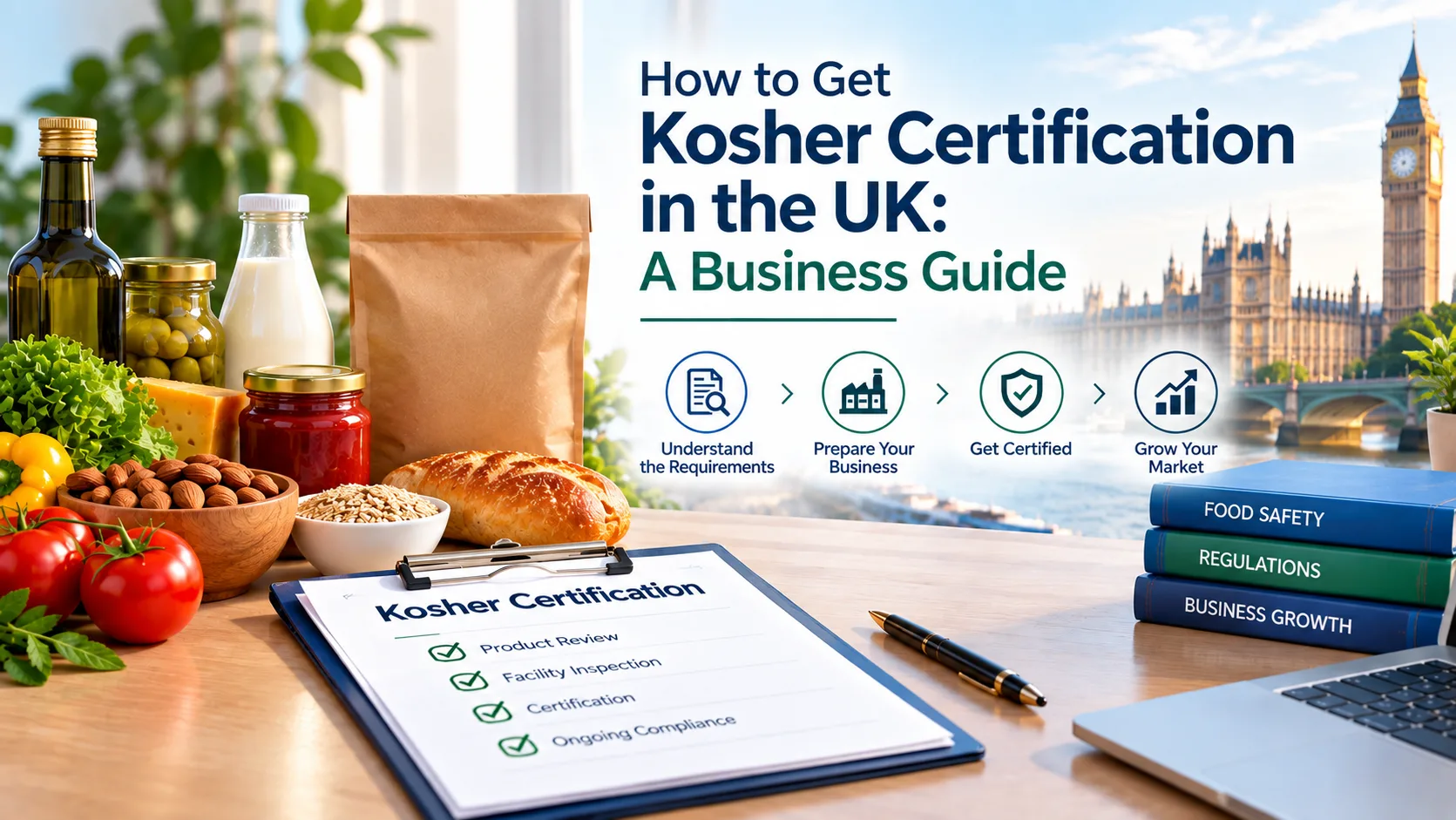
Understand → Apply → Review Ingredients → Assess Manufacturing → Inspect Where Required → Address Requirements → Certify → Maintain Compliance
If you are still asking what is kosher certification, the key point is that it is a structured assessment of whether products and relevant production arrangements meet kosher requirements.
And if your business is ready to explore kosher certification, preparing your product, supplier and manufacturing information in advance can help create a clearer starting point.
KLBD provides an online application route for businesses looking to begin the certification process and can assess the requirements relevant to the specific products and facilities involved.
Ultimately, kosher certification is an ongoing process that requires businesses to maintain the agreed ingredients, suppliers and manufacturing arrangements.
For food businesses considering certification in the UK, understanding these requirements before making changes to formulations or production can help create a more organised path towards certification.