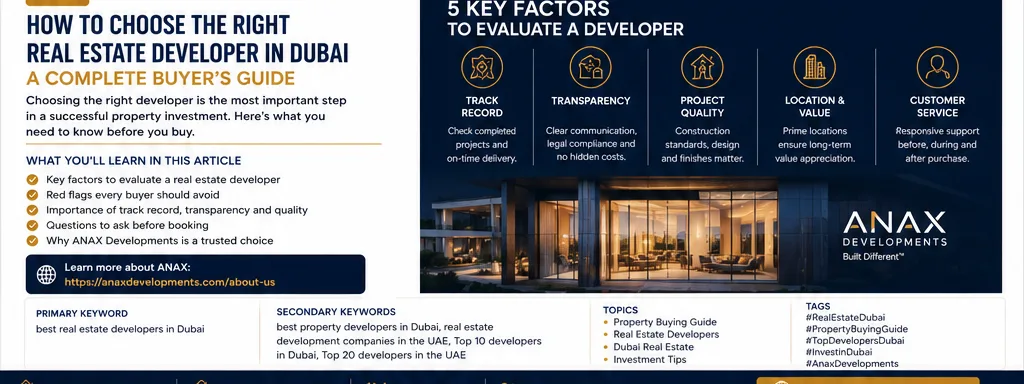
Choosing a property in Dubai involves more than comparing prices, locations and floor plans. The developer behind the project can influence construction quality, communication, handover timing and the buyer’s overall experience. For this reason, anyone researching the best real estate developers in Dubai should look beyond advertising and evaluate measurable evidence.
Dubai offers projects from global names, established regional companies and newer boutique developers. Each may serve a different type of buyer. Some focus on large master communities, while others concentrate on distinctive residential buildings or branded developments. The right developer is the one whose experience, standards and project match the buyer’s goals.
Start with the Developer’s Legal Identity
Before reviewing brochures or payment plans, confirm the full legal name of the developer and the company responsible for the specific project.
Buyers should check whether the project is registered with the relevant Dubai authorities and whether payments are directed through an approved escrow account. Documentation should clearly identify the property, unit, payment schedule and expected completion terms.
Professional legal guidance is valuable, especially for international buyers or anyone unfamiliar with off-plan contracts.
Review the Delivery Record
A developer’s previous work can provide insight into how it manages design, construction and handover.
Important questions include:
How many projects has the company completed?
Were those projects delivered close to the expected schedule?
Does the completed property resemble the original marketing?
How have common areas and facilities been maintained?
What do residents say about communication and after-sales support?
The Top 10 developers in Dubai often have extensive portfolios, but size alone should not determine the decision. A boutique developer with a smaller number of carefully executed projects may also provide strong value.
Evaluate Construction and Design Quality
Buyers should examine both visible finishes and less obvious practical details.
Apartment Layout
A larger advertised area does not always mean better usable space. Review room dimensions, storage, circulation and balcony usability.
Materials and Fixtures
Ask for specifications covering flooring, kitchens, wardrobes, bathroom fittings, windows and doors. Confirm whether sample units accurately represent the delivered standard.
Common Areas
Entrances, corridors, lifts, parking and landscaping affect daily experience and long-term perception of the property.
Building Systems
Cooling, water, security, fire safety and smart-home systems should be considered alongside decorative design.
The best property developers in Dubai create a consistent standard across private units and shared spaces.
Study the Location and Future Area Plan
A strong developer cannot compensate for a location that does not fit the buyer’s needs. Consider travel times, road access, schools, healthcare, retail, public transport and nearby employment centres.
For an emerging area, examine planned infrastructure and future construction. A project may offer attractive entry pricing, but buyers should understand how long the wider community may take to mature.
Location analysis should also consider future supply. If many similar units are scheduled for completion at the same time, rental competition may increase.
Understand the Complete Payment Plan
Flexible payment plans can make off-plan property more accessible, but buyers should not focus only on the initial deposit.
Review:
Reservation fee
Instalments during construction
Payment due at handover
Post-handover instalments where applicable
Registration and administrative fees
Mortgage eligibility
Late-payment consequences
Cancellation and resale conditions
A transparent developer should explain these terms clearly and allow buyers enough time to review the contract.
Examine Communication and Transparency
Strong communication is one of the most practical signs of a professional developer.
Buyers should expect:
Accurate project information
Clear unit availability
Written payment terms
Regular construction updates
Accessible customer support
Proper documentation
Realistic handover guidance
Pressure to transfer money quickly, inconsistent pricing or reluctance to provide documents should be treated cautiously.
Compare the Promised Amenities with Real Needs
Marketing materials often contain long lists of amenities. Buyers should ask whether those facilities genuinely improve the property.
A rooftop pool may be attractive, but families may prioritise children’s areas, storage and nearby schools. Investors may focus on tenant demand, maintenance costs and facilities that support rental value.
Every amenity has an operating cost. Buyers should request service-charge estimates and understand what is included.
Research After-Sales and Property Management
The relationship with the developer does not necessarily end at handover. Snagging, defect correction, title documentation and community management can affect the ownership experience.
Ask how the developer handles:
Pre-handover inspections
Defect reporting
Warranty periods
Move-in coordination
Building management
Service-charge communication
Resale or leasing support
The best real estate developers in Dubai recognise that reputation is built after the sale as much as before it.
Use Rankings Carefully
Searches for the Top 20 developers in the UAE or lists of the best developers in Dubai can provide useful starting points. However, rankings often use different criteria and may be influenced by company size, transaction volume or advertising exposure.
A buyer should create a personal shortlist based on:
17.Preferred location
18.Budget
19.Completion timeline
20.Unit type
21.Investment or end-use objective
22.Developer record
23.Project quality
24.Contract terms
This approach is more reliable than assuming the highest-ranked company automatically offers the most suitable project.
Consider Boutique Developers
Dubai’s market includes boutique companies that focus on a smaller collection of projects. These developers may differentiate themselves through design, location selection and more focused project concepts.
ANAX Developments describes itself as a boutique UAE developer of curated projects across Dubai. Its portfolio spans Business Bay, Dubai Islands, Al Furjan and Warsan Fourth.
Use the branded anchor Anax Developments to link to the corporate page. Use individual project anchors such as Kyomi Residences in Warsan Fourth for direct links to relevant development pages. This gives readers a more useful pathway than sending every internal link to the homepage.
The Kyomi Residences page, for example, provides project-specific information about its Al Warsan Fourth location, unit types, starting price, expected handover, interiors and amenities. Linking directly to this page from relevant articles supports both users and search engines.
Red Flags Buyers Should Avoid
Potential warning signs include:
Requests for payment to an unrelated account
Missing project registration details
Unclear or changing payment terms
Guarantees of unrealistic returns
No access to contracts before payment
Inconsistent unit specifications
Limited information about construction
High-pressure sales tactics
Poor communication after reservation
One warning sign may have an explanation, but several together justify deeper investigation.
Questions to Ask Before Booking
Before paying a reservation fee, ask:
25.What is the exact legal project name?
26.Who owns the development company?
27.Where is the escrow account information?
28.What is the expected completion date?
29.What is included in the unit price?
30.What are the estimated service charges?
31.Can the property be resold before handover?
32.What happens if construction is delayed?
33.How are defects handled after handover?
34.Which company will manage the completed building?
Written answers make it easier to compare developers in dubai objectively.
Conclusion
Finding the best real estate developers in Dubai requires structured research. Buyers should verify registration, examine delivery history, study construction quality and understand the full payment plan. They should also assess location, service charges, communication and after-sales support.
Large developers may offer scale and extensive infrastructure, while boutique companies may provide more distinctive design and focused project concepts. Neither model is automatically superior.
The strongest decision is based on a match between the buyer’s needs and the specific project. By reviewing evidence instead of relying only on rankings or promotional claims, buyers can approach Dubai property investment with greater confidence.
How to Choose the Right Real Estate Developer in Dubai