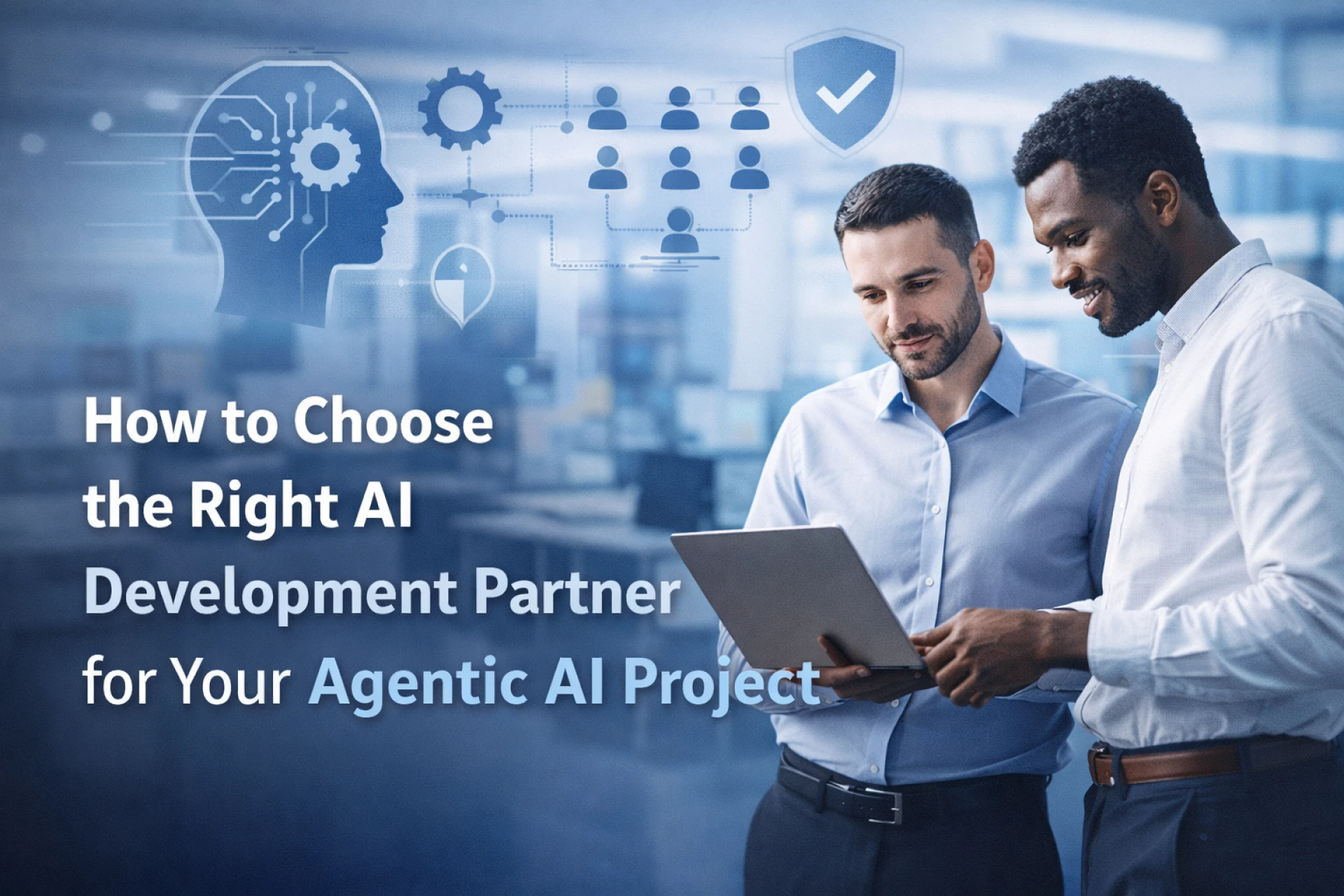
Selecting the right AI development partner is more than a vendor decision. It is a long-term investment in your company’s future. Across the US, SaaS, healthcare, fintech, and manufacturing companies are racing to adopt agentic AI. However, with nearly 70% of AI projects failing to scale, choosing the wrong partner can damage ROI, create security risks, and disrupt compliance.
Working with an experienced AI Development Partner helps organizations avoid fragile prototypes and unlock autonomous systems that manage sales operations, cybersecurity threats, and supply chains end to end.
Why Agentic AI Development Is Fundamentally Different
Agentic AI goes far beyond traditional automation. These systems use reasoning agents that coordinate tools, retain memory across interactions, and collaborate through multi-agent architectures. Unlike conventional machine learning models that only predict outcomes, agentic systems dynamically plan workflows and adapt to real-world disruptions.
This complexity raises the stakes. Poor system design can lead to hallucination loops, unstable agents, and costly failures. The right partner understands advanced memory architectures, vector databases, API orchestration, and frameworks such as LangGraph. This expertise ensures agents not only reason well but also deliver real business value.
Key Factors for Selecting the Right AI Development Partner
US executives need clear benchmarks when evaluating vendors. These criteria help identify capable partners.
Proven Experience in Agentic AI Architectures
Look for partners with practical experience working with leading LLMs such as GPT-4o, Claude, Llama, and Gemini. Strong teams demonstrate expertise in tools like LangChain, CrewAI, and AutoGen.
They should provide real-world case studies, GitHub repositories, or demos showing multi-agent deployments in production environments. This reduces dependence on marketing claims.
Strong Engineering and Product Delivery Capabilities
A reliable partner can convert high-level business goals into structured workflows. Mature teams follow agile development practices, use CI/CD pipelines, monitor uptime, and maintain strong documentation.
Preference should be given to in-house engineering teams with a proven SaaS delivery record and compliance experience, including SOC 2 certifications.
Industry-Specific Expertise
Generic AI solutions rarely succeed in regulated environments. Partners must understand industry standards such as HIPAA for healthcare, SOC 2 for fintech, and ISO 27001 for manufacturing.
Domain expertise allows them to build agents that understand compliance requirements, operational risks, and industry-specific data patterns.
End-to-End AI Development Capabilities
Effective partners manage the full lifecycle, including data ingestion, LLM customization, agent design, system integration, monitoring, and performance optimization.
Organizations seeking advanced Agentic AI Development for SaaS should prioritize teams that take full ownership of the technology stack.
Security, Privacy, and Compliance Standards
Enterprise AI systems require strong security frameworks. Partners must implement encrypted pipelines, role-based access controls, audit logging, and zero-trust architectures.
Experience with regulatory frameworks is essential when agents access sensitive business and customer data.
Transparent Pricing and Outcome-Based Delivery
Avoid vague hourly billing models. Strong partners provide structured pricing tied to project milestones and measurable KPIs, such as automation rates or resolution times.
This approach aligns development efforts with business outcomes.
Scalability and Post-Launch Support
After deployment, agents require continuous tuning, monitoring, and expansion. Reliable partners offer long-term support, model updates, and 24/7 monitoring.
They help organizations scale from pilot programs to thousands of daily interactions without performance degradation.
Warning Signs When Evaluating AI Partners
Avoid vendors that show the following red flags:
- Focus only on proofs of concept without scaling plans
- Lack of technical documentation
- Closed or “black-box” architectures
- Dependence on a single LLM provider
- No MLOps infrastructure
- Weak understanding of US compliance standards
- Unrealistic development timelines
These issues often lead to failed implementations.
A Proven Framework for Agentic AI Implementation - Successful partnerships follow a structured six-step approach.
Business Understanding and Use-Case Mapping - Identify operational challenges and map them to agent workflows.
Architecture and Data Strategy Design - Define memory systems, tools, and RAG pipelines.
Build, Test, and Optimization - Prototype agents, simulate edge cases, and refine reasoning logic.
System Integration - Connect agents securely with CRM, ERP, and internal platforms.
Deployment and Monitoring - Launch with observability tools and performance dashboards.
Continuous Improvement - Expand capabilities using operational telemetry and feedback.
Real-World Impact of the Right AI Partner
Strong partnerships enable enterprise-wide transformation:
- Sales agents automate prospecting and demos
- Support agents resolve most tickets autonomously
- Supply chains adapt to disruptions
- Healthcare systems improve compliant triage
- Cybersecurity agents detect threats proactively
- DevOps agents fix pipeline failures automatically
Poor partners struggle to scale these systems reliably.
Conclusion
Choosing the wrong AI development partner can result in insecure systems, regulatory failures, and wasted investment. The right partner delivers scalable, compliant, and intelligent agentic solutions.
Organizations that prioritize technical expertise, engineering maturity, and structured delivery frameworks position themselves for long-term success. With the right partnership, agentic AI becomes a strategic asset rather than an operational risk.