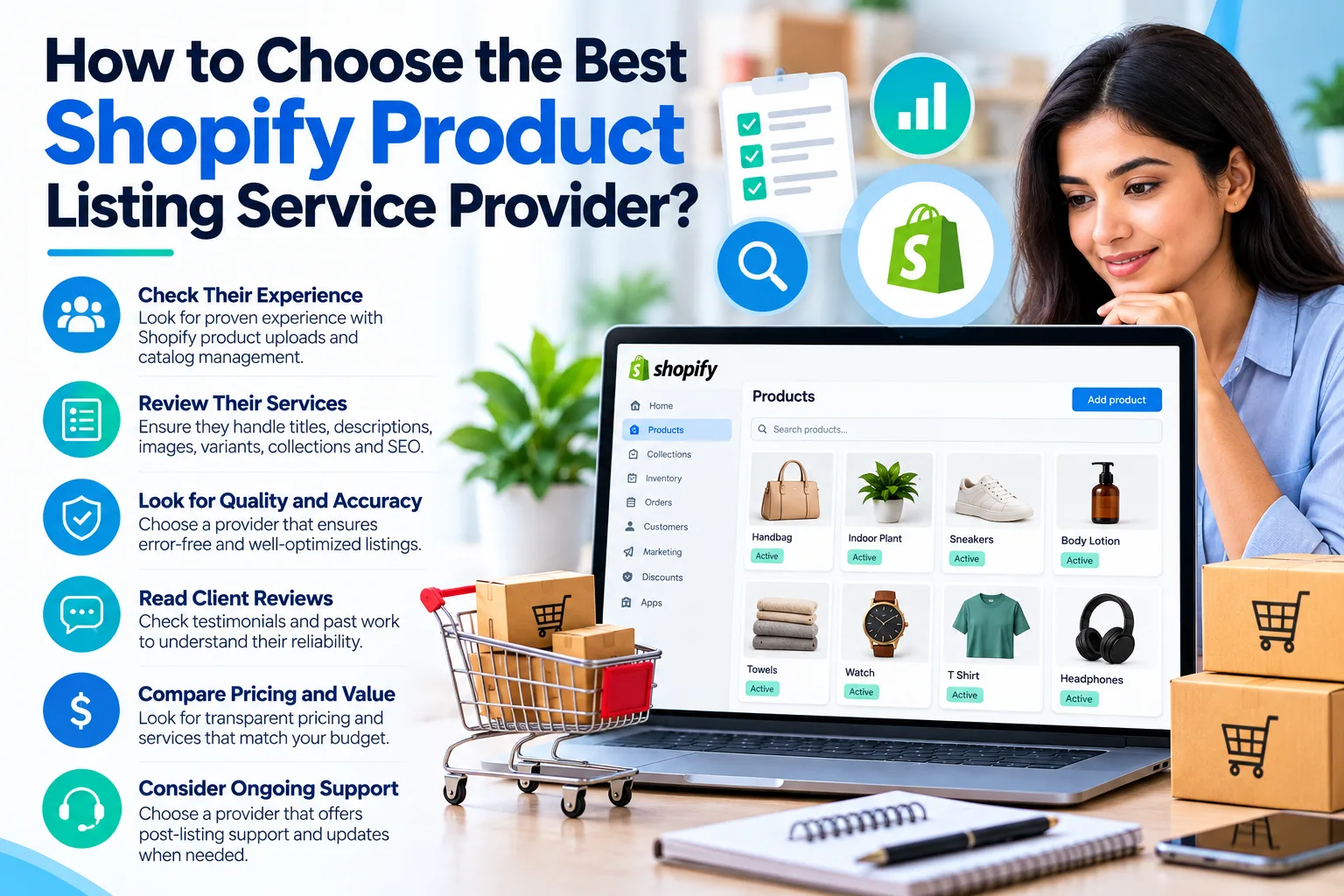
You’ve decided to outsource your catalog work. Now comes the harder part: picking someone you can trust with your products. A poor choice means wrong prices, broken variants, copied descriptions, and weeks of cleanup. A good one gives you a clean, consistent, search-friendly store.
This guide walks through how to evaluate Shopify product listing services, what to ask before you hire, and which warning signs to watch for.
Start With Your Own Requirements
Before you contact anyone, define what you need. Providers can’t quote accurately without it.
- Catalog size: 50 products or 5,000?
- Complexity: Simple items, or multiple variants, bundles, and metafields?
- Source data: Supplier spreadsheets, a marketplace like Amazon, or raw photos?
- Content needs: Data entry only, or original descriptions and SEO fields too?
- Timeline: A fixed launch date or ongoing monthly uploads?
What to Look for in a Provider
Real Shopify ExperienceShopify has its own structure for products, variants, collections, tags, and metafields. Ask whether the provider is comfortable with bulk CSV imports, variant limits, and inventory tracking. General data entry skills are not the same as Shopify product upload expertise.
SEO AwarenessGood listings do more than fill fields. Check that the provider handles:
- Keyword-aware product titles and descriptions
- Clean URL handles
- Image file names and alt text
- Meta titles and descriptions
- Logical collections and tags
Manufacturer descriptions are often reused across many stores. Ask whether descriptions are written fresh for your brand, since duplicate content can make it harder for your pages to stand out in search.
A Clear Quality ProcessReliable providers use templates, checklists, and a review step before delivery. Ask how they catch errors in pricing, SKUs, and variants.
Questions to Ask Before You Hire
- Can you show examples of live Shopify product pages you’ve listed?
- How do you count a “listing” when a product has multiple variants?
- Who writes the descriptions, and are they original?
- How do you handle image optimization and alt text?
- What is your review process, and how many revisions are included?
- How will you protect access to my store? (Ask for staff or collaborator access rather than sharing your main login.)
- What is the expected turnaround for my catalog size?
Red Flags to Avoid
- No samples or vague answers about past work
- Pricing that seems unrealistically low with no scope details
- No written agreement on revisions or deadlines
- Requests for your owner password instead of limited staff access
- Promises of guaranteed rankings or sales
Start With a Small Pilot
Before handing over your whole catalog, test the provider with 10 to 20 products. Review the results for accuracy, formatting, tone, and SEO fields. A pilot shows you how they communicate and how they handle feedback, with little risk.
Common Challenges and Fixes
Inconsistent supplier data: Ask the provider to standardize titles and attributes before upload.
Scope creep: Put deliverables, revision limits, and timelines in writing.
Communication gaps: Agree on one point of contact and a regular update schedule.
Frequently Asked Questions
What should Shopify product listing services include?
At minimum: product uploads, titles, descriptions, variants, images, collections, and SEO fields.
Should I hire a freelancer or an agency?
Freelancers can suit small catalogs. Agencies often offer review processes and capacity for larger or ongoing work.
How do I check quality before committing?
Review samples and run a small paid pilot.
Is it safe to give a provider access to my store?
Yes, if you use staff or collaborator accounts with limited permissions instead of sharing your owner login.
Do I need to supply product images?
Usually yes, though some providers can resize, rename, and optimize what you provide.
How is pricing usually structured?
Often per product, per variant, or per project. Always request a written quote.
Can I edit listings after delivery?
Yes. You keep full control of your store.
Conclusion
The best provider combines Shopify knowledge, SEO awareness, clear communication, and a repeatable quality process. Define your needs, ask direct questions, and test with a small batch before scaling up.
Ready to get your catalog live? Contact Shopify Store Manager to talk through your products and get a clear, scoped plan.