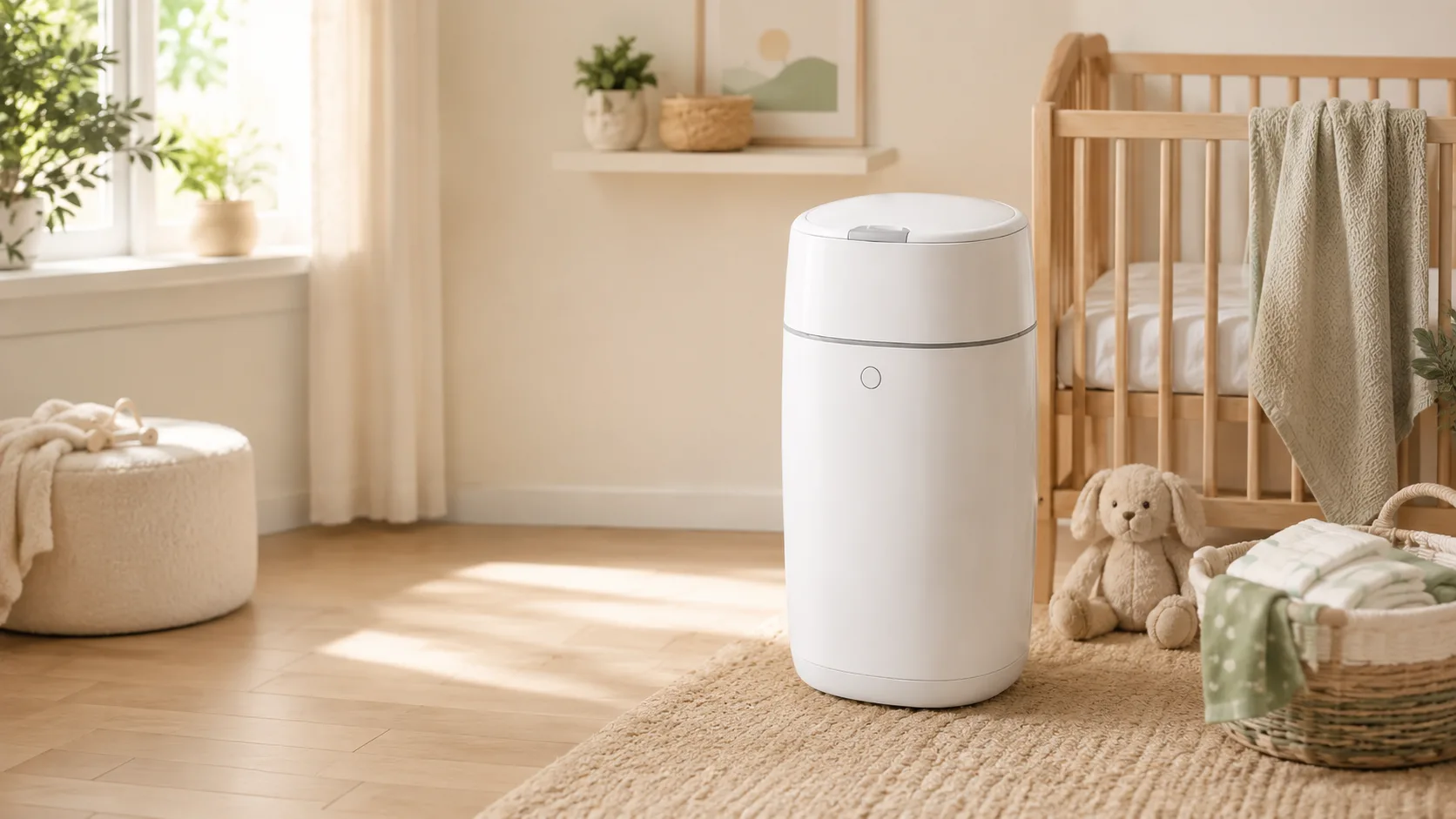
Welcoming a newborn into the home brings a whirlwind of joy, lifestyle adjustments, and unexpected household challenges. While expecting parents often dedicate weeks to curating the perfect nursery aesthetic, choosing wall colors, and assembling cribs, the practical daily workflow of infant care requires equal consideration. A newborn can easily go through eight to twelve diaper changes a day, which accumulates a significant amount of waste in a very short period. Implementing a high-quality odor locking diaper pail directly within your care space can establish an excellent foundation for waste containment, yet understanding the underlying mechanics of these specialized bins remains essential. Knowing how to choose a diaper pail that balances structural integrity, material longevity, and effective daily usability ensures that your nursery remains a fresh, sanitary, and comfortable environment for your entire family.
Many first-time parents assume a standard kitchen trash can with a lid will suffice for infant waste. However, traditional household bins lack the advanced sealing technology required to contain the complex moisture and volatile gases associated with dirty diaper storage. Without a dedicated system, ambient room air can quickly become compromised, turning what should be a peaceful sanctuary into a frustrating source of persistent household smells. This guide breaks down the essential factors to consider when selecting a diaper trash pail, detailing how specific materials, sealing mechanisms, and hands-free operations directly impact long-term nursery odor control.
The Core Science of Nursery Odor Control
To effectively evaluate different diaper pails, it helps to understand why infant waste is uniquely challenging to manage. Disposable and cloth diapers trap high amounts of moisture, organic matter, and ammonia. Inside a closed container, this combination creates an optimal environment for anaerobic bacteria to multiply. As these bacteria break down organic waste, they release pungent gases that expand and create positive air pressure within the bin.
The Chimney Effect in Regular Trash Bins
A standard household trash can relies on a basic lid that lifts open entirely. When you open a regular bin, the air displaced by the lid’s movement pulls a large volume of internal gas upward and out into the room. This is known as the chimney effect. A specialized diaper disposal system counteracts this process by utilizing a dual-barrier approach—such as an internal trapdoor, a sliding mechanism, or a split-gasket chamber—that ensures the main waste storage compartment remains isolated from the room even when the main outer lid is open.
Material Porosity and Longevity
The material composition of a waste bin significantly affects its ability to resist odor retention over months of continuous use. Standard consumer plastics are relatively porous on a microscopic scale. Over time, the volatile organic compounds (VOCs) emitted by dirty diapers can seep into these microscopic pores. Once the plastic itself absorbs these particles, the bin can emit a sour smell even when completely empty and recently washed. High-density, treated polymers or non-porous metals like aluminum and powder-coated stainless steel offer a much higher resistance to this long-term odor absorption.
Critical Features to Evaluate When Choosing a Diaper Pail
When navigating the market for nursery gear, focusing on specific engineering features will help you identify a system that provides consistent performance across your child’s diaper-wearing years.
1. The Quality of the Seals and Gaskets
A diaper pail is only as effective as its weakest closure point. Look for units that feature thick rubber or silicone gaskets surrounding all moving joints and entryways. These flexible barriers form a tight physical seal when the lid is closed, preventing expanding internal gases from leaking into the ambient air of the nursery.
2. Hands-Free Operation
During a diaper change, your infant's safety is the highest priority. Standard safety practices dictate that caregivers must keep at least one hand securely on the baby at all times while they are on an elevated changing table. A diaper pail equipped with a responsive foot pedal or a touchless motion sensor allows you to discard waste smoothly without losing physical contact with your child or awkwardly handling the bin with contaminated hands.
3. Bag Versatility and High-Density Film Refills
Another key consideration is whether the system requires proprietary diaper pail refills or if it can accommodate standard kitchen trash bags. Proprietary refills often utilize specialized, multi-layered high-density barrier films engineered specifically to block molecular gas transmission, providing superior odor retention. Some systems offer adaptable collar rings that allow for both, giving parents the flexibility to choose between maximum odor defense or lower ongoing operational costs.
4. Child and Pet Safety Locks
As infants grow into curious toddlers, the nursery environment must adapt to prevent accidents. A diaper disposal system should ideally feature a secure, integrated child lock. This safety mechanism prevents curious children or household pets from opening the outer lid or accessing the internal cutting tools often used to slice away full liner bags.
Material Comparison: Metal vs. High-Density Polymer
Feature Criteria High-Density Polymer Pails Powder-Coated Metal Pails Odor Absorption Risk Low to moderate; relies on dense plastic engineering or multi-layer liners. Exceptionally low; metal surfaces are non-porous and do not absorb scent molecules. Mechanical Variety Often features advanced hands-free foot pedals and intricate dual-trap doors. Tends to utilize simpler manual sliding mechanisms or simple step lids. Moisture & Rust Resistance Completely immune to rust and completely waterproof. Vulnerable to oxidation or rust if internal condensation pools over time. Weight & Stability Light weight and easy to move around the room for bag changes. Heavier physical footprint, making it less likely to be tipped over by a toddler.
Strategic Placement Within Your Nursery Layout
Where you position your diaper changing station and disposal bin can directly influence the fresh air quality of the nursery, regardless of the model you select.
- Avoid Heat Sources: Keep your waste container far away from baseboard radiators, space heaters, heating vents, and windows that receive direct, intense afternoon sun. Elevated temperatures accelerate the natural decomposition of organic material, causing internal gases to expand more quickly and putting extra strain on the container's sealing gaskets.
- Track Ambient Air Currents: Do not place your diaper pail directly beneath an active HVAC supply vent. If a steady draft of air continuously flows over the top of the container, it can easily capture and distribute stray odor particles across the bedroom the moment the lid is opened.
- Optimize Your Care Radius: Position the bin immediately adjacent to your changing surface so you can drop wrapped waste inside using a single, efficient motion, minimizing the time the dirty diaper is exposed to open room air.
Essential Cleaning and Maintenance Practices
To extend the operational lifespan of your selected disposal hardware and prevent the development of a persistent baseline smell, establish a proactive monthly maintenance loop.
The Monthly Deep Scrub
Roughly once a month, empty the bin completely and take it to a well-ventilated area or outdoor patio. Wash the entire interior and exterior with a soft microfiber cloth and a mild solution of warm water and dish soap. Avoid abrasive scrubbers or steel wool, as these can create microscopic scratches on plastic or strip protective coatings off metal, creating spaces where bacteria and odors can harbor.
Neutralizing with Vinegar
After cleaning away surface residues, mist the interior walls with a one-to-one mixture of white vinegar and water. Vinegar is a mild, non-toxic household acid that excels at breaking down alkaline compounds like the sharp ammonia smells common in infant waste. Let it sit for ten minutes before wiping it away with a damp cloth.
The Power of Air Drying
The most critical maintenance step is ensuring the unit dries completely before reassembly. Trapping even small droplets of water inside a closed plastic or metal bin will rapidly generate a musty smell once new diapers are introduced. Allow the disassembled container to sit completely open in direct outdoor sunlight for one to two hours, as natural ultraviolet rays act as an excellent, chemical-free deodorizer.
Frequently Asked Questions (FAQs)
Are diaper pails truly necessary, or can I use a regular trash can?
While a standard kitchen trash can is a functional choice for general household waste, it often struggles to contain the intense odors and humidity generated by infant diapers. Regular bins lack internal isolation barriers, creating a blast of stale air every time the lid is opened. A dedicated diaper disposal system uses specialized gaskets, dual-trap lids, and high-density barrier liners to actively isolate odors, making it a highly valuable tool for maintaining air quality in a compact nursery.
How often should you empty a diaper pail to prevent odors?
As a general baseline for household hygiene, a diaper pail should be emptied every two to three days, even if it has not reached its maximum physical capacity. Allowing organic waste to sit inside a dark, humid container for longer can accelerate bacterial growth, making it much harder to clear the baseline smell from the structural materials later on.
Can you use standard garbage bags in most diaper pails?
This depends entirely on the specific engineering of the model you select. Some diaper pails feature adaptable internal rings that allow you to use standard kitchen trash bags, which can lower long-term costs. However, many premium systems perform best when paired with specialized continuous diaper pail refills, as these proprietary liners are made from thick, multi-layered resin films designed specifically to block gas and moisture transmission far more effectively than standard grocery bags.
Why does my diaper pail smell bad even when it is completely empty?
If an empty bin continues to emit an unpleasant aroma, it means odor molecules have bonded with the porous inner walls of the plastic container or trapped debris has settled into the rubber gaskets. To resolve this, scrub the interior thoroughly with a baking soda and water paste, rinse it clean, and let the open unit sit in direct outdoor sunlight for several hours to break down the lingering organic compounds.
Conclusion
Understanding how to choose a diaper pail requires evaluating features that look beyond simple visual appeal. While aesthetic integration matters, long-term nursery odor control relies on robust engineering—specifically non-porous structural materials, high-density barrier liners, flexible rubber gaskets, and hands-free foot pedals. By considering how a disposal bin handles internal air pressure, mapping a layout that avoids high-heat microclimates, and committing to a consistent monthly sanitizing routine, you can select the ideal tool to keep your changing station organized, hygienic, and fresh for years to come.