If you want to build an Android app for a growing business, you need to make the right architectural and tooling decisions from day one. Enterprise Android app development is not about screens or animations. It is about building something stable, secure, and flexible enough to grow with your organization.
In this post, we will walk through how businesses actually design, compare, and build scalable Android applications. Knowing that scalability matters is only half the story. To build apps that scale, we first need to examine why many of them start to struggle as the business grows.
Why Enterprise Android Apps Break at Scale
Most Android apps do not fail right away. They fail when businesses start to grow. Performance starts to drop, releases slow down, and even small changes feel risky. You might wonder why an app that once felt fast and reliable suddenly fails when business grows.
Reality of Android Development for Businesses
Let us be honest. Most Android apps are designed to solve today’s problems, not something for the future. They work well for a limited time with a few users, a single development team, and a limited number of integrations. But as soon as you add more users, more data, more teams, and more systems, then problems start showing up.
This is where enterprise application development comes in. Unlike typical app development, it supports large organizations, complex workflows, strict security requirements, and long-term growth. The expectations are higher, and the margin for error is smaller.
Common Pain Points We See in the Field
In our experience, the same issues occur in enterprise Android apps.
- The features in the app slow down as more users come on board.
- Small code changes lead to unexpected bugs
- Security policies become difficult to manage consistently
- Integrations with ERPs, CRMs, or legacy systems are not that smooth.
The important thing to understand is this- Android is not the problem. It is how the app is designed and structured from the start.
Once you know this, the next question becomes clear- what makes enterprise Android apps differ from the consumer apps?
What Makes Enterprise Android App Development Different?
At a glance, an Android app is simply an Android app. However, building for consumers and building for enterprises are two different games entirely.
Consumer Apps vs Enterprise Apps
Consumer apps are made for speed to market and rapid experimentation. Enterprise apps are made for longevity, stability, and scalability. Let us compare them side by side to understand the differences clearly.
Here’s how they differ in practice-
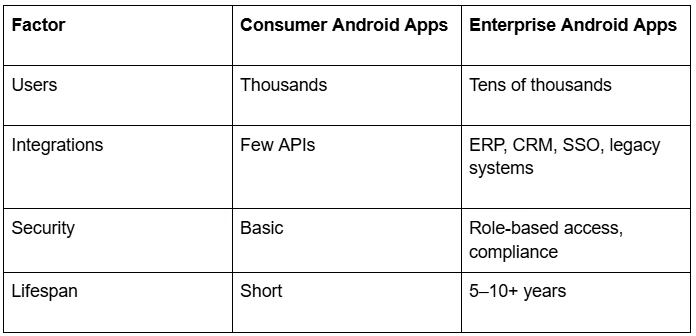
Enterprise apps have to adjust to organizational change, platform updates, and business expansion. That is why they need a stronger foundation, especially when it comes to architecture.
Once that foundation is clear, the next question to consider is- which architecture actually supports enterprise-scale growth?
Choosing the Right Architecture for Scalable Android Apps
Architecture is not just a technical concern. In reality, it is a business decision that directly affects speed, cost, and risk.
Why Architecture Is the Real Scalability Lever
Simply put, architecture defines how your app’s code, data, and business logic are organized. With good architecture, teams can
- Add features without breaking existing ones
- Onboard new developers faster
- Test and fix issues fearlessly
With poor architecture, the opposite happens. No wonder scalability problems arise here first.
Comparison of Common Android Architectures
Let us take a quick look at the most common Android architectures and where each one actually works best.
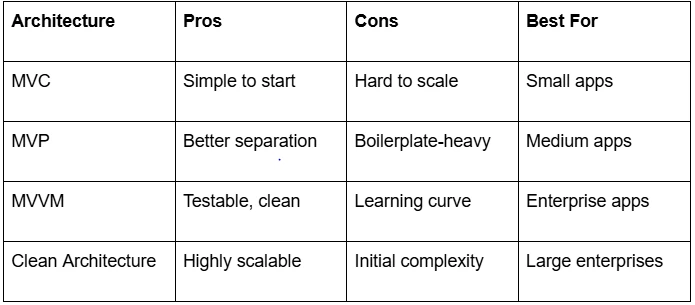
For most enterprise Android app projects, using MVVM with clean architecture is the safest long-term option. It does take a bit more work at the start, but it makes life much easier as the app and team grow.
However, architecture is not enough. You also need the tools because it play a huge role in supporting the architecture.
Android Development Tools Enterprises Actually Use
The tools you use can either support your architecture or slowly work against it. That’s why enterprises stick to tools that are proven and work well together.
Core Android Development Tools Stack
Mostly, teams start with tools they are familiar with.
- Android Studio ranks as the primary operating system
- Kotlin stands as the preferred language because it is safe and expressive.
- Jetpack libraries, such as ViewModel, Lifecycle, and Room, reduce boilerplate code and promote best practices.
Together, these tools support long-term maintainability
Tools That Enable Scale and Stability
Beyond the basics, enterprises rely on tools that support growth over time.
Architecture and Code Quality
- Hilt or Dagger to manage dependencies cleanly
- Coroutines and Flow to handle asynchronous work without chaos
Testing & Reliability
- JUnit and Espresso for unit and UI testing
- Firebase Test Lab for testing across real devices
CI/CD & DevOps
- GitHub Actions or Bitrise for automated pipelines
- Continuous builds and deployments to reduce release risk
When tools are aligned with a solid architecture, it reduces friction. Otherwise, they just automate existing problems.
So how do companies bring all of this together in practice?
How Enterprises Implement Scalable Android Apps Step by Step
It is one thing to know the theory. It’s another thing to make it work inside a real business. So how do enterprises build scalable Android apps without making everything more complex?
Step 1 – Align App Design With Business Workflows
Apps scale better when they mirror how the business actually works. This means-
- Mapping user roles and permissions early
- Planning integrations with backend systems upfront
When the app reflects real workflows, adoption improves, and rework drops significantly.
There is no single playbook, but successful enterprise teams tend to follow a similar approach. This alignment reduces rework and improves adoption across teams.
Step 2 – Design for Change, Not Perfection
In the real world, requirements always change. New features appear. New teams join. Priorities shift.
That is why a clean separation between layers - UI, domain, and data - makes those changes far less painful. It is one of the biggest reasons teams invest in clean architecture early.
Step 3 – Build Security and Compliance In
Security can’t be an afterthought in enterprise Android development. Most teams need-
- Single sign-on (SSO)
- Encryption for sensitive data
- Secure API communication
When these are built into the architecture, scalability becomes predictable instead of reactive. And once predictability is in place, growth stops feeling like a risk.
Final Thoughts- Building Android Apps That Grow With You
Scalability is something that you plan from day one. It is a choice that you make early. In enterprise Android app development, architecture matters more than features, and the right tools amplify the decisions you make. If you have the right foundation, your Android app will continue to deliver value as your business grows, changes, and competes in the years ahead.