Why do most electrical failures in homes and small commercial setups occur within just 3 to 5 years, even when the installation looks “highly effective” on the surface? Industry-level inspections across residential societies and small industrial units indicate that nearly 62% of electrical breakdowns are caused by poor component selection and inconsistent sourcing.
This means the issue begins much earlier, right at the procurement stage. Now consider this: even a perfectly designed electrical layout cannot compensate for components that cannot handle real-world load variations, temperature shifts, or continuous usage cycles.
So the real question becomes, are the materials being selected actually engineered for long-term performance, or just chosen for immediate cost savings?
A reliable electrical system depends on selecting components that are tested for consistency, aligned with load requirements, and sourced from manufacturers who maintain strict quality control.
Where Most Electrical Systems Start Failing?
A typical electrical layout begins with planning, but failures creep in during procurement. For example, when contractors source wholesale LED bulbs from inconsistent batches, lumen output varies, and thermal performance drops over time. This directly affects energy efficiency calculations and replacement cycles.
Similarly, wiring infrastructure often becomes the weakest link. Choosing a substandard PVC wiring pipe results in heat accumulation and reduced insulation performance. Over time, this leads to micro-cracks, especially in high-load zones like kitchens or server rooms.
Selecting Components That Align with Load Demands
Selecting the right components directly defines how safely and efficiently the system handles real-time electrical load. As the saying goes, “A chain is only as strong as its weakest link,” and in electrical systems, even a single mismatched component can compromise overall performance.
Lighting That Performs Under Real Conditions
Not all LEDs are built for operational consistency. When sourcing from reliable LED light manufacturers in Noida, there is a clear difference in heat sink design, driver quality, and lumen stability.
For instance, in warehouse lighting setups, poor driver circuits often cause flickering during voltage fluctuations. A properly engineered LED unit maintains consistent output even when the voltage drops by 10-12%, ensuring uninterrupted operation.
Structural Integrity in Wiring Systems
The conduit system defines the durability of the entire electrical network. High-grade PVC pipes maintain structural integrity even under prolonged exposure to heat and mechanical stress.
In industrial workshops, where machinery vibration is constant, rigid conduits prevent wire displacement and insulation wear. This significantly reduces the risk of short circuits.
Understanding the Role of Accessories in System Stability
Electrical systems are often judged by major components, but failures frequently originate in smaller parts. Choosing reliable electrical accessories manufacturers ensures that switches, sockets, and connectors maintain conductivity and do not degrade under repeated use.
For example, in high-usage commercial kitchens, low-grade switches tend to loosen internally, causing arcing. Premium-grade accessories maintain tight contact points, reducing resistance build-up and heat generation.
Quick Comparison: Component Impact on System Performance
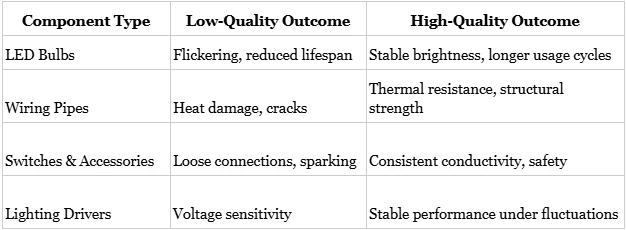
Cost-driven procurement often leads to inconsistent batches and compatibility issues. Working with structured suppliers like Vensor Electricals Pvt. Ptd. ensures uniformity in specifications across all components.
Building a System That Works Together
Electrical reliability is about how components support one another. When lighting, wiring, and accessories are of consistent quality and specification, the system behaves predictably under load. A well-integrated system:
- Maintains voltage stability
- Reduces maintenance frequency
- Extends the lifecycle of all components
Final Thoughts
Electrical systems degrade due to small, avoidable decisions made during the sourcing process. Choosing consistent materials, verified manufacturers, and application-specific components ensures long-term performance.
When every element from lighting to wiring to accessories works in sync, interruptions reduce, efficiency improves, and the system delivers exactly what it is designed to do: perform reliably, every single day.