The Economics of Attrition in Offshore Engineering
In traditional IT outsourcing, service providers treat engineering talent as fungible, billable inventory. When an engineer departs, the vendor replaces them with a comparable profile. However, for technology companies developing proprietary software products, high attrition inflicts compounding damage:
- Erosion of Institutional Knowledge: Complex codebases, system architectures, and business logic are lost, slowing down release velocity.
- Onboarding Drag: Replacing an enterprise software engineer in India takes 45 to 90 days, followed by another 3 to 6 months to reach full technical productivity.
- Architecture Fragmentation: Constant developer turnover leads to inconsistent architectural patterns, technical debt, and decaying test suites.
TRADITIONAL OUTSOURCING (STAFF AUG) BUILD-OPERATE-TRANSFER (BOT)
┌──────────────────────────────────────┐ ┌──────────────────────────────────────┐
│ • Attrition: 30% – 40% annually │ │ • Attrition: Sub-12% annually │
│ • Contractor identity / "Second-tier"│ │ • Founding captive team identity │
│ • Low-level bug fixes & tickets │ vs. │ • Core product architecture & roadmaps│
│ • Transactional billing focus │ │ • Equity alignment & long-term LTIPs │
│ • Frequent client rotation │ │ • Direct career progression into GCC │
└──────────────────────────────────────┘ └──────────────────────────────────────┘
The BOT model resolves this systemic failure by aligning the engineer’s career trajectory directly with the parent organization from day one.
The Psychological Advantage: Captive vs. Contractor Mindset
Top-tier software engineers in India’s major technology corridors—Bangalore, the National Capital Region (Gurgaon/Noida), Hyderabad, and Pune—actively avoid third-party outsourcing firms. They seek roles at product-first tech companies and established multinational captives where they can build scalable systems, contribute to technical roadmaps, and gain recognized brand equity on their resumes.
1. The Promise of the Permanent Subsidiary
Under a BOT engagement, recruitment is conducted under a co-branded or designated captive incubator model. Candidates are not recruited to join a generic vendor pool; they are hired explicitly as the foundational engineering team for the client's future Indian subsidiary.
The value proposition to candidates is transparent and compelling:
- You are building the core systems of the client enterprise.
- Your compensation, evaluation, and engineering standards mirror the parent company.
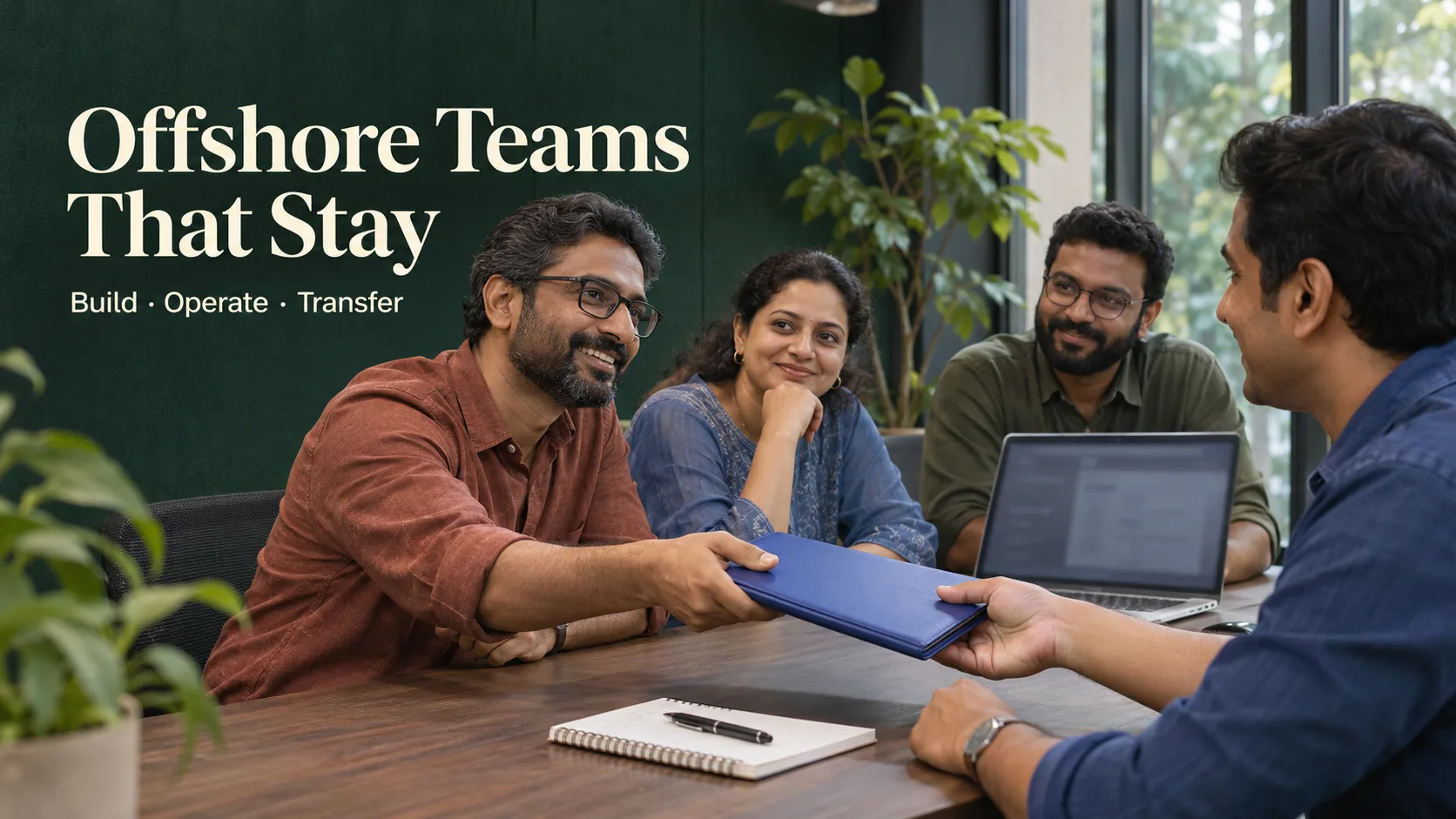
- Upon exercise of the Transfer clause, your employment contract novates directly to the client's wholly owned Indian entity, maintaining your tenure and seniority.
2. Eliminating the "Ticket-Taking" Culture
Nothing accelerates developer churn faster than treating remote engineers as disconnected "ticket-takers" who execute maintenance tasks after the onshore team logs off. To build high retention:
- Feature Ownership: Assign whole product features or microservices to the offshore team rather than fragmented task tickets.
- Direct Architectural Voice: Include offshore staff in RFC reviews, technical sprint planning, and architectural retrospectives.
- Direct Leadership Access: Establish direct reporting lines to onshore Engineering Managers or Directors, with the local BOT partner managing administrative, HR, and facility logistics.
The Day-1 Cultural Integration Framework
Retaining offshore engineers requires bridging geographical and cultural divides early. The transition from external vendor team to integrated captive engineering arm begins during the Build phase.
┌───────────────────────────────────────────────────────────────────────────┐
│ THE 4 PILLARS OF DAY-1 INTEGRATION │
├─────────────────────┬─────────────────────┬───────────────────────────────┤
│ 1. Unified DevEx │ 2. Asynchronous │ 3. Bilateral Travel │
│ • Identical tooling │ Cadence │ • Onshore immersion during │
│ • Single GitHub org │ • Overlap windows │ onboarding │
│ • Same Slack / Jira │ • Written-first RFCs│ • Regular leadership visits │
└─────────────────────┴─────────────────────┴───────────────────────────────┘
1. Unified Developer Experience (DevEx)
High-performing teams cannot function across siloed tools. The offshore team must operate inside the same digital ecosystem as your internal engineers:
- Unified communication channels (Slack, Microsoft Teams) with open access to core company-wide technical discussions.
- Direct access to the enterprise's primary code repositories (GitHub, GitLab) with standard branch protection and PR review workflows.
- Identical hardware baselines: enterprise-grade laptops (e.g., Apple Silicon M-series or high-spec enterprise ThinkPads) provisioned with standard MDM configurations.
2. Sustainable Time-Zone Cadence
A major cause of burnout in offshore teams is the expectation to work late into the night to overlap with US or European business hours.
- Focused Overlap Windows: Establish a strictly bounded 2-to-3-hour daily overlap window for synchronous collaboration (standups, backlog grooming, pair programming).
- Asynchronous-First Workflow: Shift documentation, code reviews, and status updates into structured written artifacts (RFCs, Notion/Confluence specs, Loom walkthroughs) to empower offshore engineers to work autonomously during their core business hours in Indian Standard Time (IST).
3. Bilateral Exchange & Executive Presence
- Onshore Immersion: Fly founding offshore technical leads to headquarters for a 2-to-4-week onboarding sprint. Experiencing company culture and building personal relationships with onshore peers cements long-term organizational loyalty.
- Executive Visits to India: Regular visits by the CTO, VP of Engineering, or Product Leads demonstrate executive commitment to the Indian center and reinforce its standing as a strategic hub rather than a low-cost outpost.
Compensation and Retention Architecture
Competitive base salaries in India’s tech hubs are necessary to attract talent, but structured retention mechanisms are what keep engineers from jumping to competitors.
┌─────────────────────────────────────────────────────────────────────────┐
│ TOTAL REWARDS FRAMEWORK IN A BOT MODEL │
├────────────────────────────────┬────────────────────────────────────────┤
│ Guaranteed Base & Benefits │ • 75th-90th percentile market base pay │
│ │ • Comprehensive family health cover │
├────────────────────────────────┼────────────────────────────────────────┤
│ Performance-Linked Variable │ • Bi-annual or annual bonus tied to │
│ │ sprint velocity and code quality │
├────────────────────────────────┼────────────────────────────────────────┤
│ Transfer-Gated Retention Bonus │ • Lump-sum bonus payable upon contract │
│ │ novation to the captive GCC entity │
├────────────────────────────────┼────────────────────────────────────────┤
│ Shadow Equity / Phantom Stock │ • Synthetic units tracking parent stock│
│ │ converting to real RSUs/ESOPs at │
│ │ transfer incorporation │
└────────────────────────────────┴────────────────────────────────────────┘
1. Market-Calibrated Base Pay
Compensation must be benchmarked against Tier-1 product companies and GCCs in India, not legacy service vendors. Offering compensation at the 75th to 90th percentile ensures you attract engineers capable of independent technical ownership.
2. Milestone-Linked Retention Bonuses
Structure a tiered retention bonus program aligned with the BOT timeline:
- A milestone bonus distributed at the end of Year 1 of continuous service.
- A substantial Transfer Completion Bonus payable upon the formal novation of the engineer’s employment contract into the newly incorporated captive entity. This provides a compelling financial incentive to see the transition through to full execution.
3. Shadow Equity and Phantom Stock Plans
One historical challenge of incubating teams via a third-party partner was the inability to issue equity in the parent company. Modern BOT engagements resolve this through Phantom Stock Units (PSUs):
- Engineers receive synthetic equity grants that mirror the valuation growth or share price of the parent enterprise.
- The plan rules specify that upon the execution of the Transfer phase and incorporation of the local Indian subsidiary, these phantom units convert directly into real parent RSUs or an approved Indian ESOP trust pool.
Securing the Transfer: Preventing the Handover Spike
The most vulnerable point in the talent retention lifecycle occurs during the formal Transfer Phase. If engineers perceive operational instability, changes in benefits, or bureaucratic friction during contract novation, attrition can spike.
To ensure seamless retention through the handover:
1. Statutory Benefit Continuity
Under Indian labor regulations, the transition from the partner's payroll to the new entity must protect accrued statutory entitlements:
- Gratuity Protection (Payment of Gratuity Act, 1972): Gratuity is a statutory terminal benefit payable after five years of continuous service. Contracts must guarantee that service tenure with the BOT partner counts toward the five-year qualifying period under the new captive entity, or that accrued liabilities are formally transferred.
- Provident Fund (EPFO) Transfer: Facilitate seamless online transfer of Employee Provident Fund balances from the vendor’s establishment code to the new entity’s account.
- Leave Balances: Recognize all accrued annual leave balances without resetting quotas to zero.
2. Eliminating Probation Resets
Requiring engineers who have delivered software successfully for two years to undergo a new "probationary period" under the newly formed subsidiary damages morale and creates an immediate flight risk. Contract novations must formally confirm the employee’s confirmed status, recognizing their full historical tenure.
Tracking Retention Health: The Offshore Metric Dashboard
To monitor organizational health before issues result in resignations, engineering leadership should track these four key metrics:
| Metric | Target Benchmark | Early Warning Indicator | Action Trigger |
|---|---|---|---|
| Annualized Voluntary Attrition | < 12% | Spike above 15% in any rolling quarter | Conduct immediate compensation benchmarking and anonymous retrospective interviews. |
| Employee Net Promoter Score (eNPS) | > +45 | Score falls below +30 | Deep-dive into management friction, unmanageable overlap hours, or tooling deficiencies. |
| Pull Request (PR) Lead Time | < 24 hours | PR reviews consistently stalling > 48 hours | Re-evaluate cross-timezone code review practices and empower local leads to approve merges. |
| Offer Acceptance Ratio | > 85% | Acceptance falls below 70% | Adjust compensation bands or optimize recruitment turnaround time to counter competing offers. |
Conclusion: Turning Offshore Talent into a Core Enterprise Advantage
Building a high-retention offshore engineering team is not an exercise in low-cost procurement; it is an exercise in organizational design. By leveraging the Build Operate Transfer GCC framework, enterprises provide engineers with the stability, technical challenges, and career progression of a top-tier captive center—while benefiting from the operational agility, local recruiting reach, and administrative infrastructure of an experienced partner.
Learn how MetaDesign Solutions builds and retains elite, dedicated GCC engineering teams tailored to your exact technical specifications by reviewing our proven GCC setup in India frameworks.
Frequently Asked Questions
Q1. Why is attrition so much lower in BOT-model teams compared to traditional staff augmentation?
The core reason is candidate psychology. Engineers in a BOT engagement are recruited as the founding core of a future captive subsidiary, not as replaceable vendor contractors. They operate under the client's engineering standards, participate in real product roadmaps, and are explicitly promised that their employment will novate directly to the client's permanent Indian entity upon Transfer. This combination of product ownership, brand association, and career continuity creates the kind of institutional loyalty that generic outsourcing firms cannot replicate through perks alone.
Q2. How should we structure the overlap hours for an India-based offshore team to prevent burnout?
Limit synchronous overlap to a focused two-to-three-hour daily window that falls within normal Indian Standard Time (IST) business hours. All coordination outside this window—status updates, code reviews, documentation, design reviews—should shift to asynchronous written formats: RFC documents, Loom walkthroughs, Confluence specs, and structured PR descriptions. Requiring engineers to consistently work late evenings is the single fastest driver of burnout and voluntary resignation in offshore software organizations.
Q3. What is a Phantom Stock Unit (PSU) plan and how does it apply to offshore BOT teams?
A Phantom Stock Unit is a synthetic equity instrument that mirrors the valuation growth or share price of the parent company without granting actual shares in the foreign entity. In a BOT engagement, engineers receive PSU grants that vest over a multi-year schedule. The plan rules specify that upon execution of the Transfer clause and legal incorporation of the Indian captive subsidiary, the vested phantom units convert into real RSUs under the parent company's equity plan or into an India-domiciled ESOP trust. This bridges the equity participation gap that historically made BOT-incubated teams feel financially disadvantaged compared to direct-hire headquarters employees.
Q4. How do we prevent attrition from spiking during the Transfer phase itself?
The handover period is the highest-risk retention window. Three measures are critical: First, guarantee that all historical employment tenure with the vendor counts toward statutory benefit eligibility (gratuity, PF, leave balances) under the new captive entity—never reset tenure to zero. Second, disburse the Transfer Completion Bonus promptly at the point of contract novation to reinforce the financial upside of continuity. Third, communicate the transfer plan to the team 90 days in advance with complete transparency about entity structure, payroll continuity, and benefits. Engineers who understand what is happening and why do not start passive job searches out of uncertainty.
Q5. What is the right cadence for executive visits to the offshore center?
Engineering leadership—CTO, VP of Engineering, or senior product directors—should visit the offshore center at least twice per year, ideally in conjunction with major product planning cycles or retrospective events. Visits should not be ceremonial fly-throughs; they should include structured technical deep-dives, one-on-one career conversations with high-potential engineers, joint architectural whiteboarding sessions, and social engagements that build personal relationships across time zones. Executive presence signals organizational commitment and dramatically reduces the perceived status differential between headquarters and the GCC.
Q6. Can engineers in a BOT center be promoted into global leadership roles?
Yes, and structuring that pathway explicitly is a powerful retention lever. High-performing engineers in BOT-incubated GCCs should be eligible for the same global career ladders as onshore equivalents: Engineering Manager tracks, Principal Engineer designations, and cross-functional Product Engineering roles. Some of the most effective GCCs eventually see India-based technical leads take ownership of entire product verticals or platform domains, reporting directly to global C-suite stakeholders. Making this aspiration visible and structurally achievable during recruitment significantly attracts senior engineering talent who would otherwise dismiss offshore roles as career ceilings.