
Introduction
AI agent development services are easier to buy than to measure. The demo looks great. The pilot ships. Leadership asks, "What is the ROI?" and the team scrambles for a number.
The problem is not that agents lack value. It is that most teams do not set up measurement before they build. This piece gives you a framework you can set up before development, track during the pilot, and report after launch.
Why Most AI Agent ROI Claims Are Weak
The "hours saved" estimate. A vendor claims the agent saves 200 hours per month. The number comes from multiplying volume by estimated human time per task. It ignores whether those hours were reallocated to higher-value work or absorbed into meetings.
The "automation rate" metric. The agent handles 80 percent of tickets autonomously. But if the remaining 20 percent are harder and humans now take longer on those, total cost may not have changed.
Good ROI measurement compares the full cost of the agent-assisted workflow against the full cost of the previous one, including human time that remains.
The Four Metrics That Matter
1. Task completion rate
What percentage of tasks does the agent complete end to end without human intervention? This is the foundation metric. Track it by task type, not as a single aggregate.
A support agent might resolve 70 percent of password resets but only 30 percent of billing disputes. A sales agent might qualify 85 percent of inbound leads but only draft usable outreach for 50 percent of outbound targets. The aggregate hides the detail that drives decisions.
2. Cost per completed task
Total the agent's operating costs (LLM API spend, infrastructure, tool costs, maintenance labor) and divide by tasks completed. Compare this to the fully loaded cost of a human completing the same task (salary, benefits, tooling, management overhead).
This is where the real ROI lives. If the agent completes a task for 0.40 USD that costs a
human 8 USD in loaded time, the math speaks for itself. If the agent costs 3 USD per task on a task that takes a human 5 minutes, the math does not work at low volume.
When you hire AI agent developers, ask them to instrument cost tracking from day one, not as a post-launch add-on.
3. Time-to-resolution or time-to-completion
How fast does the agent finish the task compared to the previous workflow? Speed matters in support (wait time), sales (time-to-first-touch), and operations (processing lag). Measure the full cycle, not just the agent's processing time.
4. Quality delta
Is the agent's output as good as the human's? Quality metrics are domain-specific. Support: CSAT on agent-handled vs. human-handled tickets. Sales: reply rate on agent-drafted vs. human-drafted emails. Coding: PR merge rate without revisions. Compliance: false positive rate.
A fast, cheap agent that produces lower-quality outcomes will get turned off within a quarter.
Setting Baselines Before You Build
You cannot measure improvement without a baseline. Before development starts, measure: tasks completed per day, by whom, at what cost, at what quality, with what error rate, and how long from arrival to completion.
If you lack this data, spend the first two weeks collecting it. Any AI agent development company worth hiring will insist on this. A generative AI development company building agents should include baseline measurement in the project plan.
Isolating Agent Impact
The hardest part is attribution. Other things change at the same time: team size, processes, seasonal volume.
A/B comparison. Route half of tasks to the agent, half to the existing workflow. Compare side by side. Cleanest method but requires sufficient volume.
Before/after with controls. Measure the current workflow for 4 to 6 weeks, launch the agent, measure again. Control for volume and seasonal patterns.
Task-level logging. Tag every task: agent-handled, human-handled, or agent-started and human-finished. AI agent development solutions with built-in observability make this easier.
Domain-Specific ROI Frameworks
Customer support
Primary metrics: autonomous resolution rate, cost per resolution, CSAT delta, escalation rate. Secondary: average handle time on escalated tickets (does the agent's pre-work make human resolution faster?).
Sales
Primary metrics: time-to-first-touch, qualified-lead throughput, meeting conversion rate. Secondary: CRM data accuracy, pipeline coverage ratio.
Software development
Primary metrics: PR merge rate without human revision, developer time reclaimed per week. Secondary: defect rate on agent-generated code vs. human-generated code.
Compliance and operations
Primary metrics: false positive rate, audit completion time, exception processing speed. Secondary: human review time per flagged case.
How to Report ROI to Leadership
Leadership wants three things: what did we spend, what did we get, should we expand.
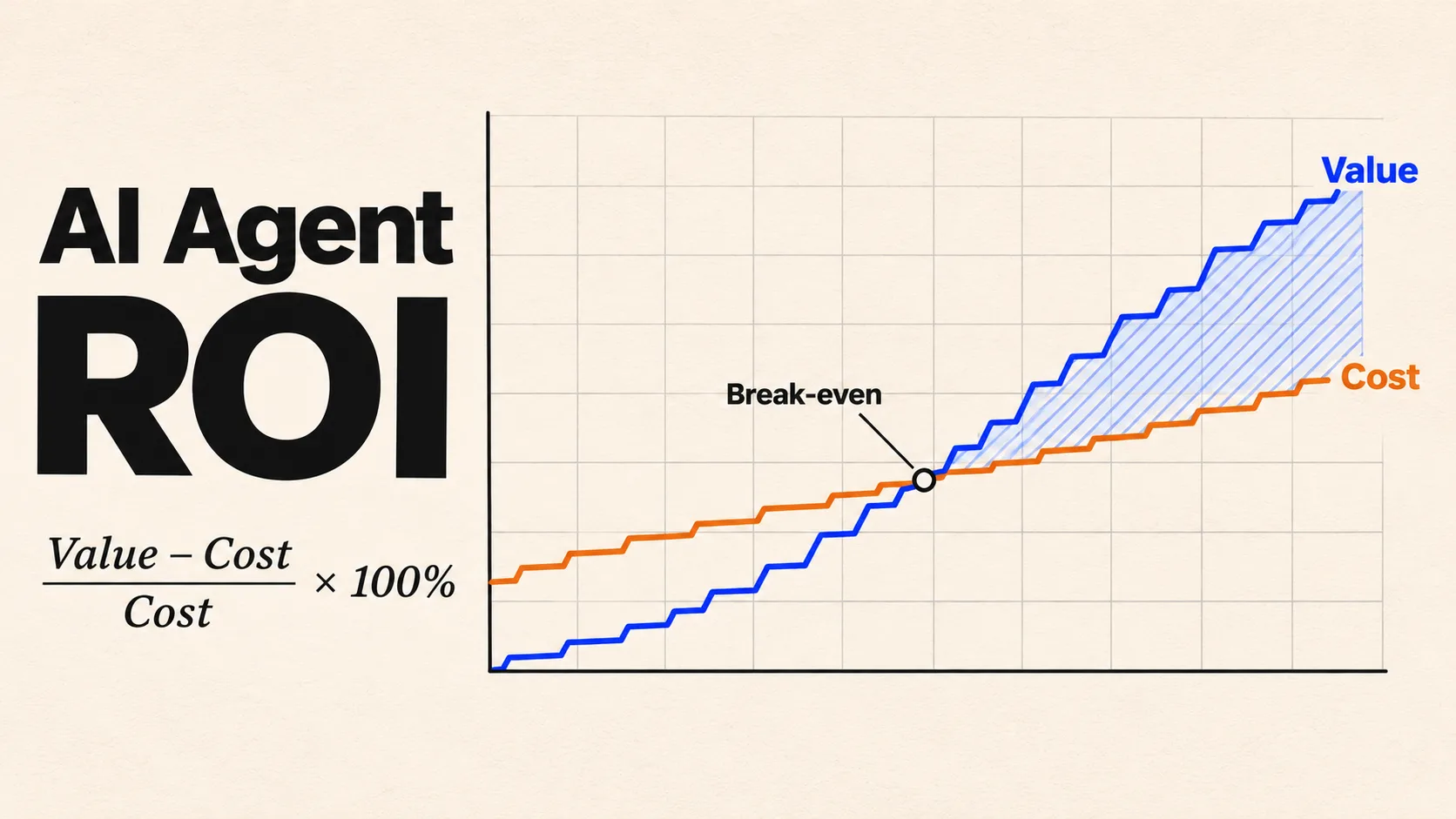
Structure: total agent cost (build plus operating), total value delivered (tasks completed times cost savings per task, plus revenue impact), and net ROI as a percentage. Include the quality delta to show the agent is not trading savings for worse outcomes.
An AI agent consultant can help structure this for your audience, whether a CFO wanting a dollar figure or a CTO wanting task-level breakdowns.
Conclusion
Measuring ROI on AI agents is not hard if you set up the framework before you build. Baseline your current workflow. Instrument the agent for cost, speed, quality, and completion rate. Isolate impact with A/B or before/after controls. Report the number that matters: net value delivered relative to total cost.
If you skip baseline measurement, you will spend more time arguing about the ROI than capturing it.
Planning an AI agent pilot? Talk to our team about setting up the measurement framework before development starts.
Frequently Asked Questions
1. When should I start measuring AI agent ROI?
Before development begins. Collect baselines on the current workflow (cost, speed, quality, volume) during the first two weeks of the engagement.
2. What is the single most important metric?
Cost per completed task, compared against the fully loaded cost of a human completing the same task. This is the number leadership cares about most.
3. How do I measure quality for an AI agent?
Use domain-specific metrics: CSAT for support, reply rate for sales, merge rate for code, false positive rate for compliance. Compare agent outputs against human outputs on the same task types.
4. How long should a pilot run before I measure ROI?
At least 4 to 6 weeks of live operation, assuming sufficient task volume for meaningful comparison. Shorter pilots produce noisy data.
5. What if the agent only handles easy tasks?
That is expected in early deployment. Measure ROI on the tasks the agent handles, and separately track whether human agents are faster or slower on the remaining harder cases.
6. How do I account for the build cost in ROI calculations?
Amortize the build cost over the expected useful life of the agent (typically 2 to 3 years). Add monthly operating costs. Divide by tasks completed per month to get the true per-task cost.
7. Should I hire AI agent developers who specialize in measurement?
Not necessarily a separate hire, but any AI agent development services vendor should include observability and cost tracking in the build. If they do not, add it to the scope.
8. What are vanity metrics in AI agent ROI?
"Hours saved" without evidence of reallocation. "Automation rate" without quality or cost data. "Tasks processed" without completion or accuracy rates.
9. Can I measure ROI if I hire AI developers in India for the build?
Yes. The measurement framework is independent of who builds the agent. Ensure the build includes the instrumentation (task logging, cost tracking, quality scoring) needed to collect the data.
10. How do I compare ROI across different AI agent use cases?
Normalize to cost per completed task and quality delta. A support agent and a sales agent have different raw metrics, but both can be compared on cost efficiency and output quality relative to human baselines.