
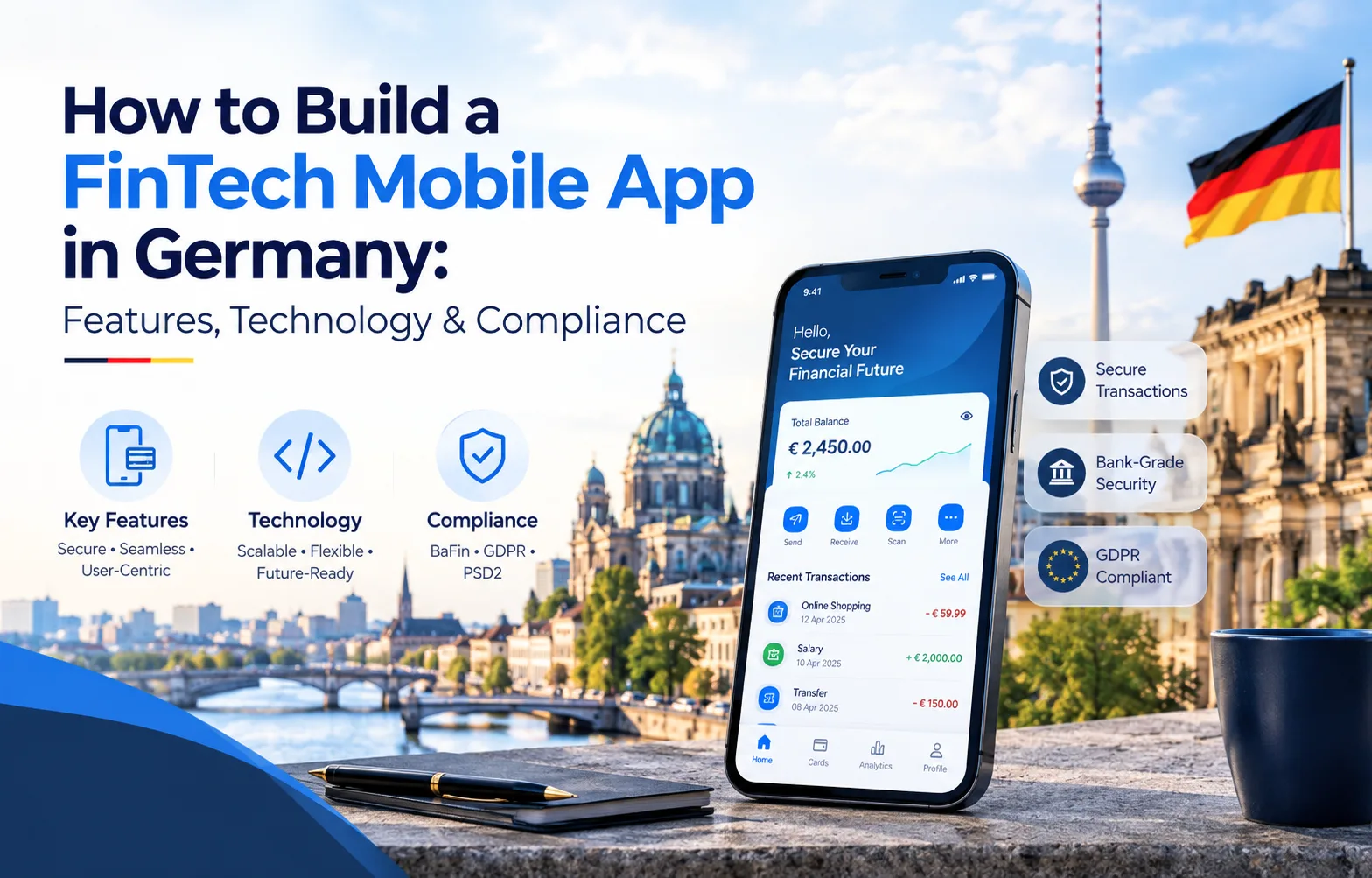
Germany has a mature financial services market, strong digital infrastructure, and growing demand for convenient mobile banking and financial management solutions. For businesses entering this space, building a secure and compliant fintech mobile app requires more than an attractive interface. It involves choosing the right technology, integrating financial services, protecting user data, and meeting Germany’s regulatory requirements.
Whether you are planning a digital banking platform, payment application, investment app, personal finance solution, or business finance product, understanding the development process can help you plan the project more effectively.
This guide explains how fintech app development works in Germany, including key features, technology choices, compliance considerations, development costs, and how to choose the right development team.
What Is FinTech App Development?
Fintech app development involves creating mobile applications that provide or support financial services through digital platforms. Depending on the business model, a fintech mobile app may allow users to make payments, manage accounts, transfer money, track expenses, invest, access financial products, or manage business finances.
Common types of fintech mobile apps include:
- Mobile banking applications
- Digital payment and wallet apps
- Personal finance management apps
- Investment and wealth management platforms
- Insurtech applications
- Lending and financing apps
- Business banking and expense management apps
- Cryptocurrency and digital asset platforms
The exact features, integrations, security architecture, and compliance requirements depend on the type of financial service being offered.
How to Build a FinTech Mobile App in Germany
A successful fintech product should be planned around business requirements, user needs, security, and regulatory obligations from the beginning.
1. Define the Business Model
Start by identifying the financial service your app will provide and who will use it. A consumer payment app will have different requirements from an investment platform or business banking application.
Define:
- Target users and market
- Core financial services
- Revenue model
- Geographic coverage
- Required financial partners
- Regulatory requirements
- MVP features
A clearly defined scope helps your fintech app developers establish the right technical architecture before development begins.
2. Design the User Experience
Financial applications need simple and transparent interfaces because users are dealing with sensitive information and financial transactions.
The design should make important actions such as payments, transfers, account verification, transaction history, and security settings easy to understand.
German users may also expect clear information about fees, permissions, privacy, and transaction status. These details should be incorporated into the UX rather than added at the end of development.
Essential Features for FinTech Mobile Apps
The feature set will vary depending on the product, but several capabilities are commonly important for modern financial applications.
Secure User Authentication
Use secure login mechanisms such as:
- Multi-factor authentication
- Biometric authentication
- One-time passwords
- Device verification
- Session management
Digital Onboarding and KYC
Digital onboarding can allow users to create accounts and submit identity information remotely. KYC workflows should be designed according to the applicable regulatory requirements and the financial services being offered.
Payments and Money Transfers
Payment functionality can include bank transfers, card payments, peer-to-peer transfers, scheduled payments, and transaction tracking.
Account and Transaction Management
Users should be able to view balances, transaction histories, account details, payment status, and relevant financial activity from a centralized dashboard.
Notifications and Alerts
Real-time notifications can inform users about transactions, payment confirmations, suspicious activity, account changes, and important service updates.
Analytics and Financial Insights
Personal finance and business finance applications can provide spending categorization, budgeting tools, reports, and financial summaries to help users understand their financial activity.
Customer Support
In-app support, FAQs, secure messaging, and issue-reporting functionality can make it easier to resolve account and transaction-related problems.
Technology Stack for FinTech Mobile App Development
Technology selection should depend on the app's functionality, scalability, integrations, and security requirements.
A typical fintech mobile app development project may use:
- Mobile: Swift for iOS, Kotlin for Android, or Flutter/React Native for cross-platform development
- Backend: Node.js, Java, .NET, Python, or similar technologies
- Databases: PostgreSQL, MySQL, MongoDB, or other suitable database systems
- APIs: REST or GraphQL APIs for connecting financial services and third-party platforms
- Cloud: AWS, Microsoft Azure, Google Cloud, or a suitable European hosting environment
- Security: Encryption, secure API communication, access controls, tokenization, and monitoring
The technology architecture should be designed to handle sensitive financial data, high transaction volumes, integrations, and future product expansion.
FinTech App Compliance in Germany
Compliance should be considered from the planning stage, particularly because financial applications may fall under multiple European and German regulatory frameworks.
Depending on the service and business model, relevant areas can include:
- GDPR: Requirements concerning personal data protection and processing
- PSD2: Relevant to certain payment services and account-access scenarios
- BaFin requirements: Applicable where the business provides regulated financial services
- AML requirements: Relevant to anti-money-laundering and customer due diligence processes
- Strong Customer Authentication (SCA): Applicable to certain electronic payment transactions
- DORA: Digital operational resilience requirements for covered financial entities
The exact obligations depend on what the app does, who operates it, and which financial services are being provided. Businesses should work with qualified legal and compliance professionals rather than treating compliance as only a software-development task.
How Much Does FinTech App Development Cost in Germany?
The cost of fintech software development depends heavily on the application's complexity, integrations, security requirements, platforms, and development location.
A basic fintech MVP may require significantly less investment than a full-scale banking, payment, investment, or lending platform.
Major cost factors include:
- Number and complexity of features
- iOS, Android, or cross-platform development
- UI/UX design
- Backend and API development
- Banking and payment integrations
- KYC and identity verification
- Security implementation
- Compliance requirements
- Third-party services
- Testing and quality assurance
- Post-launch maintenance
The best way to establish a realistic budget is to define the MVP first and obtain a technical scope covering features, integrations, architecture, security, and compliance requirements.
Choosing a FinTech Mobile App Development Company
Selecting the right fintech mobile app development company can significantly affect the technical quality and scalability of your product.
Before hiring a development partner, evaluate:
- Experience with financial applications
- Understanding of security requirements
- Experience with payment and banking APIs
- Mobile and backend development capabilities
- Quality assurance and testing processes
- Post-launch maintenance and support
- Ability to work with compliance requirements
- Communication and project management practices
Companies such as Apptunix can be considered when evaluating a fintech app development firm, particularly when you need a team covering mobile development, backend engineering, integrations, and product development under one project.
Benefits of Building a FinTech Mobile App
A well-planned financial application can help businesses:
- Provide financial services through mobile channels
- Improve customer accessibility
- Automate repetitive financial processes
- Create new digital revenue opportunities
- Deliver faster transaction experiences
- Improve customer engagement
- Build scalable digital financial products
The commercial value ultimately depends on the financial service, target market, business model, and execution of the product.
Final Thoughts
Building a fintech mobile app in Germany requires a balance between usability, security, technology, and regulatory compliance. Businesses should avoid treating compliance and security as final-stage additions. They need to be incorporated into the product architecture and development strategy from the beginning.
Whether you are developing a payment application, digital banking platform, investment product, or financial management solution, start with a clearly defined MVP, select technologies that support long-term scalability, and work with experienced fintech app developers who understand financial integrations and security requirements.
If you have a fintech product idea, define your required features, target users, integrations, and compliance needs first, then speak with a qualified development team to create a technical roadmap and project estimate.
FAQs
1. How long does it take to develop a fintech mobile app?
Development time depends on the application's features, integrations, platforms, security requirements, and complexity. An MVP generally takes less time than a full-scale financial platform.
2. What technologies are used for fintech mobile app development?
Common technologies include Swift, Kotlin, Flutter, React Native, Node.js, Java, .NET, Python, PostgreSQL, cloud platforms, and secure API architectures. The appropriate stack depends on the product requirements.
3. What compliance does a fintech app need in Germany?
Requirements depend on the financial services provided. Depending on the business model, GDPR, PSD2, AML requirements, BaFin regulations, SCA, and DORA may be relevant.
4. How much does it cost to develop a fintech app?
There is no single development price because fintech applications vary significantly in complexity. Features, integrations, security, platforms, compliance requirements, and development resources all influence the total cost.
5. How do I choose a fintech app development firm?
Look for experience in fintech software development, financial integrations, security, mobile development, testing, and ongoing maintenance. It is also useful to review relevant project experience and understand how the team approaches compliance and data protection.