The life of a modern retail trader often resembles a state of perpetual triage. Surrounded by blinking terminals, breaking news alerts, and a non-stop influx of social media speculation, many market participants fall into the trap of chaotic, emotion-driven screen watching. This algorithmic noise triggers cognitive overload, resulting in impulsive execution and psychological burnout.
However, the emergence of advanced technology has shifted the landscape. By transitioning to a structured, data-driven systematic trading workflow, traders can reclaim their time and mental clarity. Instead of using technology for blind future predictions, successful market practitioners leverage AI tools for trading to automate historical data sorting, filter out market noise, and streamline a sustainable daily trading routine.
The Paradigm Shift: Moving Beyond Chaos to Systematization
Most retail trading errors do not stem from a lack of technical knowledge, but rather from real-time decision fatigue. When a trader sits down without a defined workflow, every market tick demands an emotional response.
[Chaotic Approach] ---> Constant Screen Watching ---> Emotional Decision Making ---> Inconsistent Results
[Systematic Approach] -> Pre-Market Data Filtering -> Rules-Based Execution ---> Objective Outcomes
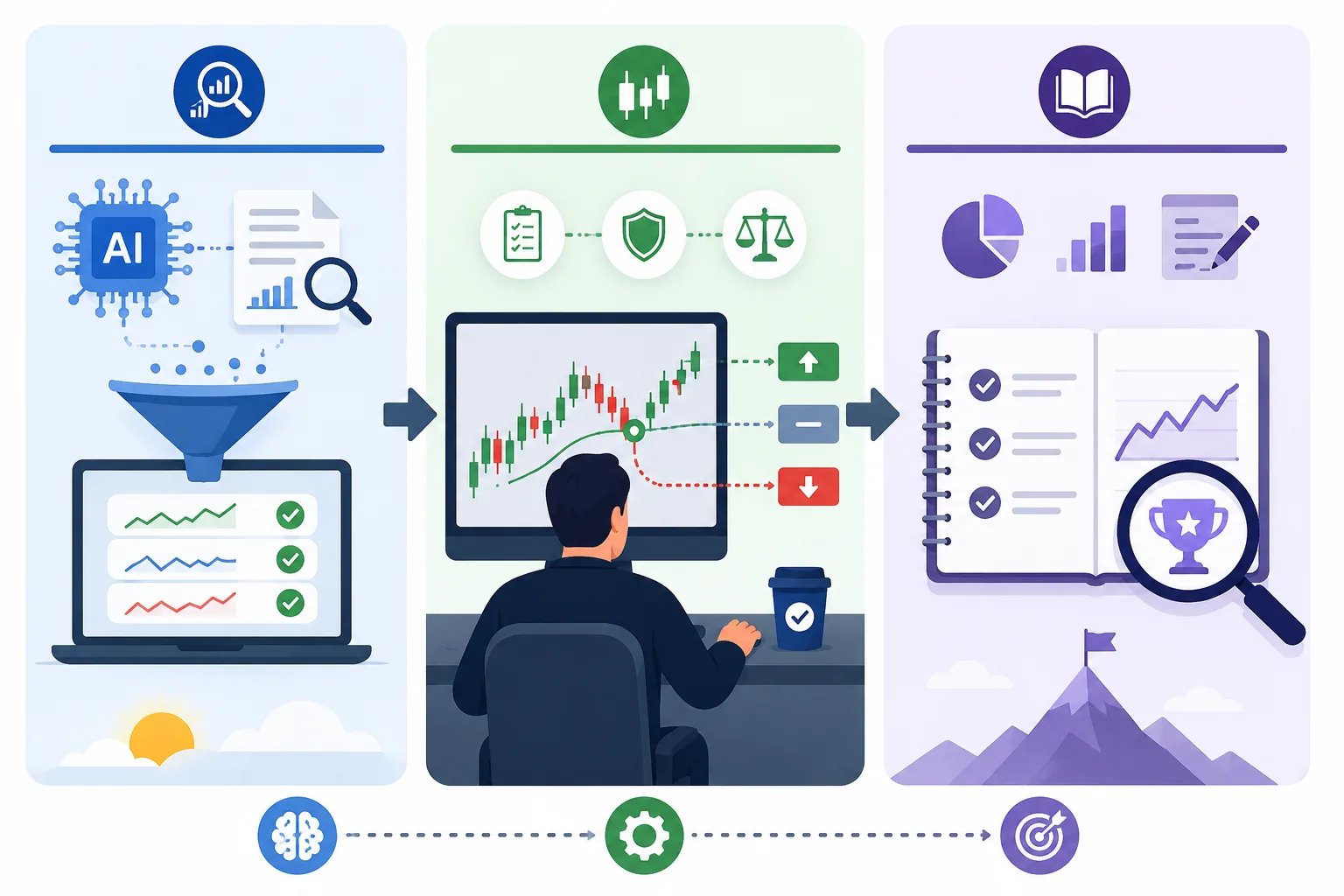
To build a balanced, repeatable routine, the trading day must be broken down into three distinct operational phases: Pre-Market Filtering, In-Market Execution, and Post-Market Review.
1. The Pre-Market Phase: High-Efficiency Data Filtering
The objective of the pre-market phase is not to predict where the index will close but to establish a clean, manageable watchlist. This is where stock market analysis automation yields the highest return on time.
Categorizing Technical Screeners
Rather than manually scanning hundreds of charts every morning, traders can use algorithmic screeners to isolate assets meeting specific structural criteria.
- Trend Alignment: Configure screeners to filter equities trading above key exponential moving averages (e.g., the 20-period and 50-period EMA).
- Volatility Compression: Isolate assets experiencing low historical volatility relative to their average true range (ATR), indicating a potential breakout expansion.
- Volume Anomalies: Look for pre-market volume that exceeds relative historical baselines by a specific standard deviation.
The Role of AI in Historical Data Sorting
A common misconception is that AI should be trusted to generate "buy" or "sell" signals. In a professional workflow, AI tools are deployed strictly as heavy-duty data processors.
Traders utilize natural language processing (NLP) models to parse through corporate earnings transcripts, macroeconomic reports, and regulatory filings over the past decade. Instead of spending hours reading hundreds of pages, an automated workflow can instantly flag structural shifts such as consecutive quarters of improving operating margins or sudden changes in inventory turnover ratios, allowing the human trader to focus purely on chart structure.
2. The In-Market Phase: Rules-Based Execution
Once the opening bell rings, the primary goal is the preservation of mental capital. Active screen watching should be replaced by alert-driven execution.
The Automated Pre-Market Checklist
Before a single order is placed, a systematic trader runs through a strict, binary checklist:
CheckpointObjective
Status
(pass/ fail)
Market Regime AlignmentIs the broader market index operating in a favorable environment?PassDefined Risk LimitIs the maximum risk per trade capped at a fixed percentage (e.g., 1%)?PassInvalidation LevelIs the exact technical stop-loss level mapped on the chart?PassProfit Target SymmetryDoes the prospective reward justify the structural risk ($R:R > 1:2$)?PassEliminating the Feedback Loop of Emotion
To maintain a balanced daily routine, avoid staring at tick-by-tick price fluctuations. Once an asset from the pre-filtered watchlist reaches a price level of interest, execution should rely on pre-set bracket orders (simultaneous entry, stop-loss, and profit targets). By outsourcing the tracking of live positions to basic automation, a trader detaches their emotions from the immediate financial outcome.
3. The Post-Market Phase: Deconstructing the Process
A professional daily routine concludes long after the exchanges close. The post-market phase is dedicated entirely to performance auditing and data archiving.
Journaling the Process, Not the PnL
An effective trade journal tracks behavioral compliance rather than just profit and loss. When reviewing the day's activity, document the following variables:
- Did the entry perfectly align with the pre-market technical screener?
- Was the position sized accurately according to the predetermined risk parameters?
- Did any premature exit occur due to emotional intervention?
Over time, this data reveals structural patterns. Traders can analyze their logbooks to determine if their highest-performing setups occur during specific market regimes or time blocks, allowing for continuous, objective refinement of their broader strategy.
Achieving Long-Term Equilibrium
Transitioning to a data-driven daily trading routine requires a fundamental shift in perspective. Technology should not be viewed as a shortcut to effortless profitability, but rather as an operational filter designed to eliminate administrative drag and cognitive fatigue.
By utilizing automation to handle the heavy lifting of historical sorting and technical screening, traders can step away from the screen, minimize emotional errors, and approach the global markets with the discipline of a systematic risk manager.
Conclusion: The Blueprint for the Modern Trader
The integration of AI and automation into a daily routine marks the evolution of retail trading from a chaotic hobby into a disciplined, repeatable business. Surviving and thriving in the AI era does not require outsmarting complex algorithms, rather, it demands automating tedious data pipelines to protect your most valuable asset: psychological discipline.
By anchoring your day around objective pre-market filtering, rigid execution rules, and rigorous post-market auditing, you successfully insulate your trading process from destructive emotional loops. Technology handles the historical sorting and technical screening, but the human manager remains the final arbiter of risk. Ultimately, the future belongs not to the trader who watches the most screens, but to the one who designs the most resilient system.