
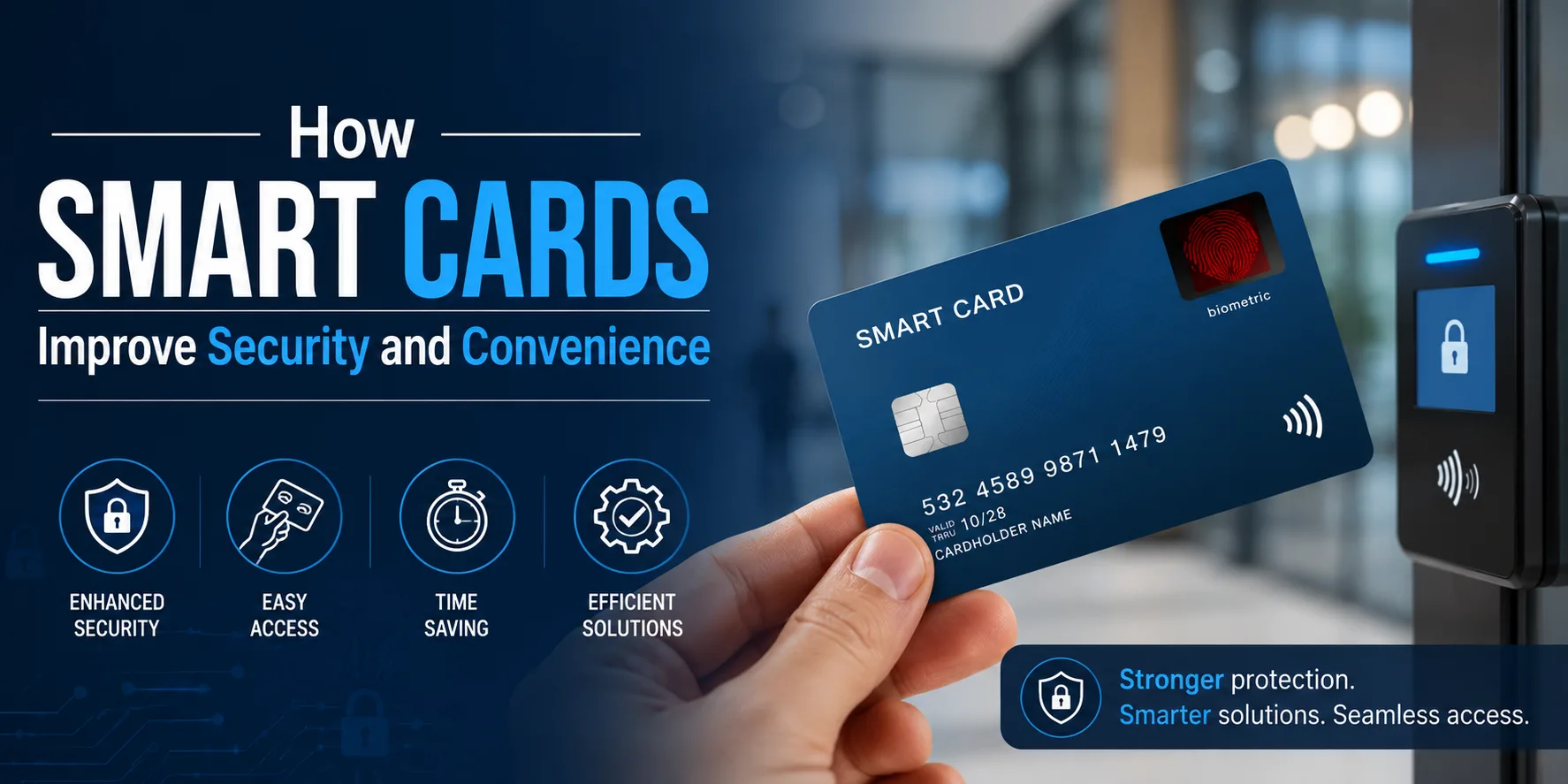
Smart cards have become a standard tool for identification, payment, and access control across many industries. Unlike a basic printed card, a smart card contains an embedded chip that stores and processes information, which allows it to support tasks that a plain plastic card cannot handle on its own.
This article explains how smart cards work, why organizations use them, and what to consider when introducing them into a business or facility.
What Makes a Card "Smart"
A traditional plastic card typically holds information on a magnetic stripe or simply displays a printed design. Smart cards go further by including a microprocessor chip, memory, or both. This chip can store data, run basic authentication processes, and communicate with a card reader through direct contact or a wireless signal.
Because the chip can encrypt data and verify identity before granting access, smart cards offer a level of protection that magnetic stripe cards generally do not provide. This is one of the main reasons organizations in banking, healthcare, transportation, and corporate security have shifted toward smart cards over the past two decades.
Types of Smart Cards
Contact Smart Cards
Contactless smart cards require direct physical contact with a card reader. The chip, visible on the surface of the card, connects with the reader's contact plate to transfer data. These cards are common in banking, where inserting a card into a payment terminal completes the transaction.
Contactless Smart Cards
Contactless smart cards use radio frequency identification or near field communication to transfer data without physical contact. Users tap or hold the card near a reader, and the transaction or access check completes within a moment. Transit systems, office badges, and hotel key cards often use this format because it speeds up daily use.
Hybrid and Dual Interface Cards
Some smart cards include both contact and contactless capability, allowing them to work with a wider range of readers. This is useful for organizations that operate multiple systems, such as a bank that needs a card to work at both ATMs and contactless payment terminals.
Security Benefits of Smart Cards
Data Encryption
Smart cards encrypt the information stored on the chip, which makes it far more difficult for the data to be copied or altered compared to a magnetic stripe. Even if a card is lost or misplaced, encrypted data on the chip is harder to access without proper authorization.
Multi-Factor Authentication
Many smart card systems pair the card with a PIN, biometric check, or secondary code, creating a multi-factor authentication process. This means a person needs both the physical card and a second form of verification to complete a transaction or gain access, which reduces the risk of unauthorized use if a card is lost or stolen.
Reduced Fraud in Payment Systems
Banks and payment networks adopted smart card technology largely to reduce card-present fraud. Chip-based payment cards generate a unique transaction code each time they are used, unlike a magnetic stripe, which transmits the same static data every time. This makes it significantly harder for stolen card data to be reused for fraudulent transactions.
Controlled Access to Physical Spaces
In office buildings, hospitals, and secure facilities, smart cards allow administrators to control exactly who can enter specific areas and when. Access can be granted, restricted, or revoked instantly by updating the card's permissions in the system, without needing to physically collect the card from an employee.
Convenience Benefits of Smart Cards
Faster Transactions and Entry
Contactless smart cards reduce the time needed to complete a purchase or pass through a secured entry point. A quick tap replaces the need to swipe, insert, or manually verify identification, which is especially useful in high-traffic environments like transit stations or large offices.
One Card, Multiple Functions
A single smart card can often be programmed to handle several tasks at once. An employee badge, for example, might double as a building access card, a payment method for the office cafeteria, and a login credential for computer systems. This reduces the number of cards or devices a person needs to carry.
Easier Management for Organizations
Because smart cards store data digitally, administrators can update permissions, reload balances, or adjust access levels without reissuing a new physical card each time. This lowers the administrative burden compared to systems that rely on manually rekeying locks or printing new access badges for every change.
Common Uses of Smart Cards
Smart cards appear in many everyday settings, including:
- Chip-based debit and credit cards for retail and banking
- Employee identification badges for office access.
- Student and faculty ID cards for campus services
- Public transit fare cards
- Healthcare ID cards that store patient or insurance information
- Government-issued identification and secure travel documents.
Each of these applications relies on the same core idea: a chip that can securely store and process information beyond what a printed card alone can offer.
Considerations Before Adopting Smart Cards
Organizations considering a shift to smart cards should evaluate a few practical points. Reader compatibility matters, since existing card reader systems may need to be upgraded or replaced to support chip-based or contactless cards. Staff training is also useful, since employees managing access systems need to understand how to issue, update, and deactivate cards properly.
Working with an experienced provider can help simplify this process. Perfect Plastic Cards, for example, has worked with organizations on custom card programs that combine identification, access control, and encoded data on a single card. Reviewing how an established provider approaches smart card programs can give organizations a clearer picture of what a full rollout involves, from card design to data encoding.
Conclusion
Smart cards offer a combination of security and convenience that traditional plastic cards cannot match. Through encrypted chips, multi-factor authentication, and contactless technology, they reduce fraud, speed up daily transactions, and give organizations more control over access and identification. As more industries continue to adopt this technology, understanding how smart cards work helps organizations make informed decisions about upgrading their own card systems.