
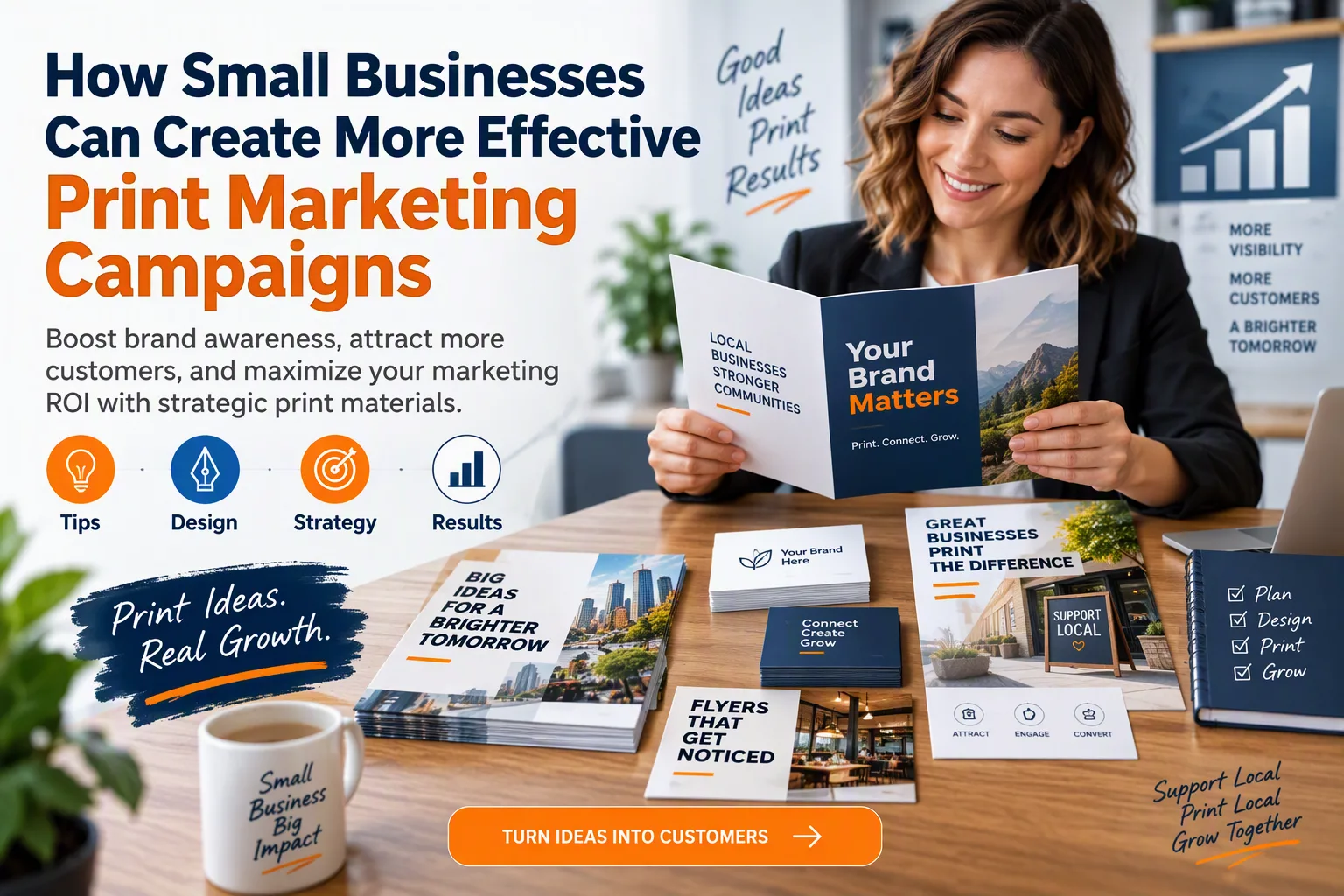
Print marketing remains a useful way for businesses to introduce their services, promote local offers, and build recognition among potential customers. From flyers and brochures to outdoor signs and direct mail, printed materials give businesses practical ways to communicate with people in their communities.
However, successful print marketing involves more than choosing a design and sending it to production. Businesses need to understand their audience, select the right materials, prepare their artwork correctly, and distribute their campaigns strategically.
By planning each step carefully, small businesses can create more consistent marketing campaigns, avoid common production problems, and make better use of their marketing budgets.
1. Start With a Clear Marketing Objective
Before choosing printed materials, define what you want your campaign to accomplish. A business trying to attract new customers will need a different approach from one promoting a seasonal offer or introducing a new service.
For example, a retail store might use printed materials to announce a grand opening, while a professional services company may need brochures to explain its offerings to prospective clients.
Common print marketing objectives include:
- Increasing awareness of a business in a local community
- Promoting a new product, service, or special offer
- Generating inquiries and customer visits
- Supporting sales meetings and networking activities
- Promoting events, seasonal campaigns, or business openings
- Maintaining relationships with existing customers
Once you establish your objective, choose a primary action for your audience. This could be visiting a website, calling your business, requesting a quote, visiting a location, or attending an event.
A clear objective makes it easier to choose appropriate materials, develop a focused message, and evaluate the campaign afterward.
2. Choose the Right Printed Materials for Your Audience
Different marketing materials serve different purposes. Selecting the right format depends on what you want to communicate, who needs to receive the message, and where they will encounter it.
Business cards for professional networking
Business cards help employees, entrepreneurs, and sales representatives share essential contact information during meetings, conferences, and networking events. A readable design, consistent brand colors, and accurate contact details help create a professional impression.
Brochures for explaining products and services
Brochures provide space for businesses to explain their services, outline benefits, and answer common customer questions. They can be useful in reception areas, sales meetings, trade shows, and customer consultations.
Flyers and postcards for promotions
Flyers are useful for announcements, community promotions, and event information. Postcards can support direct mail campaigns, promotional offers, and customer re-engagement initiatives.
Banners and signs for visibility
Banners and signs help communicate messages in physical locations, including storefronts, business premises, exhibitions, and events. Their effectiveness depends on readable text, suitable placement, and a clear message.
Before selecting a format, consider how customers will interact with it. A sign viewed from a distance needs a different layout from a brochure that someone can hold and read closely.
The goal is not to use every available print product. It is to choose materials that support your marketing objective and suit your audience.
3. Use Outdoor Advertising to Reach Local Customers
For businesses that depend on local customers, outdoor advertising can help increase awareness in the areas they serve. Strategically placed signs can introduce a business to passersby, communicate an offer, or direct people toward a physical location.
Yard signs can be useful for real estate listings, community events, local service promotions, and temporary announcements. Their effectiveness depends on location, visibility, message clarity, and whether the placement is permitted.
Before starting a campaign, businesses should consider the following factors:
- Location: Choose appropriate locations where the intended audience is likely to notice the sign.
- Readability: Keep the headline short and make important information easy to understand.
- Design: Use strong contrast, legible typography, and a clear visual hierarchy.
- Call to action: Include a relevant next step, such as a phone number, website, or brief instruction.
- Permissions: Check local regulations and property-owner requirements before placing signs.
For additional guidance, businesses can explore how to use yard signs for local advertising to understand how outdoor signage can support local promotional efforts.
Outdoor advertising should also complement other marketing activities. A business can reinforce the same campaign through its website, social media, printed flyers, and customer communications, creating a more consistent experience across different channels.
4. Maintain Consistent Branding Across Marketing Materials
Brand recognition develops when customers repeatedly encounter recognizable elements associated with a business. These elements may include a logo, brand colors, typography, imagery, tone of voice, and key messaging.
When these elements change unnecessarily between marketing materials, customers may find it harder to connect the different pieces to the same business.
To maintain consistency, businesses should establish a few basic brand guidelines.
Use the same core visual identity
Keep logos, brand colors, and typography consistent across business cards, brochures, signs, flyers, and other materials. Design layouts can vary according to the format, but the overall identity should remain recognizable.
Keep the message aligned
Each marketing piece should communicate information that supports the same broader brand promise. For example, a company that emphasizes reliability should ensure its promotional materials communicate clear information and present a professional appearance.
Adapt designs to each format
Consistency does not mean using an identical layout everywhere. A storefront sign requires a concise message that can be read quickly, while a brochure can include more detailed explanations.
The objective is to preserve recognizable brand elements while adapting the design to its intended use.
Review materials together
Before launching a campaign, review all related materials side by side. This can help identify differences in colors, logo versions, contact details, wording, and visual presentation before they reach customers.
5. Prepare Artwork Correctly Before Printing
Even a well-planned marketing campaign can encounter problems if the artwork is not prepared correctly. File quality, image resolution, dimensions, colors, and trimming requirements can all affect the final printed result.
Businesses should confirm the specifications for their chosen print product before submitting artwork.
Choose suitable image formats
Different image formats serve different purposes. Raster images, such as JPEG and PNG files, are made up of pixels and are commonly used for photographs and detailed images. Vector graphics use mathematically defined shapes and paths, making them particularly useful for logos, icons, and illustrations that need to be resized.
Understanding the difference between raster and vector images can help businesses choose suitable artwork for their marketing materials and reduce the risk of unwanted pixilation when designs are enlarged.
However, file format alone does not determine print quality. The image's resolution at its final size, the original artwork, and the printer's requirements also matter.
Check dimensions and bleed
Artwork should match the intended finished size. When a design includes backgrounds or images that extend to the edge of a printed piece, the file may need additional bleed beyond the trim line.
Important elements such as logos, contact details, and headlines should remain within the recommended safe area. Exact specifications vary by product, so businesses should follow the printer's supplied guidelines.
Confirm color and file settings
Colors displayed on a screen may not look exactly the same when printed. Screen displays commonly use RGB, while many print workflows use CMYK or other printer-specific color systems.
Businesses should confirm the appropriate color setup and export settings before submitting files. Reviewing a proof can help identify unexpected color changes, missing elements, and layout problems.
6. Avoid Common Printing Mistakes That Waste Time and Money
Printing errors can lead to delays, additional costs, and marketing materials that do not communicate the intended message. Many problems can be prevented by reviewing artwork and production details before approving an order.
Some frequent mistakes include:
- Submitting low-resolution images that appear blurry when printed
- Using incorrect dimensions or omitting required bleed
- Overlooking spelling errors, outdated phone numbers, or incorrect website addresses
- Choosing text that is too small or difficult to read
- Using inconsistent logos, colors, or fonts across campaign materials
- Approving artwork without checking the final proof
- Ordering the wrong quantity or overlooking distribution requirements
A simple review process can reduce these risks. Assign responsibility for proofreading, verify contact information, check the final dimensions, and confirm the quantity and finishing requirements before production begins.
Businesses can also review these common printing mistakes for further guidance on identifying potential issues before placing an order.
Whenever possible, allow enough time for revisions and approval. Last-minute changes can complicate production schedules, particularly when several printed products are part of the same campaign.
7. Combine Print Marketing With Digital Channels
Printed materials can work alongside digital marketing to give customers several ways to interact with a business. A flyer might introduce a service, while a website provides detailed information. A storefront sign might build awareness, while a business's online listing helps potential customers find its location and contact details.
Businesses can connect these channels through:
- QR codes that direct readers to a relevant landing page
- Website addresses printed on promotional materials
- Campaign-specific discount or reference codes
- Social media details that encourage further engagement
- Consistent offers and messaging across print and digital campaigns
For example, a local business promoting a seasonal service could distribute flyers and display appropriate outdoor signage while directing interested customers to a dedicated page with service details and contact information.
Any QR code or printed web address should be tested before production. The destination should work correctly on mobile devices and provide information relevant to the campaign.
Businesses should also respect privacy requirements when collecting customer information through online forms or promotional offers.
8. Measure Campaign Performance and Improve Future Results
An effective marketing campaign should have a way to assess whether it is meeting its objectives. Although printed materials cannot always provide the same immediate tracking information as digital advertisements, businesses can use practical methods to evaluate results.
Start by recording the campaign's objective, budget, distribution method, and expected outcome. After distribution, compare the results with the original goal.
Useful measurement methods include:
- Tracking inquiries that mention a particular flyer, sign, or postcard
- Using unique promotional codes for different campaigns
- Measuring visits to campaign-specific landing pages
- Recording event attendance or offer redemptions
- Asking customers how they heard about the business
- Comparing campaign costs with the value of the resulting inquiries or sales
For example, a company distributing promotional postcards could use a unique offer code to identify responses from that campaign. A business using outdoor signage could monitor inquiries associated with the advertised location or offer.
Not every result will be attributable to one marketing channel. Customers may encounter several messages before deciding to contact a business, so campaign results should be interpreted in context.
Use the findings to improve future campaigns. If a message generates interest but few inquiries, the call to action or landing page may need improvement. If customers struggle to read a sign, its layout or placement may need to change.
Conclusion: Build a More Effective Print Marketing Strategy
Successful print marketing starts with understanding the audience and setting a clear objective. Businesses can then select appropriate materials, maintain a consistent brand identity, prepare their artwork carefully, and distribute each campaign where it is most likely to reach the intended audience.
Attention to design and production details can help prevent avoidable errors, while combining printed materials with digital channels gives customers more ways to learn about a business and take action.
Finally, measuring campaign performance allows businesses to identify what works and improve future decisions. By treating print marketing as part of a coordinated strategy rather than an isolated activity, small businesses can communicate more clearly, strengthen brand recognition, and make more informed use of their marketing resources.