
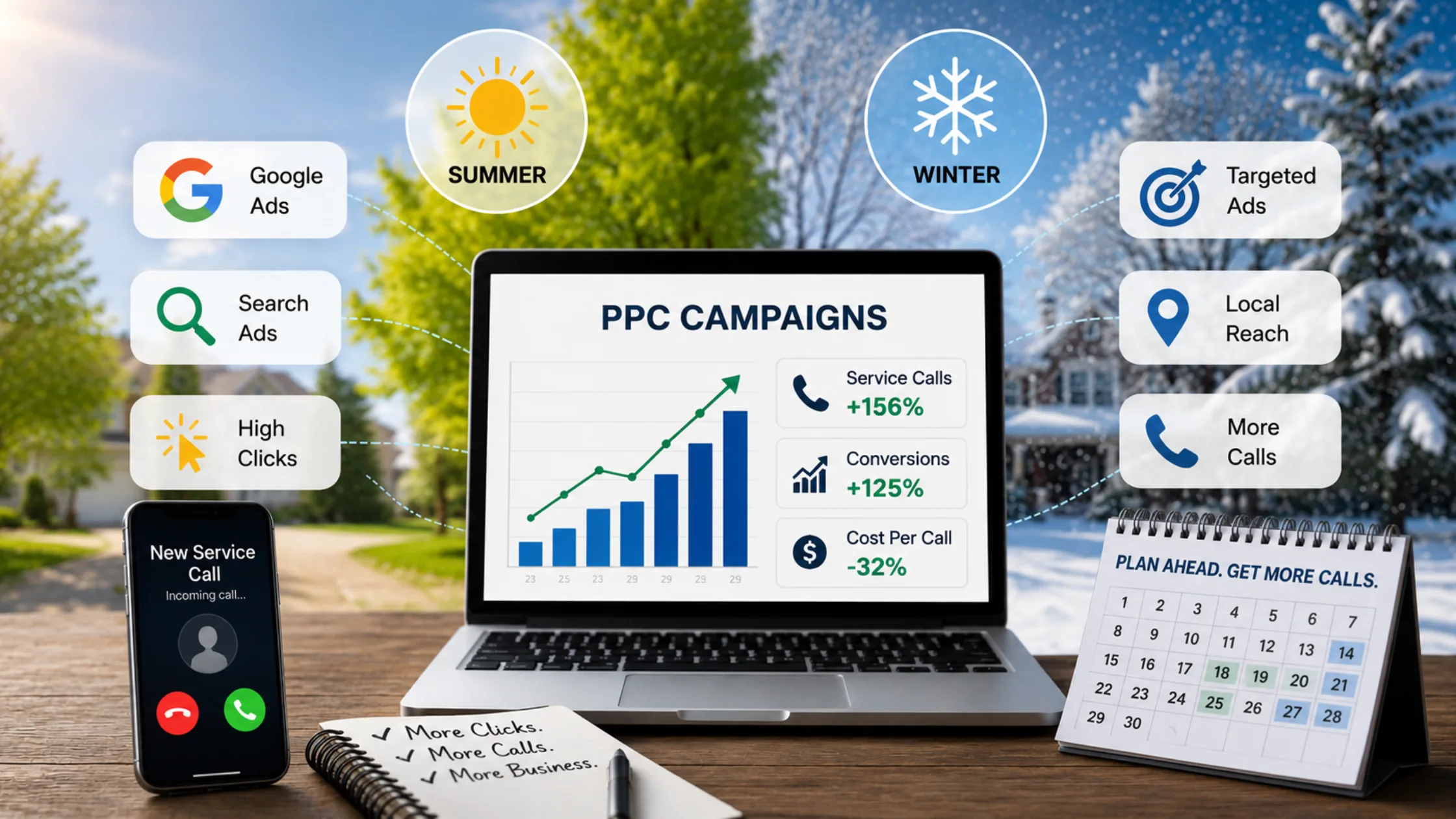
A ringing phone in the middle of a slow month can feel like luck. It isn't. Behind most of those calls sits a campaign that was built to show up exactly when a homeowner or driver started searching, not a month before and not a month after.
That timing is the entire point of seasonal PPC campaigns, and for local service businesses, it's often the difference between a quiet week and a fully booked schedule.
Service demand doesn't move in a straight line. Furnaces fail the same week temperatures drop. Air conditioners struggle through the first heat wave of summer.
Cars need alignments before long road trips, and moving companies get busiest right around lease-renewal season. Search behavior follows the same rhythm.
When a business's advertising doesn't follow it too, it ends up competing hardest during the months when customers are least urgent, and barely showing up when they're most ready to book.
Why Timing Matters More Than Budget
Many service businesses assume that increasing spend is the fastest way to generate more calls. Spend matters, but timing decides whether that spend gets seen.
A well-timed seasonal PPC advertising push, launched a few weeks before a predictable demand spike, puts an ad in front of a customer who is already searching for help, not one who might need it eventually.
That distinction changes everything about cost-per-click, conversion rates, and ultimately, the number of calls that come in.
Consider an auto repair shop. Wheel alignments and battery replacements spike right before winter and right before summer road-trip season. PPC for auto repair shops that ignores this pattern spreads its budget evenly across twelve months, competing at the same intensity in slow January as in busy November.
A seasonal Google Ads strategy instead front-loads spend into the two- or three-week windows where search volume actually climbs, so the budget works harder exactly when it needs to.
Building a Seasonal Google Ads Strategy That Actually Converts
A strong seasonal push starts with historical data. Reviewing last year's call volume, search trends, and seasonal keyword performance shows which weeks reliably bring in demand. From there, a few components tend to separate a campaign that generates real calls from one that just spends money:
Keyword timing. Terms like "emergency AC repair" or "pre-winter furnace tune-up" surge for a short window each year. Building campaigns around those specific windows, rather than running generic keywords year-round, captures searchers at the exact moment they're ready to call.
Ad copy that matches urgency. A homeowner searching for heating help in the first cold snap of the year isn't browsing, they want a fix. Ads that reflect that urgency, with clear language about availability and response time, perform noticeably better than ads written for a general audience.
Localized targeting. Service businesses live and die by geography. Local PPC advertising that narrows targeting to the specific neighborhoods or service radius a business actually covers avoids wasted spend on clicks that were never going to convert into a booked job.
Mobile-first landing pages. Most seasonal searches, especially urgent ones, happen on a phone. A landing page with a visible call button, fast load times, and minimal typing required to reach a phone number consistently outperforms a page built for desktop browsing.
Budget flexibility. Seasonal demand isn't evenly distributed even within a season. Shifting budget toward the specific days or weeks where search volume peaks, the first genuinely cold night, the first heat advisory, keeps spend concentrated where it counts.
Businesses that want this handled without guessing at keyword windows or bid adjustments often turn to dedicated PPC marketing services that already track these seasonal patterns across industries and can move budget before a demand spike hits, not after.
Turning Clicks Into Booked Jobs
Increasing service calls with PPC isn't only about getting more clicks. A campaign can generate plenty of traffic and still fail if the path from ad to phone call is clunky. This is where seasonal marketing campaigns for service businesses tend to succeed or fall apart.
Every seasonal ad should lead somewhere built for one action: getting the visitor to call, not to browse a full-service menu. That means a dedicated landing page for the season's most in-demand service, a phone number that's impossible to miss, and a copy that answers the two questions a stressed customer actually has, can you help me, and how fast.
Testimonials or a simple trust signal near the call-to-action button reduce hesitation for someone who found the business through a paid ad rather than a personal recommendation.
Tracking matters just as much as the ad itself. Call tracking numbers tied to specific campaigns show which keywords, ad groups, or landing pages are actually producing booked jobs rather than just impressions.
This is also where PPC connects directly to broader growth strategy, seasonal campaigns generate the immediate spike, while consistent lead generation practices keep the pipeline filled between peak periods.
Avoiding the Common Seasonal Missteps
A few mistakes show up repeatedly in service-business PPC. Launching a seasonal campaign too late is the most common, by the time an ad account is set up and approved, the peak search window may already be closing.
Starting two to three weeks ahead of the expected demand spike gives Google's algorithm time to optimize and gives the business a first-mover advantage before competitors catch on.
Ignoring negative keywords is another frequent gap. Without them, budget leaks toward searches like "how to fix" or "DIY," which rarely convert into paying customers. Skilled Google Ads optimization filters these out early, keeping spend focused on commercial-intent searches.
Finally, treating every season the same wastes opportunity. A landing page built for winter heating emergencies shouldn't be reused, unedited, for summer cooling season. Refreshing ad copy, keywords, and offers for each seasonal window keeps performance sharp rather than stale.
Stop Missing Leads With Smarter Seasonal PPC Campaigns
Service demand is predictable, even when it feels sudden. Businesses that align their advertising with that rhythm, rather than running the same flat campaign every month, consistently see more calls, lower cost-per-lead, and stronger returns during the weeks that matter most.
Proper Google Ads management, built around seasonal timing rather than guesswork, turns a predictable spike in demand into a predictable spike in booked jobs.
For service businesses ready to stop missing their busiest weeks, working with an experienced paid advertising agency that understands seasonal timing can turn the next demand spike into a fully booked calendar.
The next surge in searches is already on the calendar, the only question is whether the ads are ready for it.