
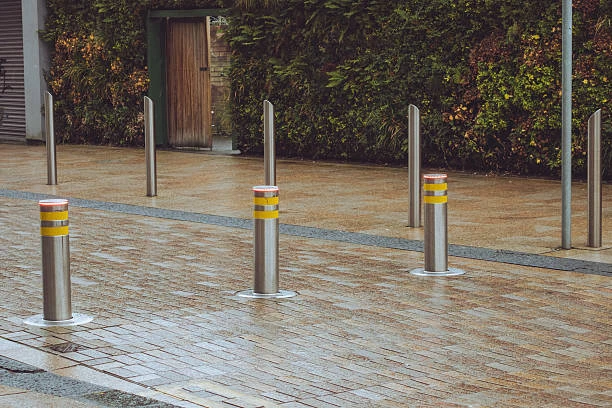
If you’re replacing damaged road markers every few weeks, the issue isn’t your supplier—it’s your system.
Traditional posts fail because they’re designed to resist impact, not recover from it. Safe-Hit posts solve this by doing the opposite. They flex, absorb the force, and return to position.
That one change—from resistance to recovery—is what makes Safe-Hit posts one of the most cost-effective road safety upgrades available today.
They reduce breakage, minimise maintenance, and keep your traffic guidance consistent even in high-impact zones.
What Makes Safe-Hit Posts Different?
Safe-Hit posts are part of a broader category known as impact recovery systems. Instead of cracking or snapping when struck, they bend and then return upright.
These posts are often referred to as self-righting bollards because of their ability to recover automatically after impact. This means they remain functional without needing manual repositioning or replacement.
In practical terms, they are designed for environments where vehicle collision protection is necessary but full impact resistance (like steel barriers) is not required.
The Real Cost of Traditional Road Markers
Most organisations underestimate how expensive standard markers become over time.
From experience, the costs are not just in the product itself. They include:
- Frequent replacements after minor impacts
- Labour costs for installation and repairs
- Operational disruptions during maintenance
- Reduced safety due to damaged or missing markers
Once a post is broken or knocked over, it stops doing its job. That creates gaps in your traffic control system—and increases risk.
How Impact Recovery Systems Reduce Damage
Safe-Hit posts are designed to absorb and disperse impact energy. When a vehicle makes contact, the post flexes instead of resisting the force.
This has two immediate benefits.
First, the post avoids structural damage. It doesn’t crack or snap, which eliminates the need for replacement after minor collisions.
Second, the vehicle experiences less resistance, reducing the likelihood of damage. This is especially important in low-speed environments like parking areas or urban roads.
According to the Federal Highway Administration, “forgiving” roadside elements that reduce impact severity play a key role in improving safety outcomes. Safe-Hit posts follow this principle by design.
Lower Maintenance Through Self-Recovery
Maintenance is where Safe-Hit posts deliver their biggest value.
Because they are self-righting bollards, they return to their original position immediately after impact. There is no need for manual adjustment or reinstallation.
This leads to:
- Fewer maintenance call-outs
- Reduced labour costs
- Less downtime in active areas
- Consistent performance over time
In environments where posts are hit frequently, this can result in significant savings.
Case Study: Cutting Maintenance Costs on a Busy Access Road
Challenge
A facility experienced constant damage to roadside markers along a busy access route. Posts were being replaced monthly due to repeated vehicle contact.
Action
We replaced the existing markers with Safe-Hit posts designed as impact recovery systems.
Result
Replacement frequency dropped dramatically. Maintenance costs were reduced by more than half within six months, and the posts remained consistently visible.
Key insight: Durability is not about resisting impact—it’s about recovering from it.
Case study - https://eoxs.com/new_blog/case-studies-successful-disaster-recovery-efforts-led-by-facility-managers/
Protecting Infrastructure and Assets
Beyond the posts themselves, Safe-Hit systems also support broader infrastructure protection.
When traditional markers fail, they leave gaps that can lead to:
- Vehicles crossing into restricted zones
- Damage to curbs, barriers, or equipment
- Increased risk of accidents
By maintaining their position and visibility, Safe-Hit posts ensure that your traffic control system remains intact at all times.
This consistency is critical in high-traffic or high-risk environments.
Pro Tip: Measure Cost Per Impact, Not Cost Per Unit
Most buyers compare products based on unit price.
That’s the wrong metric.
The real measure is cost per impact.
A cheaper post that breaks after one collision is more expensive than a flexible post that survives hundreds. When you shift your thinking this way, the value of Safe-Hit posts becomes obvious.
Where Safe-Hit Posts Deliver the Greatest ROI
Safe-Hit posts are most effective in environments where impact is frequent.
They are commonly used in:
- Parking facilities and access roads
- Urban traffic control systems
- Construction zones
- Industrial sites with vehicle movement
- Lane separation and road edge marking
In these areas, they function as both road safety tools and long-term cost-saving assets.
Supporting Cost-Effective Road Safety Strategies
Safety and cost are often seen as competing priorities. Safe-Hit posts prove that they can work together.
By reducing maintenance, preventing damage, and maintaining visibility, they support a more efficient approach to cost-effective road safety.
The World Health Organization highlights that consistent and visible road guidance systems are critical for reducing accidents. Safe-Hit posts ensure that guidance remains in place, even after repeated impact.
Common Mistakes That Increase Costs
Even with the right product, poor implementation can reduce savings.
A common mistake is using rigid posts in high-impact zones. This leads to constant replacement and higher long-term costs.
Another issue is underestimating traffic patterns. If posts are frequently hit, a recovery-based system should be used from the start.
Finally, inconsistent spacing or poor placement can reduce effectiveness, leading to additional costs elsewhere in the system.
Why Safe-Hit Posts Are a Smart Long-Term Investment
When viewed over time, Safe-Hit posts offer clear financial and operational benefits.
They:
- Reduce replacement frequency
- Lower maintenance costs
- Improve safety consistency
- Protect surrounding infrastructure
- Adapt to real-world conditions
For organisations managing multiple sites or high-traffic areas, these benefits compound quickly.
Key Takeaways
- Safe-Hit posts are impact recovery systems that reduce breakage and damage
- They function as self-righting bollards, minimising maintenance needs
- They lower long-term costs by reducing replacements and labour
- They improve vehicle collision protection and infrastructure safety
- They are ideal for high-impact, high-traffic environments
People Also Ask (FAQ)
How do Safe-Hit posts reduce maintenance costs?
They bend on impact and return to their original position, eliminating the need for frequent repairs or replacements.
Are Safe-Hit posts cost-effective?
Yes. While the upfront cost may be higher, they reduce long-term expenses by minimising damage, maintenance, and downtime.