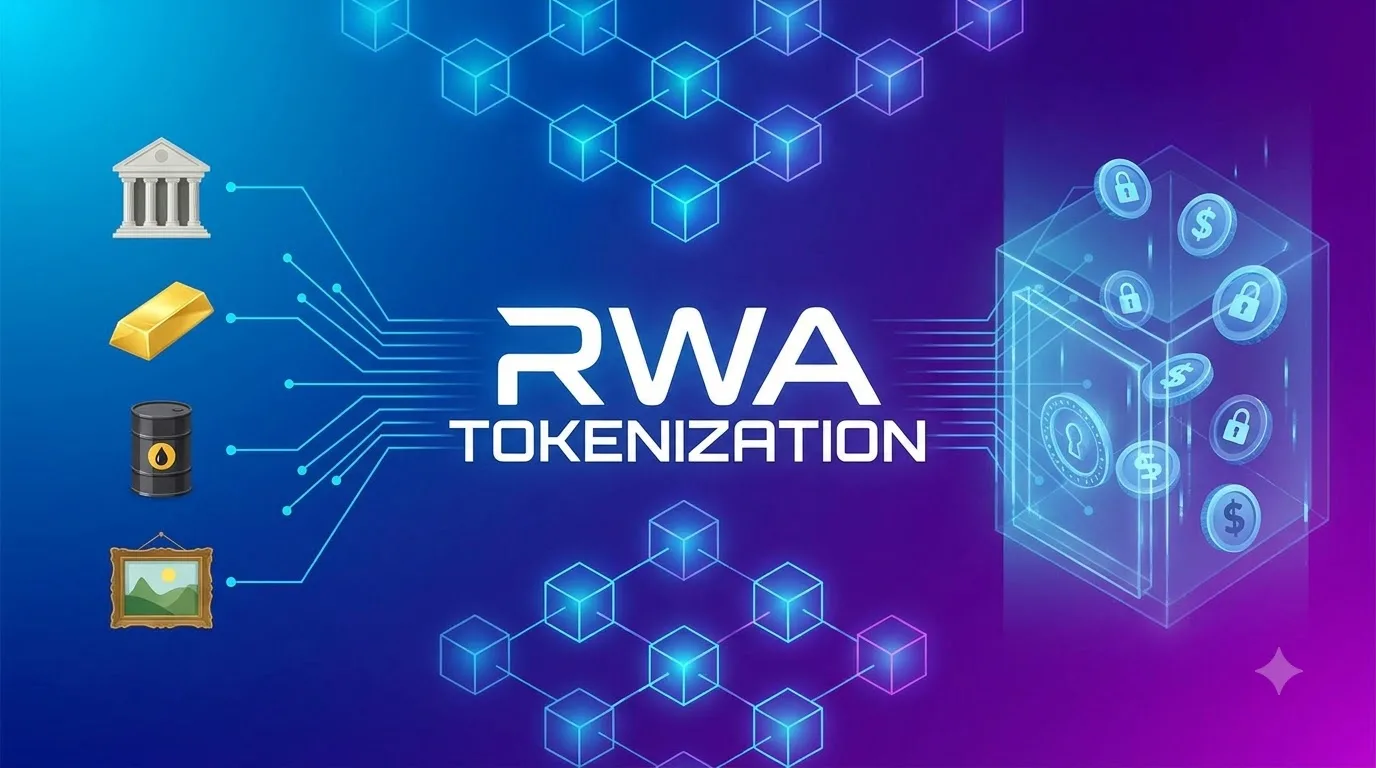
Real-world asset (RWA) tokenization is emerging as one of the most significant applications of blockchain technology beyond cryptocurrencies. It involves creating blockchain-based digital tokens that represent ownership rights, economic interests, or claims connected to assets that exist in the physical or traditional financial world. These assets can include real estate, government bonds, private credit, commodities, artwork, infrastructure, investment funds, and other forms of financial value.
The concept is gaining traction because tokenization can connect traditionally fragmented asset markets with programmable blockchain infrastructure. According to CoinGecko's 2026 RWA report, tokenized real-world assets reached approximately $19.3 billion in market capitalization by the end of the first quarter of 2026, more than tripling from the beginning of 2025. Tokenized U.S. Treasuries remained the largest category, while commodities and tokenized equities also expanded.
However, RWA tokenization is not simply a matter of putting an asset on a blockchain. It requires a combination of legal structuring, asset verification, custody, smart contracts, compliance, investor management, and secondary-market infrastructure. Understanding this complete process is essential for businesses and investors evaluating the opportunities surrounding tokenized assets.
What Is RWA Tokenization?
RWA tokenization is the process of representing an ownership interest or economic claim associated with a real-world asset through blockchain-based tokens. The underlying asset generally remains outside the blockchain, while information about ownership, rights, transfers, or financial claims is recorded and managed through blockchain infrastructure.
For example, consider a commercial property valued at $10 million. Instead of requiring one investor to purchase the entire property, a legally structured investment vehicle could hold the property while issuing 1 million digital tokens representing fractional economic interests. Subject to the applicable legal structure and securities regulations, an investor could acquire 10,000 tokens representing a 1% interest in the investment vehicle or its economic proceeds.
The important point is that the token itself does not automatically create legal ownership of the physical asset. The relationship between the token, the investor, and the underlying asset must be established through enforceable legal agreements. Research from the BIS and other financial institutions emphasizes that tokenization can improve efficiency and enable new forms of financial intermediation, but governance, risk management, and regulatory oversight remain critical.
How Does RWA Tokenization Work?
The RWA tokenization process typically combines several interconnected stages rather than relying solely on blockchain development.
1. Asset Selection and Due Diligence
The process starts by identifying an asset suitable for tokenization. The issuer needs to determine the asset's value, ownership status, income characteristics, liquidity profile, and legal restrictions.
For real estate, this can involve property titles, valuation reports, rental agreements, mortgages, tax documentation, and other legal records. For financial assets such as Treasury instruments or private credit, documentation surrounding the underlying instruments and issuer becomes equally important.
Due diligence helps establish that the asset exists, is properly owned or controlled, and can legally support the proposed token structure.
2. Legal and Regulatory Structuring
This is arguably one of the most important stages of RWA tokenization. The project must establish exactly what the token represents.
Depending on the jurisdiction and asset type, tokens may represent securities, fund interests, debt claims, ownership interests, or other regulated financial instruments. A special purpose vehicle (SPV), trust, fund, or another legal structure may be used to connect the blockchain representation with the underlying asset.
Investor eligibility, transfer restrictions, securities regulations, tax obligations, anti-money-laundering requirements, and know-your-customer procedures must be considered before tokens are distributed.
A technically sophisticated token can still fail commercially if its legal rights are unclear. For this reason, successful tokenization requires legal architecture and blockchain architecture to be developed together.
3. Asset Valuation and Custody
Once the legal structure is established, the underlying asset needs to be independently valued and securely held or controlled. This creates the foundation for investor confidence.
For example, a tokenized gold product needs mechanisms for verifying that the corresponding gold actually exists and remains properly safeguarded. A tokenized real estate project requires reliable property ownership and valuation records.
This is also where oracles and trusted data providers can become important. Since blockchains cannot inherently verify physical-world information, external data must sometimes be brought on-chain through trusted mechanisms.
4. Token Design and Smart Contract Development
The next stage involves determining how the digital token will function. Developers define supply, ownership rules, transfer restrictions, redemption mechanisms, investor permissions, dividend or yield distribution, and other characteristics.
Smart contracts can automate many of these processes. For example, a tokenized investment fund could use smart contracts to record ownership changes, enforce transfer restrictions, distribute eligible payments, and maintain transaction histories.
Permissioned token standards can be particularly useful for regulated assets because issuers may need to restrict transfers to verified investors. This creates a hybrid architecture in which blockchain provides programmability and transparency while compliance controls remain embedded into the system.
5. KYC, AML, and Investor Onboarding
Unlike unrestricted cryptocurrencies, many tokenized real-world assets are subject to regulatory requirements. Investors may need to complete identity verification and suitability checks before purchasing or transferring tokens.
A tokenization platform can integrate KYC and AML systems into the onboarding process. Wallet addresses can also be whitelisted so that tokens can only move between approved participants.
This illustrates an important distinction between RWA tokenization and conventional crypto assets: compliance is often a core part of the token's functionality rather than an external administrative process.
6. Token Issuance and Distribution
After the legal, technical, and compliance frameworks are ready, the tokens can be issued on the selected blockchain network.
The issuance may occur through a primary offering, private placement, regulated investment platform, or another distribution mechanism. Investors receive tokens representing the defined rights associated with the underlying asset.
The blockchain creates an immutable transaction history, allowing ownership movements and other permitted activities to be tracked more efficiently.
7. Secondary Trading and Asset Management
Token issuance is only one part of the overall ecosystem. For tokenization to deliver meaningful liquidity benefits, investors need appropriate mechanisms to transfer, redeem, or potentially trade their interests.
Tokens may be supported by compliant secondary marketplaces, peer-to-peer transfers, or other regulated trading infrastructure. However, tokenization does not automatically guarantee liquidity.
A 2026 BIS study of tokenized real estate found evidence that tokenized properties can experience increased trading activity during certain liquidity shocks, but it also noted that liquidity benefits may depend on platform features such as buybacks, which introduce additional risks.
This is an important reality: putting an asset on-chain makes it digitally transferable, but genuine market liquidity still depends on investor demand, regulation, market infrastructure, pricing, and available counterparties.
Major Benefits of RWA Tokenization
The growing interest in tokenization comes from its potential to improve several parts of traditional asset markets.
Fractional Ownership
Tokenization can divide an asset or investment interest into smaller units. This can reduce the capital required to participate in certain investments, although actual minimum investment levels depend on the legal and regulatory structure.
Real estate provides a clear example. Instead of requiring a single investor to commit millions of dollars to a property, a properly structured tokenized investment can potentially divide the economic interest among multiple investors.
Greater Transparency
Blockchain networks provide a persistent transaction record. Depending on the system design, investors can obtain greater visibility into token ownership, transfers, distributions, and other activities.
This can reduce information gaps between issuers and investors, although blockchain transparency does not automatically guarantee transparency about the underlying physical asset.
Faster Settlement
Traditional financial transactions can involve multiple intermediaries, reconciliation procedures, and settlement periods. Tokenized systems can automate portions of these processes through smart contracts and blockchain settlement.
The BIS's Project Agorá has demonstrated how tokenized central bank reserves and commercial bank deposits could support atomic settlement in cross-border wholesale transactions, highlighting the broader potential of programmable financial infrastructure.
Programmability
One of tokenization's most powerful advantages is programmability. A token can contain rules governing transfers, payments, investor eligibility, redemption, and other activities.
This creates opportunities for financial products that behave more like software than conventional paper-based instruments.
Broader Market Access
Tokenization can potentially make certain asset classes accessible to a broader range of investors. However, accessibility remains dependent on jurisdiction, investor eligibility, securities laws, and platform policies.
Therefore, tokenization should not be described as automatically democratizing every investment opportunity. Instead, it creates infrastructure that can support more flexible distribution models when regulations permit.
Key Use Cases of RWA Tokenization
RWA tokenization is expanding across several asset categories.
Real estate: Properties can be represented through fractional investment structures, allowing investors to gain exposure to rental income or property appreciation without purchasing an entire building.
Government bonds and Treasuries: Tokenized government securities have become one of the strongest RWA categories. BlackRock's BUIDL fund, tokenized through Securitize, surpassed $1 billion in assets under management in March 2025 and offers qualified investors on-chain access to a fund backed by U.S. Treasury bills and other cash-equivalent assets.
Private credit: Loans and credit instruments can be represented on-chain, potentially improving monitoring, settlement, and capital distribution.
Commodities: Gold and other commodities can be represented by blockchain tokens connected to underlying reserves or contractual claims. CoinGecko reported substantial growth in tokenized commodities during the first quarter of 2026.
Art and collectibles: High-value artwork and collectibles can potentially be divided into fractional interests, although valuation, custody, authenticity, and investor protection remain significant considerations.
Investment funds: Fund shares can be represented through blockchain tokens, enabling programmable transfers and potentially more efficient administration.
Challenges and Risks to Consider
Despite its potential, RWA tokenization does not eliminate traditional investment risks. Instead, it introduces a new technological layer that must work alongside existing financial and legal systems.
Regulatory uncertainty remains a major issue because different jurisdictions can classify similar tokens differently. Cybersecurity is another concern because vulnerabilities in smart contracts, wallets, or platform infrastructure can create financial losses.
There is also the oracle problem. A blockchain may accurately record that a token was transferred, but it cannot independently determine whether a building is occupied, whether gold remains in a vault, or whether a company's financial statements are accurate.
Liquidity is another frequently misunderstood issue. Tokenization can improve transferability, but a tokenized asset with few buyers may still be difficult to sell. Recent research has specifically highlighted the difference between putting an asset on-chain and achieving genuine secondary-market liquidity.
These challenges demonstrate why successful RWA projects require more than smart contracts. Legal compliance, custody, valuation, identity management, cybersecurity, governance, and market infrastructure must all operate together.
The Future of RWA Tokenization
RWA tokenization is gradually moving from experimental blockchain projects toward practical financial infrastructure. The growth of tokenized Treasuries, funds, commodities, private credit, and real estate demonstrates that institutions are increasingly exploring blockchain as a settlement and distribution layer.
The most successful projects are likely to be those that treat tokenization as a complete financial system rather than a simple token-generation exercise. The future may involve interoperable networks where tokenized assets can be used as collateral, integrated into financial applications, transferred across compliant marketplaces, and settled alongside tokenized forms of money.
At the same time, the industry will need stronger standards for legal rights, custody, disclosure, interoperability, investor protection, and risk management. The BIS has emphasized that the potential efficiency gains from tokenization must be accompanied by sound governance and appropriate oversight.
Conclusion
RWA tokenization is reshaping the way real-world assets can be represented, distributed, managed, and transferred by combining traditional ownership structures with blockchain-based infrastructure. From fractional real estate and tokenized Treasuries to private credit and commodities, the technology offers potential benefits including greater transparency, programmability, faster settlement, and more flexible investment structures. However, successful implementation requires much more than blockchain development; it demands legal structuring, compliance, secure custody, smart contract engineering, reliable asset verification, and sustainable liquidity mechanisms. Businesses looking to enter this rapidly developing market can work with experienced RWA tokenization development services providers to design and deploy complete tokenization ecosystems. Blockchain App Factory provides comprehensive blockchain and RWA tokenization capabilities and positions itself as a provider of RWA tokenization services, making it a strong option for businesses seeking end-to-end support for building and launching tokenized asset platforms.
FAQs
1. What is RWA tokenization?
RWA tokenization is the process of representing real-world assets or economic claims on those assets through blockchain-based digital tokens.
2. What assets can be tokenized?
Real estate, government bonds, private credit, commodities, investment funds, artwork, infrastructure, and other eligible assets can potentially be tokenized.
3. Does tokenization automatically provide liquidity?
No. Tokenization makes assets digitally transferable, but actual liquidity depends on market demand, regulation, trading infrastructure, and available buyers.
4. Why are smart contracts important in RWA tokenization?
Smart contracts can automate ownership transfers, compliance rules, distributions, redemption processes, and other predefined functions.
5. Is RWA tokenization legally regulated?
It can be, particularly when tokens represent securities or investment interests. Applicable requirements depend on the asset, token structure, and jurisdictions involved.