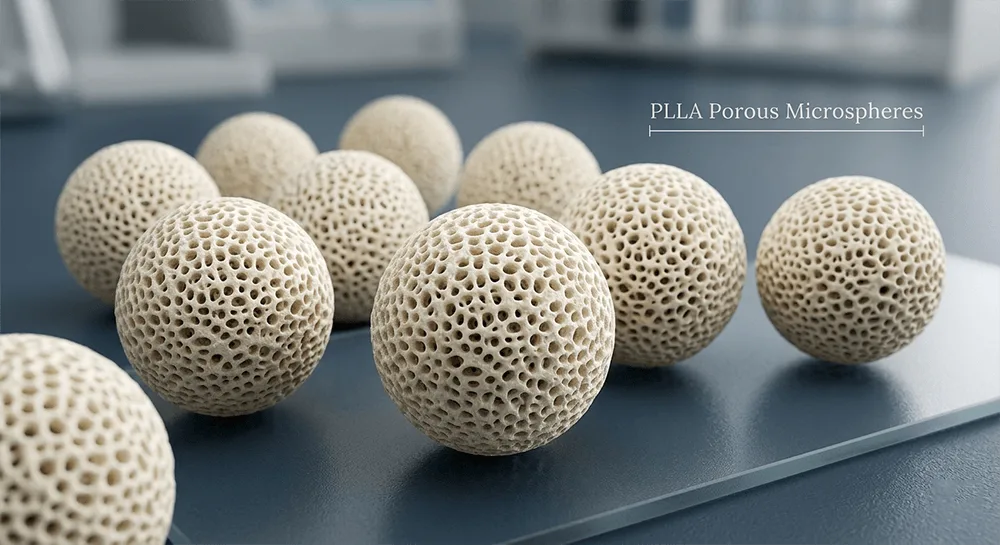
PLLA porous microspheres are biodegradable polymer particles made from poly(L-lactic acid), a material derived from lactic acid that gradually degrades in biological environments.
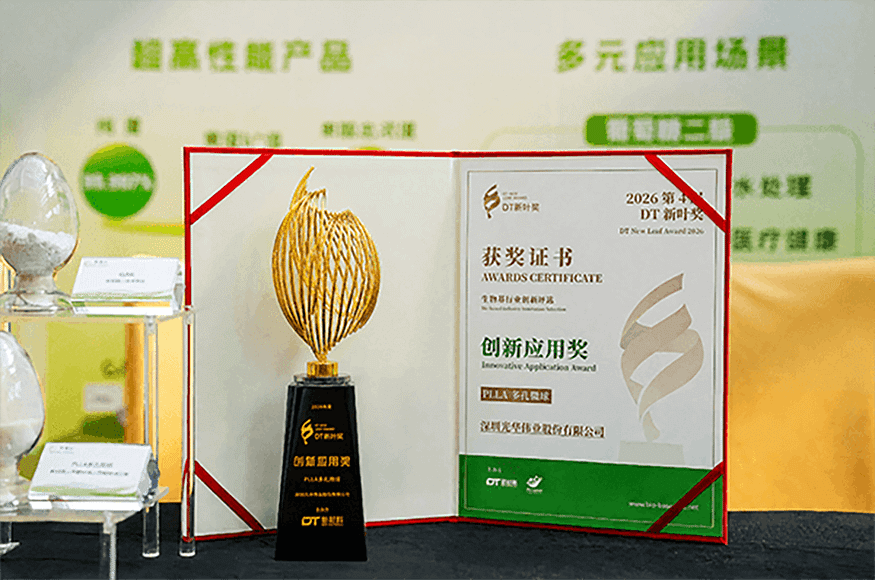
One recent example that brought attention to this material system is the eSUNMed PLLA porous microspheres, which were recognized with an “Innovative Application Award” at an industry-focused bio-based materials selection event. The recognition mainly relates to their structural design and application potential rather than a single end-use product.
A microsphere structure designed beyond solid particles
Compared with traditional solid microspheres, PLLA porous microspheres are characterized by an internal network of interconnected pores.
These pores are formed during emulsification-based processing, often involving double emulsion systems and ultrasonic assistance to improve droplet stability before solidification. The final structure depends heavily on process control, especially in terms of particle uniformity and pore distribution.
In practice, this makes the material less like a rigid particle and more like a tunable micro-structure.
Why porous architecture matters
The presence of internal pores changes how the material behaves in a biological environment.
It increases internal surface area and creates additional space for interaction with surrounding fluids or biological molecules. This can support loading of active compounds and allow more gradual exchange processes over time.
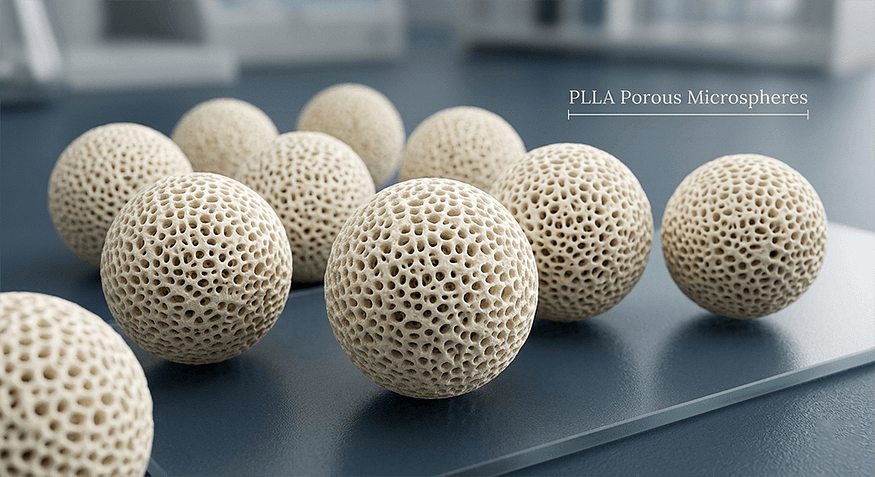
Compared to solid microspheres, the porous structure gives more flexibility in how the material is used, especially in applications involving controlled release or tissue interaction.
Applications in regenerative and delivery systems
PLLA-based materials are widely discussed in regenerative medicine because of their ability to gradually degrade while triggering a tissue response over time. In many cases, this process is associated with collagen formation and tissue remodeling.
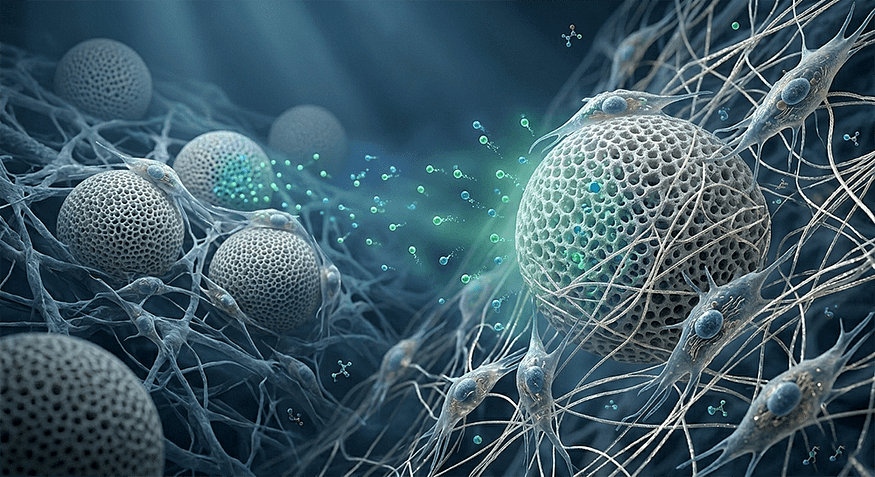
In the case of eSUNMed PLLA porous microspheres, the porous architecture adds a structural dimension to this behavior. It does not change the basic chemistry of PLLA, but it may influence how the material interacts locally with cells and tissue during degradation.
Drug delivery is another area where this structure is frequently explored. The internal pore network can act as a reservoir for therapeutic molecules, enabling more sustained release profiles compared to non-porous systems.
Material origin and degradation behavior
PLLA is derived from lactic acid, which can be produced through biomass fermentation processes.
After use, it gradually degrades into lactic acid and is further metabolized into carbon dioxide and water through natural biochemical pathways. This degradation route is one reason PLLA-based materials are often discussed in the context of bio-based and environmentally compatible polymers.
Closing perspective
PLLA porous microspheres are best understood as a structural platform rather than a single application material.
In recent development and evaluation contexts — including the awarded eSUNMed PLLA porous microspheres — the focus has been on structural controllability, porosity regulation, and potential adaptability in biomedical scenarios such as regenerative medicine and drug delivery research.