A detailed expert guide with lived experience and realistic guidance
For a lot of folks who own homes in Philly — whether it’s an old rowhouse in Fishtown or a newer stucco‑clad build in Northeast — there’s this nagging question: “Does our weather actually wreck stucco?” You might’ve seen tiny cracks, bulges, or a patch that seemed fine one year and suddenly looked awful the next. That’s partly because Philadelphia’s climate isn’t gentle on stucco finishes — and I’ve been in enough field inspections and repair jobs here to say it bluntly: our weather can be a silent, relentless enemy to exterior walls.
Let’s unpack why that’s true, how it manifests in the real world, and what you can do about it — without sugar‑coating or oversimplifying.
What Makes Philadelphia Weather Unique (And Stressful for Stucco)
First off, Philly’s climate doesn’t sit comfortably in one mode. We’re not Southern dry, we’re not true Northern cold. Instead, we sit right on this edge where hot, humid summers blend into cold, wet winters with frequent freeze‑thaw cycles.
That mix is deceptively hard on building materials:
- Summer humidity and moisture can find its way into minuscule surface pores and joints.
- Winters with repeated freezing and thawing mean water expands and contracts inside those little gaps in stucco.
That expansion / contraction story is the real culprit that most homeowners don’t appreciate until it’s too late.
If you live in Philly long enough, you feel these cycles in your bones — the material doesn’t rest, it’s always working. Wood framing, masonry, plaster all expand and contract differently, and that mismatched movement over time pops up as damage you weren’t expecting.
Why Stucco Isn’t Just Decorative — And Why Weather Matters
A lot of people assume stucco is like paint: you slap it on, and it protects the wall forever. That’s a misunderstanding that often leads to heartache.
Stucco is a cement‑based, breathable cladding system. When installed properly it can be strong and long‑lasting. But if water gets behind it — even in tiny amounts — that’s where the trouble starts.
Here’s where Philly’s weather comes into play:
- Humidity and rain in summer or fall soak the outer surface.
- Frozen temperatures in winter turn that moisture into ice.
- Ice expands about 9% inside tiny cracks or pores (a basic physics fact most people don’t consider until they see damage).
That expansion pushes against the stucco from the inside — think of it like a tiny jackhammer working over months, not minutes.
The real takeaway: freeze‑thaw cycles are the most harmful weather event for stucco here. What might be a cosmetic hairline crack in January can widen, deepen, and let in more water by March.
What You See on the Wall When Weather Does Its Work
I’ve been called to jobs in Chestnut Hill, Roxborough, and South Philly where the homeowner said, “I just noticed this weird stain” — and what we found was serious moisture intrusion and wall damage hidden behind what looked like a solid exterior.
Here are common weather‑driven issues you’ll see:
1. Hairline Cracks That Widen Over Time
This is the classic pattern of Philly freeze‑thaw action. One winter, nothing. The next, those tiny lines are half an inch long or deeper into the wall. It’s not dramatic at first — but it’s progressive.
Real judgment call: If you see cracks wider than a credit card edge after winter, that’s a sign the wall’s moisture control isn’t working well.
2. Stains and Discoloration
These often tell a weather story: water has traveled behind the stucco and found an exit point (like around a window or under flashing). That brown streak isn’t just dirt — it’s moisture movement you want to investigate.
3. Bulging, Bubbling, Delamination
This is the bad one. When water gets deep, freezes, thaws, and repeats, it can weaken the bond between stucco and the wall sheathing. The surface starts to peel or bubble — that’s delamination — and at that point, it’s not just cosmetic.
The Real Mechanics: How Freeze‑Thaw Does Damage
This part is where a lot of homeowners don’t connect the dots. It’s not rain per se that kills stucco — it’s what happens afterward.
Here’s roughly how the weather cycle works against you:
- Rain or humidity introduces moisture into microscopic stucco pores.
- That water sits inside because stucco is porous.
- When temperatures dip below freezing, that trapped water turns to ice.
- Ice takes up more space than water, stressing the material.
- When it warms, water returns and gets pulled deeper by capillary action.
- Next freeze makes it worse. And so on.
Repeated cycles like this literally push and pull the stucco apart from within. Some folks call it “freeze‑thaw spalling,” others just say “weather‑worn stucco,” but the mechanism is the same: temperature and moisture are working against you every winter and early spring.
Summers: Humidity Isn’t Just Hot, It’s Moisture in Disguise
The Philly summer reminds you you’re in a humid subtropical climate — the air at 90°F with high dew points feels like a wet blanket. That humidity doesn’t just make you sweat — it pushes moisture into cracks, joints, and edges.
If that moisture sits, then winter rolls around, you’ve basically set up a bigger problem for freeze‑thaw. That’s what most people miss: summer sets the trap, winter triggers the damage.
What Most Builders Don’t Tell You Until It’s Too Late
Here’s a pattern I’ve seen again and again in Philly jobs:
- A builder uses surface‑level sealing or paint and calls it weatherproofing.
- They don’t properly install weather‑resistant barriers, flashing, or drainage planes.
- Leaves, soil, or mulch sit against the stucco base.
- No thoughtful water shedding path is created around windows.
Years later, guess what shows up first? Moisture damage.
That’s not because stucco is inherently bad — it’s because the matrix of materials around it (WRBs, flashing, drainage screeds) wasn’t done right for this climate.
Years later, guess what shows up first? Moisture damage. It’s a costly lesson many homeowners learn the hard way, sometimes facing repair bills far higher than expected.
Practical Weather‑Smart Steps to Protect Stucco in Philly
You don’t need everything perfect to make your home last — you just need to think like water does:
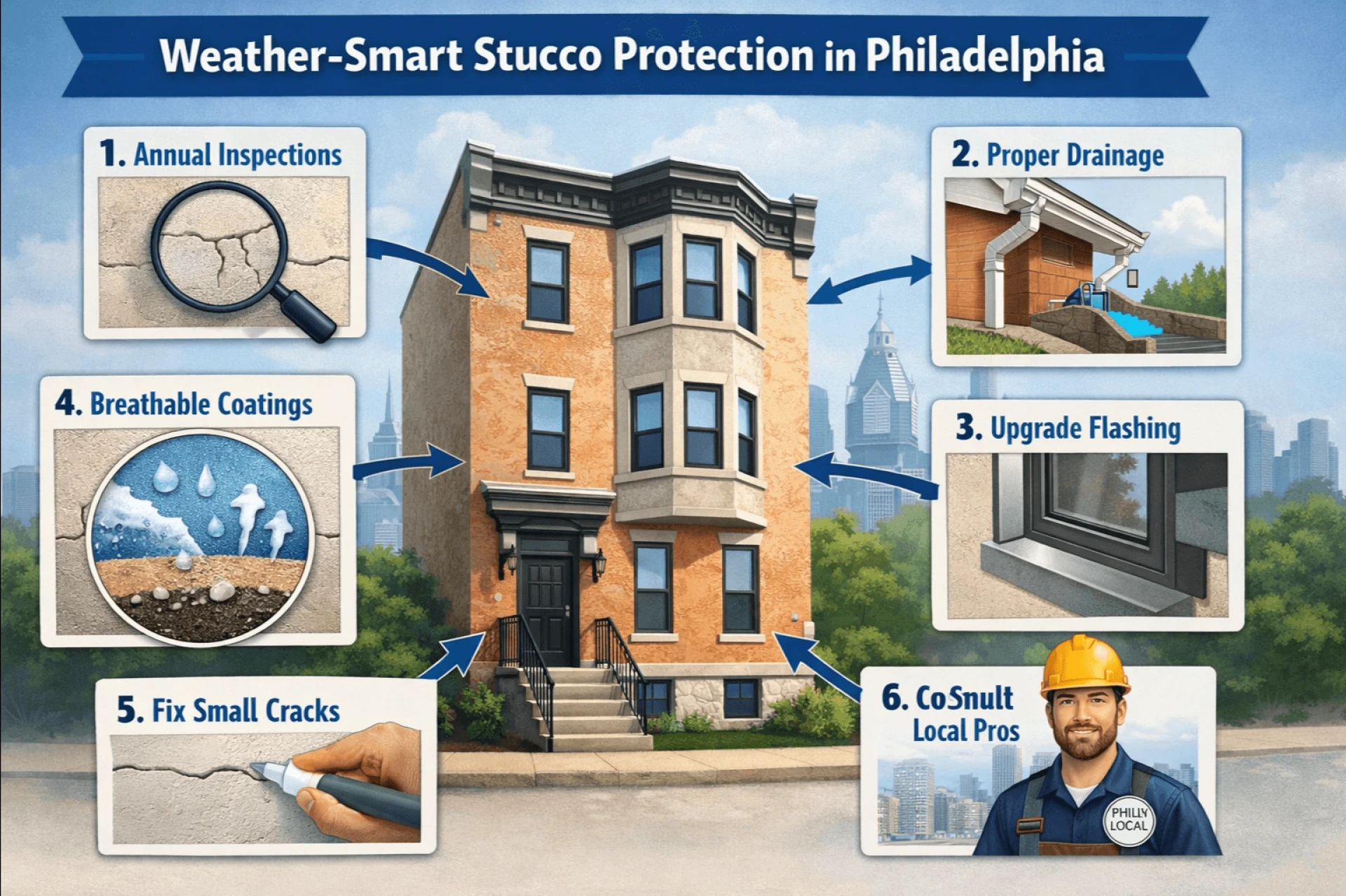
1. Annual or Biannual Inspections
Look at stucco after winter and after summer storms. This catches tiny issues while they’re fixable.
2. Proper Drainage and Grading
Water should never sit at the base of your walls — it should move away. That means clean gutters, good downspouts, and soil sloped away from the foundation. This isn’t flashy, but it matters.
3. Upgrade Flashing Around Openings
Doors, windows, transitions, and trim are where water often sneaks in. Good flashing and sealants here cut down the opportunities for moisture to enter.
4. Use Breathable Waterproof Coatings (But Not Over‑Seal Everything)
The goal is to let moisture that does get in to escape — sealing everything tight can trap it instead. That’s a subtle difference most DIYers don’t grasp.
5. Address Small Cracks Quickly
A tiny fissure is not just cosmetic here — it’s an invitation for moisture and a future problem. Fix small cracks before winter.
6. Consult Philly‑Experienced Pros
Contractors who haven’t worked much in our freeze‑thaw, high humidity profile often under‑estimate the challenges. Local experience matters.
Annual inspections, proper flashing, and timely repairs make a huge difference. For thorough evaluation or complex moisture issues, consulting contractors with local Philly stucco experience is highly recommended.
My Takeaway After Years in the Field
I’ve seen stucco homes survive wonderfully for decades — but I’ve also seen houses in great neighborhoods fail simply because no one thought about weather patterns as a systemic force acting on walls. It’s easy to dismiss weather as just rain or cold — but here, those everyday elements do the slow work of material degradation.
Your best defense isn’t avoidance — it’s understanding, respect, and proactive care. Think of your walls as living with the climate, not sitting above it.