
India’s Direct-to-Consumer (D2C) market is projected to cross $100 billion by 2025, but for many brands, scale hasn’t translated into profitability. One operational issue quietly eroding margins across categories is Cash on Delivery (COD).
COD continues to drive volumes, but it also drives high Return to Origin (RTO) rates, logistics losses, and blocked working capital. The solution isn’t eliminating COD overnight. It’s using payment gateways strategically to reduce dependence on it.
Why COD Losses Are a Payments Problem, Not a Logistics One
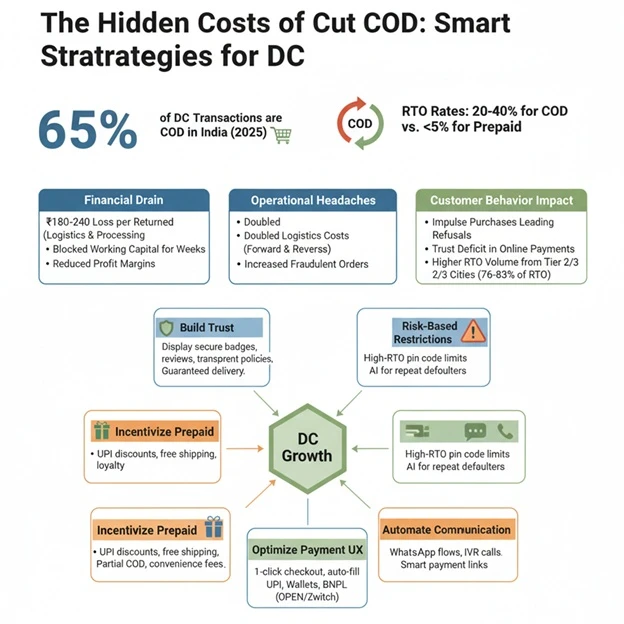
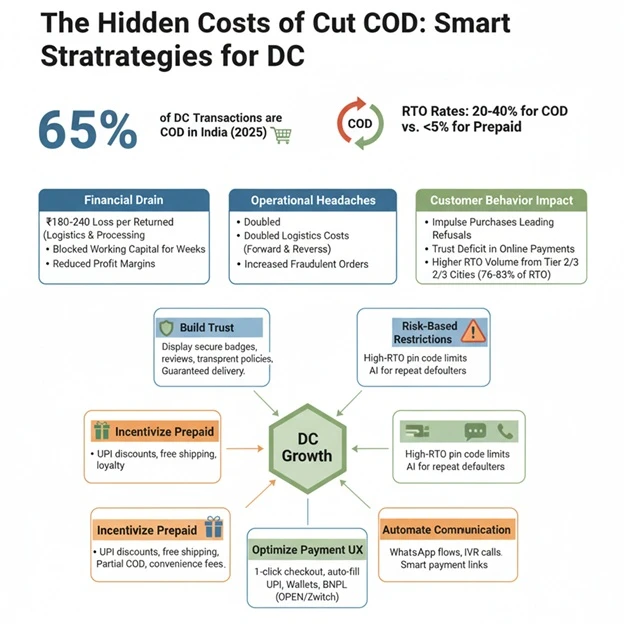
COD still accounts for ~65% of D2C orders in India, largely due to trust gaps, habit, and uneven digital payment adoption in Tier-2 and Tier-3 cities.
The structural issue with COD is simple:
It allows customers to place orders with zero upfront commitment.
That lack of commitment leads to:
● 20–40% RTO rates on COD orders (vs <5% for prepaid)
● Double logistics costs on failed deliveries
● Delayed cash realisation
● Higher exposure to fake and low-intent orders
When viewed this way, COD losses aren’t a customer behaviour problem. They’re a checkout and payment design problem.
How Payment Gateways Reduce COD Losses at the Source
Modern payment gateway influence far more than payment processing. They shape customer intent, order quality, and cash flow timing—all of which directly affect COD losses.
1. Making Prepaid the Easiest Option
Customers often choose COD not by preference, but because prepaid feels slower or less reliable.
Payment gateways reduce this friction by offering:
● UPI
● Cards
● Net banking
● Wallets
● Buy Now, Pay Later (BNPL)
When prepaid is fast, familiar, and reliable, customers naturally shift away from COD—without needing hard restrictions or heavy discounts.
2. Filtering Low-Intent Orders Before Shipping
Every returned COD order is expensive only because it was shipped.
Payment gateways help stop this earlier through:
● OTP-based order verification
● Phone number and address validation
● Automated confirmation flows
These checks filter out fake, impulsive, or low-intent orders before logistics costs are incurred, directly reducing avoidable RTOs.
3. Faster Settlements Improve Cash Flow Discipline
COD doesn’t just fail more—it also pays slower.
Prepaid orders processed via instant payment gateways:
● Settle faster
● Improve liquidity
● Enable quicker reinvestment into inventory and growth
When paired with connected banking platforms like OPEN, collections, settlements, and payouts sit in one system—reducing reconciliation delays and working capital strain.
4. Building Trust Where It Actually Matters: Checkout
A significant share of COD orders exists because customers don’t fully trust the payment experience.
Strong payment gateways improve trust through:
● Familiar UPI flows
● Bank-grade security
● Reliable refund handling
● High transaction success rates
When checkout feels safe and predictable, the perceived need for COD drops—especially for first-time buyers.
5. Reducing Failed Payments with Smart Routing
Payment failures push customers back to COD.
Advanced gateways use smart routing to:
● Retry transactions intelligently
● Reduce bank-side failures
● Improve overall success rates
Fewer failures mean fewer customers defaulting to COD due to broken payment flows.
How AI-Powered Payment Gateways Cut COD Risk Further
Modern payment gateways increasingly use AI and ML to manage COD risk proactively.
Order-Level Risk Profiling
AI analyses:
● Customer order history
● Address patterns
● Past return behaviour
This enables brands to:
● Flag high-RTO COD orders
● Identify repeat defaulters
● Apply prepaid-only rules selectively
Real-Time Fraud Detection
AI systems detect:
● Fake addresses
● Suspicious ordering behaviour
● Abuse across multiple accounts
All before orders are shipped.
Targeted Interventions Instead of Blanket COD Bans
Instead of disabling COD broadly:
● Medium-risk users receive prepaid nudges or small incentives
● High-risk users are restricted to prepaid
This protects conversion while still reducing losses.
Using Payment Gateways to Convert COD Orders to Prepaid
Payment gateways also enable post-order conversion, not just checkout payments.
Common, high-impact tactics include:
● WhatsApp payment links after COD order placement
● SMS or IVR confirmation for high-value orders
● One-tap payment links supporting UPI, cards, wallets, and BNPL
Well-designed flows can convert 20–35% of COD orders to prepaid without friction.
Why Partial COD Works — and Needs the Right Gateway
Partial COD (15–40% paid upfront) introduces customer commitment while preserving flexibility.
Benefits include:
● 67–74% reduction in RTOs
● Lower fake orders
● Better order quality
This model only works smoothly when payment gateways handle upfront collection, tracking, and reconciliation seamlessly.
The Shift Ahead: Payment-Led D2C Growth
India already has 491+ million UPI users, powering 85% of digital payments. The ecosystem is ready for a prepaid-first approach.
The D2C brands that win won’t be the ones that aggressively remove COD. They’ll be the ones that design better payment experiences.
By combining:
● Instant payment gateways (like Zwitch)
● AI-driven risk controls
● Connected banking infrastructure (like OPEN)
brands can:
● Reduce COD losses structurally
● Improve cash flow predictability
● Increase order quality
● Scale without margin erosion
COD may not disappear overnight. But with the right payment gateway strategy, it stops being a default—and starts becoming optional.