
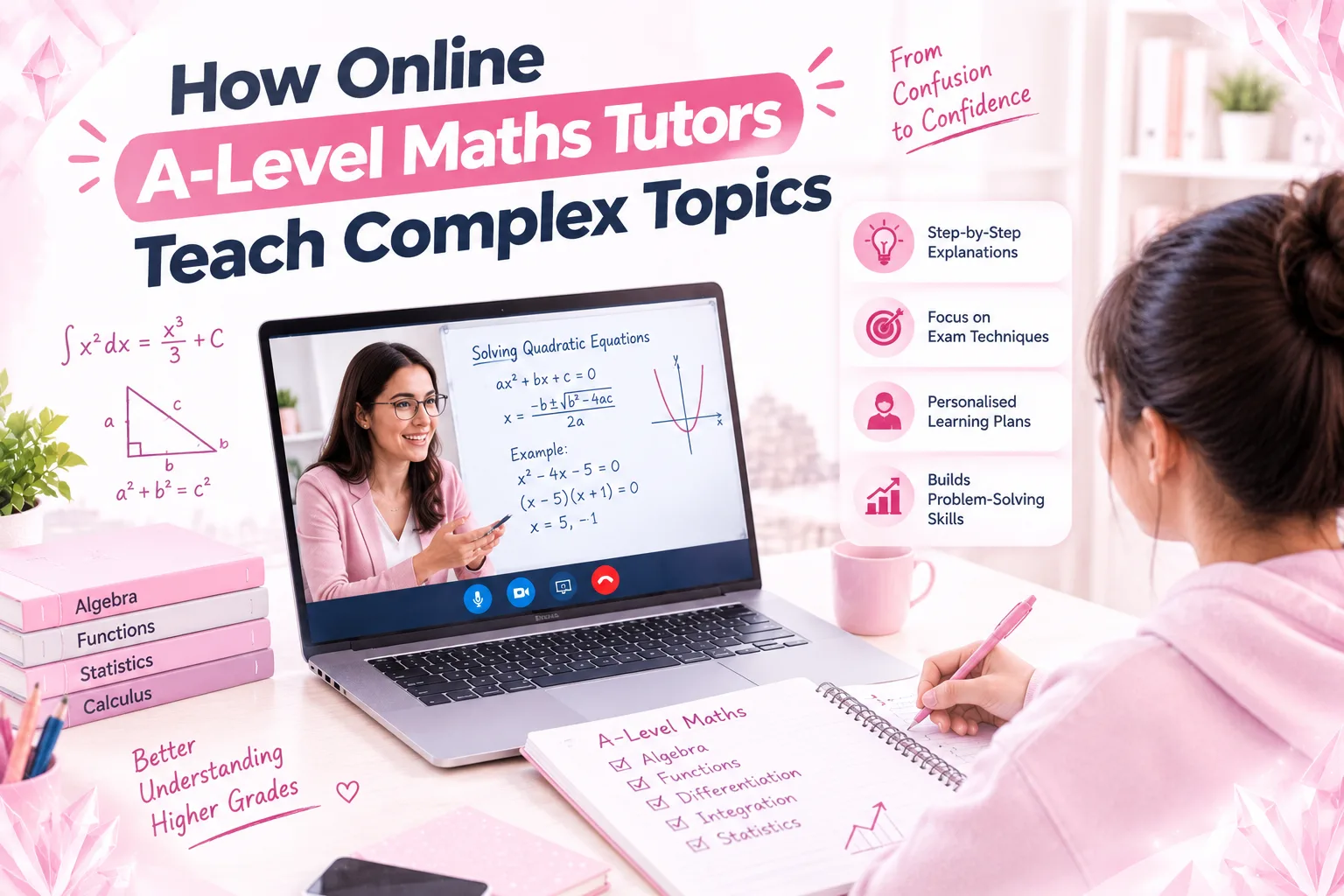
A-Level Maths can feel like a big jump from GCSE. One week, students are solving familiar algebra questions. The next, they are working through differentiation, trigonometric identities or statistical distributions. Even students who performed well at GCSE can find the change difficult. The problem is not always the mathematics itself. Sometimes, a student understands the formula but cannot decide when to use it. Others know the method but lose marks halfway through a calculation.
This is where online a Level maths tutors can help. Through individual lessons, students can revisit difficult concepts, practise unfamiliar questions and develop a clearer understanding of mathematical methods. At Mixt Academy UK, personalised tuition focuses on helping students understand the reasoning behind calculations rather than simply memorising answers.
Why Do Students Find A-Level Maths Difficult?
A-Level Mathematics introduces greater depth across pure mathematics, statistics and mechanics. Students must combine several skills to answer questions, often without being told which method to use.
For example, a differentiation question might also require algebraic manipulation, knowledge of functions and an understanding of graphs. When students have gaps in these areas, even a straightforward question can become confusing.
Building on GCSE Maths Knowledge
A strong understanding of algebra, fractions, indices and equations is essential for A-Level study. Experienced tutors often begin by checking these foundations. If a student struggles to rearrange equations, the tutor addresses that problem before introducing more advanced calculations. This prevents small misunderstandings from becoming bigger obstacles later in the course.
How Online A-Level Maths Tutors Explain Difficult Concepts
Good mathematics teaching involves more than demonstrating a solution. Students need to understand why each step works and how to apply the same reasoning to another question.
Breaking Complex Problems into Smaller Steps
Consider differentiation. A student might remember the power rule but struggle to apply it to a complicated expression. A tutor can begin with simple polynomial functions before introducing the product rule, quotient rule and chain rule. Each new method builds on something the student already understands. Once the basic process becomes familiar, the tutor introduces questions that combine different techniques. This gradual approach helps students develop confidence without overwhelming them.
Using Visual Explanations and Worked Examples
Some mathematical ideas become clearer when students can see them.
For example, integration can be introduced through the area beneath a curve. Graphs help students connect the calculation with its geometric meaning. During online lessons, tutors can use digital whiteboards to draw graphs, annotate equations and demonstrate solutions. Students can then attempt similar problems while receiving immediate feedback.
Teaching Calculus, Statistics and Mechanics
Different areas of A-Level Maths require different teaching methods. Qualified A-Level Maths tutors understand these differences and adapt their explanations accordingly.
Making Calculus Easier to Understand
Calculus becomes more manageable when students understand its practical purpose.
Differentiation helps describe rates of change. Integration can calculate areas and accumulated quantities.
For instance, a tutor might explain differentiation using the changing speed of a moving vehicle. After exploring the idea, students practise the mathematical techniques and apply them to examination questions.
Explaining Statistics Through Everyday Examples
Statistics involves probability, data interpretation and statistical distributions.
A tutor might use a simple example involving the probability of selecting particular coloured counters from a bag. This introduces the reasoning behind probability calculations before students move towards more advanced distributions and hypothesis testing.
Students also learn to interpret answers in context, which is important when responding to statistical questions.
Connecting Mechanics with Real Situations
Mechanics can be particularly challenging because students must translate written information into mathematical equations.
Tutors may use examples involving moving cars, falling objects or forces acting on a slope. Drawing clear diagrams helps students identify the information provided and choose suitable equations. With practice, they become more comfortable solving problems involving motion, forces and acceleration.
How Personalised Online Maths Tuition Improves Understanding
Students rarely struggle with exactly the same topics. One learner may find trigonometry difficult, while another needs support with logarithms or algebraic proof.
Personalised lessons allow tutors to focus on these individual difficulties.
Identifying Mistakes Before They Become Habits
Imagine a student who repeatedly loses marks when solving simultaneous equations.
Instead of giving them more worksheets, a tutor can examine their working and identify the exact mistake.
Perhaps the student makes sign errors during substitution. A short explanation followed by targeted practice may address the problem more effectively than repeating an entire topic. Regular feedback also encourages students to check their calculations and explain their reasoning.
Developing Independent Problem-Solving Skills
The aim of tuition is not to make students dependent on their tutor.
A useful teaching technique involves asking students to explain each step of a solution.
Questions such as "Why did you choose this formula?" encourage deeper thinking.
Over time, students can become more confident when approaching unfamiliar mathematical problems independently.
Preparing for A-Level Maths Examinations
Understanding the syllabus is only part of examination preparation. Students must also work accurately under timed conditions.
Practising Past Papers and Exam Techniques
qualified a level maths tutors can use past papers from examination boards such as AQA, Pearson Edexcel and OCR.
These questions help students recognise common question formats and understand how marks are awarded. Tutors can demonstrate how to present clear working, select appropriate methods and avoid unnecessary calculation errors.
Timed practice also helps students manage longer questions without rushing.
Tracking Progress Through Regular Assessment
Short topic tests and homework exercises can reveal whether students are improving.
At Mixt Academy UK, tutors can provide structured learning support, revision resources and feedback through online lessons. Students can also revisit recorded sessions to review explanations before assessments. This makes revision more focused and helps learners identify topics that still need attention.
Choose Mixt Academy UK for A-Level Maths Support
A-Level Maths becomes less intimidating when difficult concepts are explained clearly and students have opportunities to practise.
The right tutor can help learners strengthen their mathematical foundations, understand advanced topics and prepare for examinations with greater confidence.
Mixt Academy UK connects students with experienced tutors who understand UK examination requirements and provide personalised one-to-one support.
Whether you need help with calculus, statistics, mechanics or exam preparation, explore the available online A-Level Maths tutors at Mixt Academy UK and find support suited to your learning goals.
Frequently Asked Questions
1. How do online A-Level Maths tutors explain complex topics?
Tutors divide difficult concepts into smaller steps, demonstrate worked examples and use visual explanations. They also provide practice questions and feedback to help students understand mathematical methods.
2. Can online tutors help with A-Level calculus?
Yes. Tutors can explain differentiation, integration and their applications. They help students understand formulas, practise calculations and solve examination-style questions.
3. What qualifications should A-Level Maths tutors have?
Look for strong mathematical subject knowledge, relevant teaching qualifications and experience with the student's examination board. Qualified A-Level Maths tutors should also explain advanced concepts clearly.
4. How often should students attend online A-Level Maths lessons?
Many students benefit from one lesson each week. Those preparing for examinations or struggling with several topics may need additional sessions, depending on their goals and available study time.
5. Why choose Mixt Academy UK for A-Level Maths tuition?
Mixt Academy UK offers personalised online lessons, curriculum-focused teaching and exam preparation support. Students can receive guidance on challenging mathematical topics and revisit recorded lessons during revision.