
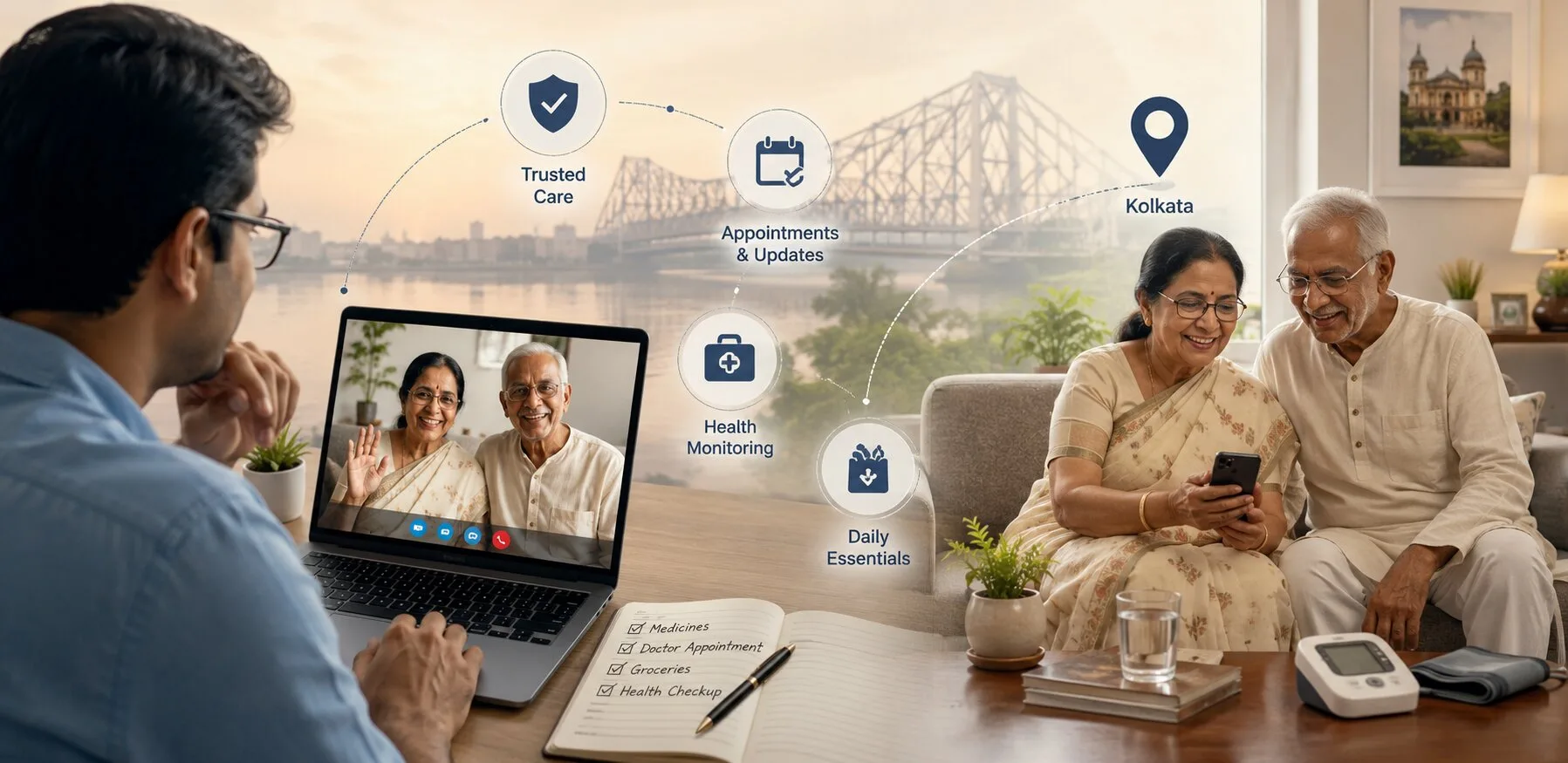
It usually starts with a 2 a.m. phone call, or worse, a missed one. An adult child living in London or Dubai calls their elderly mother in South Kolkata to check in, the call rings out twice, and for the next twenty minutes every possible scenario runs through their head before she finally picks up — she was just in the bathroom. That twenty minutes of dread is becoming a familiar experience for a growing number of NRI families, and it's exactly why coordinating elderly parent care in Kolkata from abroad has turned into one of the most searched, most anxious questions on expat forums and Q&A sites today.
Why this question is getting harder to answer from abroad
In short: more Kolkata families now have their primary caregivers living overseas, and the usual "just hire someone locally" advice doesn't address the coordination gap that actually causes stress.
Search any expat forum for "elderly parent care India" and the pattern repeats: someone posting from abroad, describing a parent who's still independent but slowing down, asking how to arrange medical support without being physically present to manage it. The advice that comes back is often surprisingly casual — "you don't need a nurse, just ask a neighbour" — which misses the actual problem. It was never about finding someone. It's about finding someone reliable, medically trained, and answerable to a family that's seven or ten time zones away and can't verify anything in person.
Cost data backs up how real this shift is. Recent guidance for NRI families planning elder care in Kolkata put a qualified home nurse on a 12-hour shift at roughly ₹22,000 to ₹38,000 a month, with full-time live-in care running higher still — numbers that only make sense to budget for once a family accepts this isn't a short-term arrangement. It's an ongoing system that has to work without them in the room.
What actually breaks down when care is coordinated from another time zone
In short: three specific failure points show up again and again — delayed emergency response, no way to verify a caregiver's quality, and losing track of care the moment a parent leaves the hospital.
The emergency lag
When something goes wrong at 6 p.m. in Kolkata, it's often the middle of the night somewhere else. A fall, a spike in blood pressure, a bad reaction to medication — the family finds out hours later, after the moment where fast decisions actually mattered has already passed. Local, on-call medical support that doesn't need a family member's sign-off to act is the only real fix here, not a longer WhatsApp check-in schedule.
The verification gap
Hiring an attendant through a classified ad or a neighbour's referral is common in Kolkata, and it can work fine — until a family six thousand kilometres away has no way to confirm training, background checks, or even that the person shows up consistently. Trust becomes something you're told about, not something you can see.
The discharge cliff
This is the one nobody warns families about. A parent gets admitted, treated, and discharged — and the moment they're back home is exactly when structured care usually disappears, replaced by whatever the family can improvise. Research on family caregivers of hospitalized older adults in Kolkata found that the transition period around admission and discharge was consistently the most practically difficult and poorly supported part of the entire caregiving experience — and that's for caregivers who were physically present. For a family managing it from abroad, the discharge cliff is even steeper.
What does "long-distance elder care coordination" actually mean in Kolkata?
Long-distance elder care coordination means setting up a local system — nursing visits, a care coordinator, or a caregiver on call — that can act on a parent's behalf without waiting for permission from family overseas every time something comes up. It's different from simply hiring an attendant, because it includes a communication loop back to the family: updates after visits, a clear escalation path for emergencies, and someone locally accountable if care quality slips.
In practice, this looks like scheduled nursing visits for check-ups, wound care, or medication management, paired with a point of contact the family can reach directly rather than relaying everything through the parent themselves. Kolkata's growing home nursing sector has expanded specifically to meet this kind of demand, offering hourly visits for vitals monitoring, injections, and wound dressing rather than requiring a full-time live-in hire for every family.
The hospital-to-home gap nobody warns you about
In short: the days right after a hospital discharge are when a parent is most vulnerable and least likely to have any structured support, especially if the family managing it is abroad.
A hospital discharge summary is not a care plan. It tells you what happened, not what to do next week when a wound needs redressing or a medication schedule needs adjusting and there's no nurse booked to check on either. Families abroad often only find out something's gone wrong when a parent mentions it in passing on a call, days after it started.
This is where structured post-surgery and post-discharge home care makes the difference — someone trained showing up on a schedule, not waiting to be called. In South Kolkata specifically, Medilink's post-surgery care service is built around exactly this handoff: picking up care the moment a patient leaves the hospital, so recovery doesn't depend on a family member noticing a problem from thousands of miles away.
Building a care plan that works when you can't be there
Not every family needs 24/7 support from day one. A parent who's largely independent but has one chronic condition to monitor needs something very different from a parent recovering from a stroke or managing advanced dementia. The mismatch — either underestimating what's needed or over-hiring out of anxiety — is where most long-distance care plans go wrong.
A workable structure usually has three layers:
· Routine medical support — scheduled nursing visits for vitals, medication management, and chronic condition monitoring, so problems get caught early instead of at the next family video call.
· A local point of contact — someone the family can reach directly for updates and emergencies, rather than relying on a parent to accurately report their own condition.
· Flexible escalation — the ability to scale up quickly to full-time or 24/7 live-in care if a parent's condition changes, without starting the search for a provider from scratch during a crisis.
Families juggling this from abroad, or siblings sharing the load with someone local, also lean on respite care arrangements — built specifically for situations where the primary support system is stretched thin across distance or time, giving a break to whichever family member is carrying the coordination weight locally.
Is remote coordination different from just hiring a local caregiver?
Yes — the caregiver is only one piece of it. Hiring a single attendant solves for day-to-day help, but it doesn't solve for verification, emergency response, or what happens during a hospital transition. Coordination means the caregiver, a nursing care provider for medical needs, and a communication system back to the family are all working together, so no single point of failure — one missed call, one unavailable attendant — leaves a parent unsupported.
For families managing this from a different country, the honest answer is that a single hire rarely holds up under real pressure. A structured service with a clinical backbone, not just a person showing up to help, is what actually closes the gap distance creates.
Where this leaves families managing care from abroad
The 2 a.m. phone calls and the anxious forum posts aren't going away — more Indian families than ever have adult children living overseas while parents age in place at home. What's changing is the option available to them: structured, locally accountable home healthcare that doesn't require a family member to be in the room to work properly.
If there's one thing worth doing before the next emergency, it's this — build the coordination system before you need it, not during a crisis. For families with parents in South Kolkata, exploring a local home healthcare provider that already understands the discharge-to-recovery gap, and can be reached directly rather than through a relay of phone calls, is worth doing while everyone involved still has the time to plan calmly.
Author bio: This article is contributed by the care team at Medilink Healthcare Services, a home and healthcare provider serving families across Joka, Behala, Thakurpukur, New Alipore, and Tollygunge in South Kolkata. The team works with local and NRI families to coordinate nursing care, post-surgery recovery, and respite support for aging parents living independently at home. Learn more at medilinkhealthcareservices.com.