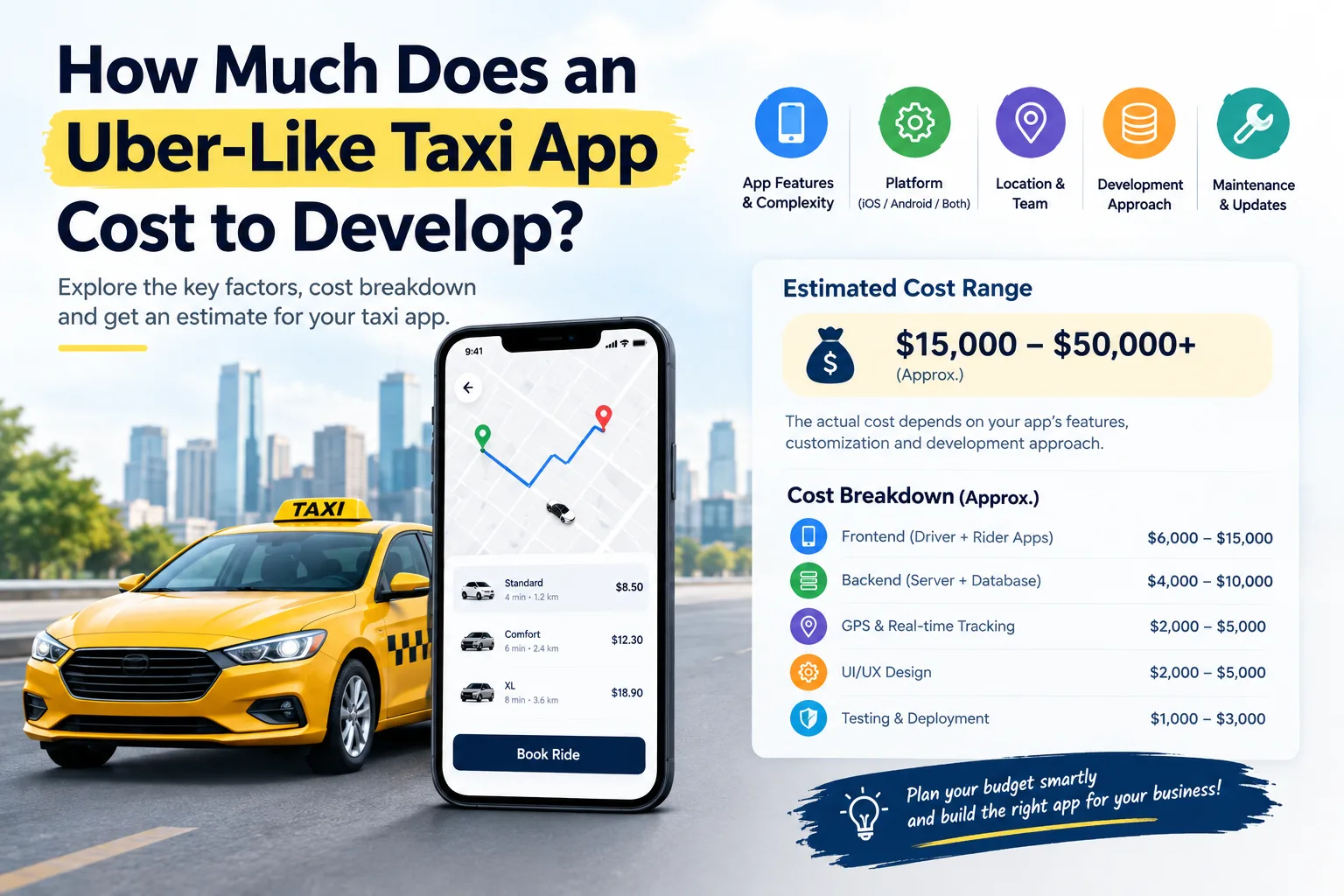
An Uber-like taxi app is not just a passenger mobile application. It is a complete technology platform connecting riders, drivers, administrators, payments, maps, notifications, and real-time trip management.
For businesses considering taxi app development services, the cost can vary significantly depending on the product scope, target market, technology choices, customization, and development approach.
A basic taxi booking MVP may require a relatively modest investment, while a multi-city platform with advanced dispatch, fleet management, AI-powered pricing, corporate accounts, and sophisticated analytics can require substantially more.
The important question is not simply, “How much does a taxi app cost?” It is what exactly are you building, and what will it take to operate it reliably?
What Is the Average Cost of an Uber-Like Taxi App?
A practical way to estimate development investment is to divide taxi apps into three broad categories:
App TypeApproximate Development RangeBasic MVP$20,000–$40,000Mid-Level Custom App$40,000–$80,000Advanced Multi-Feature Platform$80,000–$150,000+These are indicative development ranges, not fixed market prices. Actual quotations can differ considerably depending on the development team's location, technology stack, feature requirements, integrations, UI/UX complexity, testing scope, and post-launch support.
An MVP might include passenger and driver apps, basic booking, GPS tracking, payments, notifications, ratings, and an admin panel.
An advanced platform could add corporate accounts, scheduled rides, multiple vehicle categories, sophisticated dispatch, dynamic pricing, subscriptions, loyalty programs, fleet management, AI capabilities, and multi-city support.
Why Does Uber-Like App Development Cost So Much?
The biggest reason is that an Uber-like platform is actually several connected systems.
A typical solution includes:
- Passenger application
- Driver application
- Admin dashboard
- Backend infrastructure
- Database
- Dispatch system
- Payment processing
- GPS and mapping
- Push notifications
- Customer support
- Analytics
Each component has its own development and testing requirements.
For example, real-time driver tracking requires location services, backend processing, map integration, and a reliable communication layer. Payment processing requires secure integration and testing for successful, failed, refunded, and cancelled transactions.
The complexity increases further when these systems need to work together at scale.
How Much Do Passenger and Driver Apps Cost?
An Uber-like platform normally requires at least two mobile experiences.
Passenger App
Typical features include:
- Registration and login
- Pickup and destination selection
- Fare estimation
- Vehicle selection
- Ride booking
- Driver details
- Live tracking
- In-app communication
- Payments
- Ride history
- Ratings and reviews
- Cancellation
- Receipts
- Customer support
Driver App
Drivers may need:
- Registration
- Document verification
- Online/offline status
- Trip requests
- Ride acceptance
- Navigation
- Passenger information
- Earnings
- Trip history
- Ratings
- Support
Developing both apps increases cost compared with building a simple single-user application because each has different workflows and permissions.
Which Features Have the Biggest Impact on Cost?
Some features require substantially more engineering than others.
Real-Time GPS Tracking
The system must continuously process driver locations and display relevant information to passengers.
Driver Matching
The dispatch engine needs to identify suitable drivers based on location, availability, vehicle type, distance, and business rules.
Dynamic Pricing
If fares change according to demand, supply, traffic, or other conditions, the platform needs a pricing engine and appropriate controls.
Multiple Payment Methods
Supporting cards, wallets, cash, local payment systems, refunds, and transaction records increases integration and testing requirements.
Scheduled Rides
Advance bookings require additional scheduling, notification, driver allocation, and cancellation logic.
Corporate Accounts
Business customers may require employee profiles, approval workflows, invoices, expense reports, and centralized billing.
The more specialized the workflow, the greater the development effort.
Can Third-Party Integrations Increase Development Costs?
Yes.
An Uber-like taxi app commonly depends on external services such as:
- Mapping APIs
- Geolocation services
- Payment gateways
- SMS providers
- Email services
- Push notification platforms
- Identity verification
- Analytics tools
- Customer support systems
Some providers charge based on usage, so these are not always one-time development expenses.
For example, a platform operating 100,000 monthly trips may generate significantly more map and location API usage than a new service handling 5,000 trips.
These recurring costs should be included in the business plan.
How Does Location Affect Development Cost?
The development team's location can influence pricing, but it should not be the only factor used to select a partner.
Rates vary across regions because of differences in labor costs, specialization, project complexity, and agency structure.
Instead of comparing hourly rates alone, compare the complete proposal:
- Features included
- Development methodology
- Technology stack
- UI/UX design
- Testing
- Project management
- Deployment
- Source-code ownership
- Documentation
- Maintenance
- Support
A cheaper initial quote can become more expensive if important features, testing, documentation, or post-launch support are excluded.
When Should You Choose an MVP?
An MVP can be useful when you want to validate the business model before committing to a larger platform.
A practical first version might include:
Passenger booking → Driver matching → Live trip → Payment → Rating
You could initially launch in one city and support a limited number of vehicle categories.
Once the platform generates real usage data, you can prioritize features based on actual demand.
For example, if customers frequently request scheduled airport rides, scheduled booking can become a high-priority second-phase feature. If corporate customers become an important revenue source, business accounts can be added later.
This approach can reduce initial development risk.
Should You Buy Taxi App Source Code or Build Custom?
This depends on your requirements.
A ready-made taxi app source code can provide common features more quickly and may reduce initial development effort. It can work well for businesses with standard taxi workflows.
Custom development is more suitable when the platform requires unique pricing, dispatch, fleet, corporate, subscription, or integration requirements.
Before choosing, compare:
- Initial cost
- Customization requirements
- Source-code ownership
- Licensing
- Scalability
- Maintenance
- Security
- Third-party dependencies
- Long-term development needs
A source-code solution that requires extensive rewriting may not provide the savings expected at the beginning.
What Does an Admin Panel Add to the Cost?
The admin dashboard is sometimes underestimated.
For a serious taxi business, administrators need visibility into the entire operation.
Common tools include:
- Driver management
- Passenger management
- Booking management
- Pricing controls
- Payment management
- Driver document verification
- Promotions
- Complaints
- Reports
- Analytics
- Service areas
- Notifications
Advanced dashboards may also include demand heatmaps, driver performance, revenue reports, fraud alerts, and fleet management.
The more control the business requires, the more complex the administration system becomes.
Which Technology Choices Affect Cost?
Technology decisions can influence both initial development and future maintenance.
Factors include:
- Native versus cross-platform mobile development
- Backend framework
- Database technology
- Cloud infrastructure
- API architecture
- Real-time communication
- Security requirements
- Analytics infrastructure
There is no single technology stack that is correct for every taxi platform.
The better approach is to choose technology according to expected traffic, development requirements, available expertise, integration needs, and long-term scalability.
How Much Should You Budget for Maintenance?
Development is only the beginning.
After launch, businesses may need ongoing spending for:
- Bug fixes
- Security updates
- Operating system compatibility
- Server infrastructure
- API usage
- Monitoring
- Technical support
- New features
- Performance optimization
A growing platform also needs regular updates as business requirements change.
When evaluating taxi app development services, ask for a clear distinction between initial development costs and ongoing maintenance costs.
How Can a Taxi App Development Company Control Costs?
An experienced taxi app development company can help control costs by prioritizing features instead of simply adding everything to the first release.
A sensible roadmap could be:
Phase 1: Core booking, driver app, passenger app, payments, GPS, admin panel.
Phase 2: Scheduled rides, promotions, corporate accounts, advanced analytics.
Phase 3: AI-powered pricing, demand forecasting, loyalty programs, multi-city optimization, and advanced fleet tools.
This phased approach allows the business to invest as the platform proves its market potential.
Final Thoughts
The cost of building an Uber-like platform through taxi app development services depends on what you want the product to accomplish.
A basic MVP can focus on the essential booking cycle, while a full-scale platform may require advanced dispatch, real-time infrastructure, multiple payment options, fleet management, corporate features, analytics, and AI.
Before selecting a development partner, create a detailed feature list, separate essential features from future additions, understand third-party and infrastructure costs, and ask for a transparent breakdown of development and maintenance expenses.
The cheapest taxi app is not necessarily the most economical business solution. The better financial decision is to build a reliable first version with a clear path toward the scale and features your business actually needs.