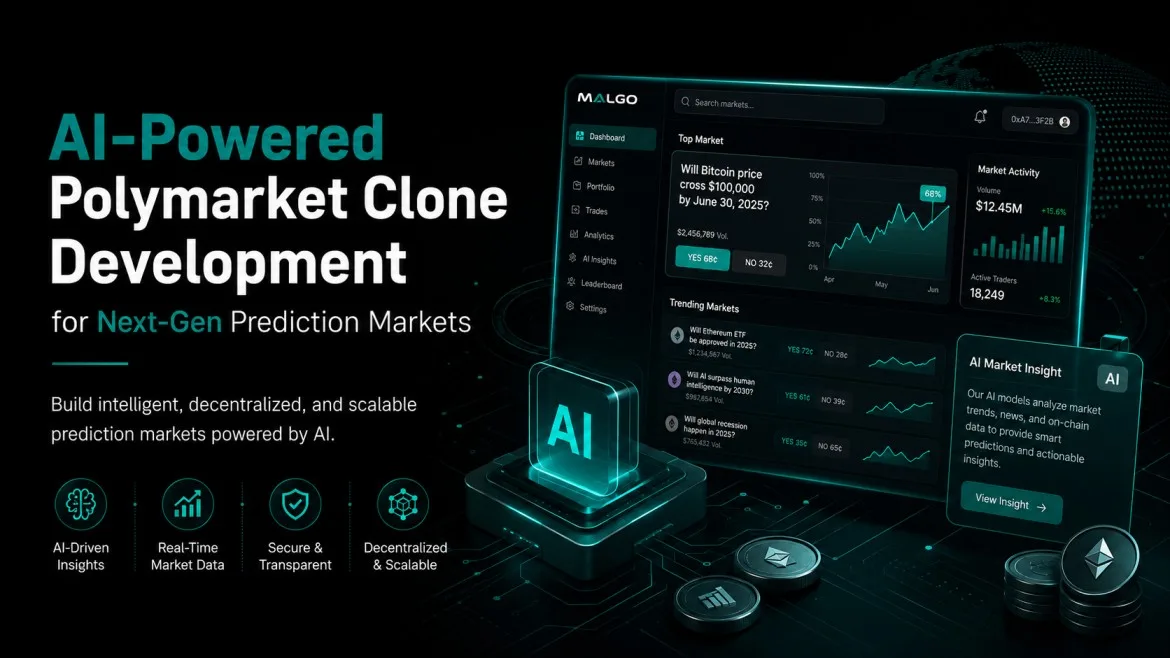
Prediction markets have evolved far beyond simple websites where users select an outcome and wait for a result. Modern platforms combine real-time trading infrastructure, blockchain technology, smart contracts, digital wallets, market data, and automated settlement into one connected ecosystem.
For businesses exploring Polymarket clone development, understanding this underlying architecture is essential. A successful prediction market is not simply a clone of an existing interface. The real challenge lies in designing a platform that can handle continuous trading, represent event probabilities accurately, protect user funds, resolve markets fairly, and remain reliable when thousands of users interact with it simultaneously.
At the heart of the model is a straightforward idea: users trade positions based on the possible outcomes of future events. As demand changes, the market price changes, giving participants a continuously updated indication of collective expectations. Polymarket, for example, describes prediction-market prices as representing the market's current probability estimate, with prices driven by supply and demand rather than being fixed by the platform.
The technology required to make that experience work, however, is considerably more sophisticated.
The Core Architecture Behind a Prediction Market
A modern prediction market platform generally follows a layered architecture rather than relying on one single application.
The major components typically include:
- User application layer
- Market discovery and information layer
- Trading engine or order book
- Wallet and asset management
- Blockchain and smart contracts
- Oracle and market-resolution system
- Risk and compliance infrastructure
- Administrative and monitoring tools
- Data analytics and notification services
Each layer has a specific responsibility, but they must work together with very little friction.
A user might see only a simple “Yes” or “No” trading interface. Behind that interaction, the platform may be validating an order, checking available balances, matching the trade, recording transaction data, updating the market probability, and preparing the position for eventual settlement.
That is why prediction market development should be approached as financial infrastructure development rather than ordinary website development.
1. Market Creation Comes First
Every prediction market begins with a clearly defined event.
A platform needs a structured way to create markets with information such as:
- Market title
- Description
- Possible outcomes
- Opening and closing dates
- Resolution conditions
- Official resolution source
- Trading status
- Category and tags
- Market-specific rules
- Dispute procedures
This part is often underestimated.
A poorly written market question can create ambiguity when the underlying event occurs. Modern platforms therefore need clearly documented resolution rules that explain what constitutes a winning outcome and which source has authority when the result is unclear.
Polymarket's current documentation similarly emphasizes that market rules define the resolution source, end date, and treatment of edge cases.
For a new prediction market platform, these rules should be treated as part of the product architecture—not merely content entered by an administrator.
2. The Trading Engine Powers Real-Time Markets
The trading engine is one of the most technically demanding parts of the platform.
Instead of simply recording that someone selected an outcome, a modern prediction market can operate more like an exchange. Users submit buy and sell orders, while the system determines when compatible orders can be matched.
A central limit order book (CLOB) is one common approach. It maintains available bids and asks and continuously matches compatible orders.
For example, imagine a market asking:
“Will Event X happen before December 31?”
One trader may be willing to buy YES at a particular probability, while another may be willing to sell at a different level. When compatible orders meet, the trading engine executes the transaction and updates the relevant market data.
This architecture makes liquidity and execution speed extremely important.
A production-grade trading engine generally needs:
- Order creation and cancellation
- Limit-order management
- Matching logic
- Order prioritization
- Trade execution
- Balance verification
- Position tracking
- Market status validation
- Transaction history
- Real-time order-book updates
The displayed probability can then be derived from current market activity. Polymarket's documentation notes that its displayed prices can be based on the midpoint of the bid-ask spread, with specific handling for wider spreads.
3. Blockchain Adds Verifiable Settlement
Blockchain technology can provide an important layer of transparency and settlement for prediction markets.
Instead of keeping every element inside a conventional database, the platform can use smart contracts to manage selected financial operations, including collateral, outcome positions, redemption, and settlement.
The exact blockchain architecture depends on the product strategy. Developers may evaluate factors such as:
- Transaction throughput
- Confirmation speed
- Network reliability
- Smart-contract ecosystem
- Wallet compatibility
- Developer tooling
- Liquidity availability
- User experience
- Regulatory considerations
The objective is not simply to choose the most popular blockchain. The network should support the platform's actual trading and settlement requirements.
4. Smart Contracts Manage Critical Market Logic
Smart contracts form the programmable settlement layer of a blockchain-based prediction market.
Depending on the architecture, contracts may handle functions such as:
- Accepting collateral
- Creating outcome positions
- Managing market states
- Recording settlement conditions
- Redeeming winning positions
- Preventing unauthorized withdrawals
- Handling disputed outcomes
The contract logic needs to be extremely precise because financial assets may depend on its execution.
A common development mistake is to focus heavily on the trading interface while treating smart contracts as a secondary component. The opposite approach is safer: contract logic, access controls, failure scenarios, and upgrade mechanisms should be considered during the earliest architecture discussions.
Security testing and independent contract review are particularly important before production deployment.
5. Oracles Connect Real-World Events With Blockchain Logic
Blockchains cannot inherently determine whether an off-chain event has occurred.
For example, a smart contract cannot independently know who won an election, whether a sports match ended with a particular score, or whether a company released a specific announcement.
That is where an oracle becomes necessary.
Ethereum's developer documentation describes oracles as systems that make off-chain information available to blockchain applications, including information required by on-chain prediction markets.
A prediction market therefore needs a carefully designed resolution mechanism.
The workflow can look like this:
Real-world event → trusted data source → oracle → verification/dispute process → smart contract → settlement
This is one of the most important parts of the entire platform because even a perfectly executed trade becomes problematic if the final outcome is resolved incorrectly.
Polymarket's current documentation, for example, identifies the UMA Optimistic Oracle as its market-resolution mechanism.
6. Market Resolution Needs More Than a “Winner”
Resolution is not always as simple as checking whether an outcome is true or false.
Real-world events can produce:
- Delayed results
- Conflicting reports
- Cancellations
- Postponements
- Changes in official data
- Unexpected edge cases
- Ambiguous wording
- Disputed outcomes
A robust platform should therefore define resolution logic before trading begins.
The resolution module can include:
- Designated authoritative sources
- Resolution timestamps
- Proposed outcomes
- Challenge periods
- Dispute handling
- Admin escalation
- Final settlement
- Audit trails
This gives users a transparent understanding of how their positions will ultimately be handled.
7. Wallets and Account Infrastructure
Prediction market users need a straightforward way to manage their positions and assets.
Depending on the platform model, this can involve:
- External Web3 wallets
- Embedded wallets
- Social or email-based onboarding
- Wallet connection providers
- Asset deposits
- Withdrawals
- Transaction history
- Position management
- Portfolio tracking
The best user experience hides unnecessary blockchain complexity without compromising transparency.
A user should be able to understand what they own, what they have committed to a market, what is available for trading, and what happens after resolution.
8. The Front End Is More Than a Trading Screen
The user interface is where complex infrastructure becomes understandable.
A modern prediction market interface usually includes:
Market discovery
Users should be able to browse markets by categories such as politics, sports, technology, finance, crypto, culture, or current events.
Market detail pages
Each market page should provide the question, outcomes, probability indicators, rules, resolution source, trading activity, and relevant supporting information.
Trading interface
The trading screen should make order placement intuitive while clearly communicating price, position size, potential outcome, and execution status.
Portfolio dashboard
Users need a consolidated view of open positions, resolved markets, available balances, transaction history, and performance.
Real-time updates
Probability changes, executed trades, order-book movements, and market-status changes should appear without requiring users to repeatedly refresh the page.
This is where WebSocket-based communication, event streaming, caching, and efficient frontend state management become valuable.
9. Data Infrastructure Keeps the Platform Responsive
A prediction market generates a significant amount of constantly changing data.
The backend may need to process:
- Market updates
- Orders
- Trades
- User positions
- Blockchain events
- Price changes
- Volume statistics
- Resolution events
- Notifications
- Analytics
A scalable architecture commonly separates transactional operations from analytics workloads.
For example, the core database can handle user and trading records while dedicated services process historical market data, charts, rankings, notifications, and reporting.
This separation becomes increasingly important as the number of markets and trading events grows.
10. Security Has to Be Designed Into Every Layer
Prediction markets handle valuable positions and sensitive account information, so security cannot be added at the end of development.
A serious platform should consider:
- Smart-contract vulnerabilities
- Wallet security
- Authentication
- Authorization
- API abuse
- Rate limiting
- Front-running and market manipulation risks
- Data integrity
- Withdrawal protection
- Infrastructure monitoring
- Private-key management
- Database security
- DDoS protection
Smart-contract security deserves particular attention because blockchain transactions can be difficult or impossible to reverse once finalized.
The platform should also maintain comprehensive logs so suspicious activity and unexpected market behavior can be investigated.
11. Compliance Is Part of the Architecture
Prediction markets operate in a regulatory environment that can differ substantially depending on jurisdiction, product structure, market category, and user location.
That means compliance should not be treated as a checkbox added immediately before launch.
Depending on the operating model and applicable jurisdiction, platform architecture may need to accommodate:
- User verification
- Geographic restrictions
- Transaction monitoring
- Risk controls
- Responsible-use mechanisms
- Restricted-market rules
- Record keeping
- Regulatory reporting
- Terms and disclosures
The technical implementation should be developed alongside qualified legal and compliance professionals rather than assuming that one jurisdiction's framework applies everywhere.
12. Admin Infrastructure Controls the Entire Ecosystem
Behind the public-facing platform is an administrative system responsible for managing markets and monitoring activity.
A comprehensive admin dashboard can include:
- Market creation and editing
- Market approval
- Resolution management
- User management
- Transaction monitoring
- Liquidity monitoring
- Risk alerts
- Dispute handling
- Content moderation
- Category management
- Platform analytics
- System health monitoring
This layer is particularly important because prediction markets are event-driven. Administrators may need to react quickly when an event changes, a data source becomes unavailable, or a market requires clarification.
A Typical Prediction Market Technology Stack
There is no single technology stack that fits every prediction market. The final selection depends on the platform's trading model, blockchain strategy, expected traffic, security requirements, and regulatory framework.
A modern architecture may include:
LayerTypical TechnologiesFrontendReact, Next.js, TypeScriptBackendNode.js, Python, GoDatabasePostgreSQLCacheRedisReal-time communicationWebSocketsBlockchainEVM-compatible networks or another suitable chainSmart contractsSolidity or chain-specific languageWalletsWeb3 wallet infrastructureOracleOracle/attestation infrastructureAPIsREST and WebSocket APIsInfrastructureCloud-native deployment, containers, monitoringSecurityEncryption, access controls, audit toolingThe important point is not choosing technologies because they are popular. The architecture should be selected around reliability, security, maintainability, and the expected trading workload.
How a Prediction Market Trade Travels Through the System
It helps to visualize the entire process from the user's perspective.
Step 1: A user opens a market.
Step 2: The platform retrieves current market data and displays available outcomes.
Step 3: The user submits a buy or sell order.
Step 4: The backend validates the request, account status, market status, and available balance.
Step 5: The trading engine searches for a compatible order.
Step 6: Once matched, the transaction is recorded and the user's position is updated.
Step 7: Relevant blockchain transactions or settlement operations are processed according to the platform's architecture.
Step 8: Real-time services update the order book, probability indicators, portfolio, and activity feed.
Step 9: When the underlying event is complete, the resolution mechanism determines the official outcome.
Step 10: The settlement layer finalizes winning and losing positions according to the market rules.
This sequence shows why a prediction market cannot be built effectively by focusing only on the visible trading page.
What Makes a Modern Prediction Market Different?
The strongest platforms bring several disciplines together:
Trading technology provides fast and reliable execution.
Blockchain infrastructure provides programmable settlement and transparency.
Oracle technology connects on-chain contracts with real-world events.
Data engineering keeps market information accurate and responsive.
Security engineering protects assets and prevents manipulation.
Product design makes complex financial interactions understandable.
Compliance architecture helps the platform operate within its intended legal framework.
The competitive advantage often comes from how well these components work together rather than from any single feature.
Building a Prediction Market for the Long Term
A prediction market should be designed with future expansion in mind.
The initial platform may support binary markets, but the architecture should leave room for multi-outcome markets, additional categories, new settlement mechanisms, advanced trading tools, mobile applications, analytics, and third-party integrations.
Likewise, market creation should be structured rather than hard-coded. Resolution rules should be configurable. Trading services should be independently scalable. Blockchain interactions should be separated from the presentation layer.
This modular approach makes the platform easier to improve without rebuilding its foundation every time a new feature is introduced.
Final Thoughts
Modern prediction market platforms are built at the intersection of trading systems, blockchain infrastructure, data engineering, and event-resolution technology.
The visible product may look simple: a question, several outcomes, a probability, and a trading button. Behind that interface sits an interconnected system responsible for order matching, asset management, real-time data, smart-contract execution, oracle verification, market resolution, security, and compliance.
For businesses entering this sector, the right development strategy is therefore not to reproduce another platform screen by screen. It is to understand the mechanics that make the prediction-market model work and then build an architecture capable of delivering those mechanics reliably.
That is the foundation for creating a prediction market platform that can earn user trust, support active markets, and adapt as the industry evolves.
I can also turn this into a full SEO landing page with a meta title, meta description, H1–H3 structure, FAQ schema-ready questions, semantic keywords, and a stronger commercial-intent section while keeping the same natural writing style.