
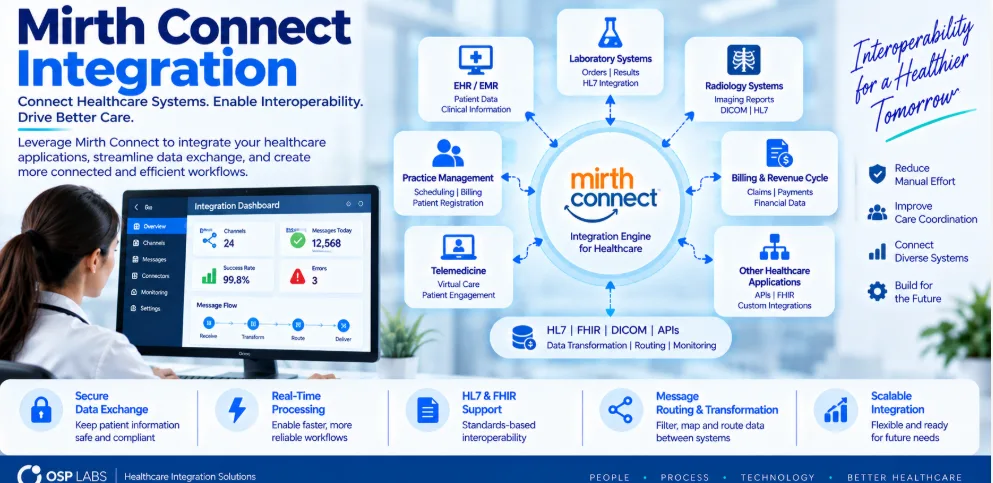
Healthcare organizations rely on multiple systems to manage patient records, laboratory results, radiology information, billing, clinical documentation, and other operational data. When these systems cannot communicate effectively, healthcare teams may face duplicate data entry, disconnected workflows, and delays in accessing important information. Mirth Connect integration services help healthcare organizations connect these systems and create more efficient data-exchange workflows.
Connecting Diverse Healthcare Systems
Mirth Connect is a healthcare-focused integration and interoperability platform that can connect systems such as EHRs, EMRs, laboratory information systems, radiology systems, and billing platforms. It can act as middleware between applications, allowing healthcare information to be transformed, routed, and exchanged between different systems.
This connectivity can help organizations reduce point-to-point integration complexity while creating a more centralized approach to managing healthcare data flows.
Transforming Healthcare Data
Different healthcare applications may use different formats and structures. Data transformation is therefore an important part of healthcare interoperability.
Mirth Connect development services can support data mapping and transformation between formats and standards. For example, healthcare data can be transformed to support HL7, FHIR, and other required formats. Filtering can also be applied according to message type, source, destination, or content.
This helps organizations establish consistent data flows between applications that were not originally designed to communicate with one another.
Routing Messages Between Systems
Healthcare information needs to reach the correct destination reliably. A Mirth Connect integration engine can use channel-based workflows to filter, transform, and route messages based on predefined rules.
For example, laboratory results can be routed to an EHR, while specific clinical messages can be sent to another authorized application. Bidirectional HL7 messaging can also support communication between connected healthcare systems.
Supporting Real-Time Healthcare Workflows
Healthcare teams often need information to move quickly between systems. Mirth Connect can be embedded within integration architectures to support real-time processing and data synchronization.
Message monitoring and tracking capabilities can help organizations identify delivery problems, monitor connections, and reprocess messages when necessary. Dashboards can also provide visibility into channel and interface activity.
Improving Integration Scalability
As healthcare organizations add applications and services, managing individual point-to-point connections can become increasingly complex. A centralized integration layer can help simplify this environment.
Custom Mirth Connect solutions can be designed around an organization's specific integration requirements, including custom connectors, APIs, message filtering, transformation, monitoring, and error handling. This allows organizations to build integration workflows that can evolve alongside their healthcare technology environment.
Supporting Secure Healthcare Data Exchange
Healthcare integration involves sensitive patient information, making security an essential consideration. Integration architectures can incorporate access controls, encryption, authentication, auditing, and other safeguards appropriate to the organization's requirements.
Mirth Connect can also support healthcare interoperability standards and secure data exchange workflows, helping organizations establish controlled connections between clinical and administrative systems.
Ultimately, Mirth Connect integration services can help healthcare organizations connect diverse systems, automate data movement, improve interoperability, and create more reliable digital healthcare workflows.