Microsoft’s IQ method brings together different kinds of intelligence. It uses enterprise data, existing AI models, regular job tasks, and outside signals. Instead of leaving each input separate, it connects them. That way, AI tools and agents have more useful context while they work.
Things change once companies move beyond simple AI chat tools. After that, they use agents that can handle more than one type of input. These agents should pull meaning from separate places, not just one feed. They can also take on daily tasks that connect back to work linked to business goals.
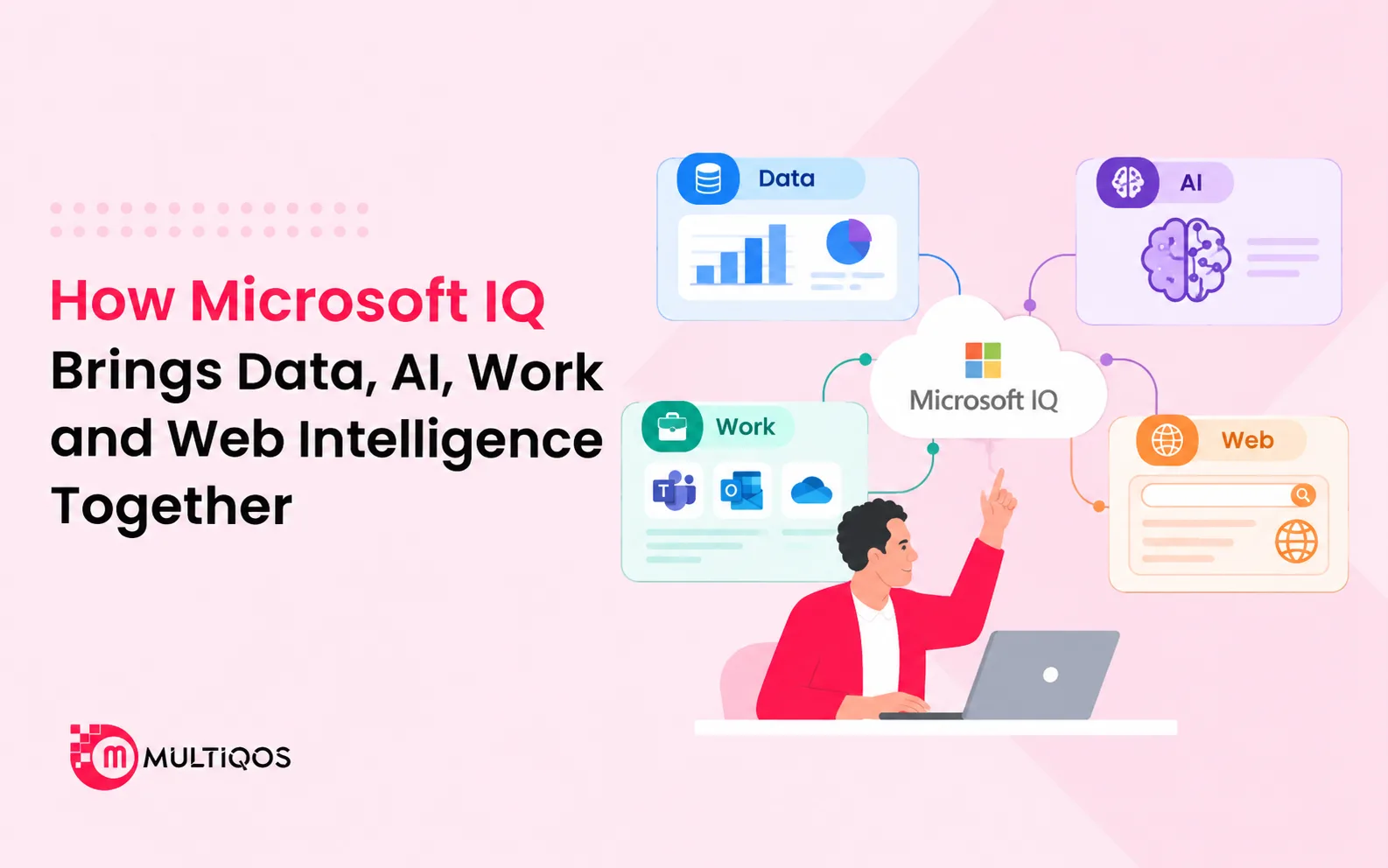
Microsoft IQ brings together four key intelligence layers: Fabric IQ, Foundry IQ, Work IQ, and Web IQ. Each layer focuses on a different form of information and intelligence.
- Fabric IQ focuses on enterprise data,
- Foundry IQ connects AI agents with relevant knowledge,
- Work IQ adds workplace context,
- Web IQ brings external information into the picture
Together, these layers can provide a broader foundation for connected enterprise intelligence.
What Is Microsoft IQ?
Microsoft IQ works like a connected intelligence model. It brings together many kinds of business data and outside signals. It links company records, AI features, help from the workplace, daily work signals, and web information. This helps give smarter apps more useful context.
How Microsoft IQ Connects Different Sources of Intelligence
Microsoft IQ connects different intelligence layers that address specific information needs within and outside an organization. Fabric IQ focuses on enterprise data, Foundry IQ supports AI agents and relevant knowledge, Work IQ provides workplace context, and Web IQ brings external information into the picture. When these sources are connected, AI systems can work with a broader range of information rather than depending on one source. This creates a more complete context for business analysis and intelligent workflows.
The Role of Data, AI, Applications, People, and External Information
A connected intelligence environment depends on several elements working together. Business records hold the facts, AI helps with thinking and back and forth interaction, Software runs the tasks that move work forward, People add what they learn in daily efforts.
Extra details give more background on the market, the competitors, and the wider industry, plus how things can shift over time.Bringing these elements together can help organizations create AI experiences that are more relevant to real business situations.
The Four Intelligence Layers Behind Microsoft IQ

- Fabric IQ: Works with company data. It helps teams link data from separate systems and different analysis tools. It builds a base layer for reporting, analytics, and AI-driven features.
- Foundry IQ: connects AI agents to useful business facts and context . It provides the context agents need to generate useful responses and support intelligent business workflows.
- Work IQ; focuses on how people and organizations work, including workplace knowledge, collaboration, activities, and workflows. It provides AI with additional context about how work happens across an organization.
- Web IQ: brings relevant information from the web and external sources into AI experiences. It adds broader context around markets, industries, competitors, and changing external conditions.
Understanding the Four Intelligence Layers of Microsoft IQ
Fabric IQ: Turning Enterprise Data Into Intelligence

- What Is Fabric IQ? : Fabric IQ is built to add intelligence to company data at scale. It links up key business information and puts it in order. Then teams can use it for reporting, deeper analysis, and AI-based product features. With that setup, leaders can make decisions based on cleaner, more useful data.
- How Fabric IQ Connects Data From Multiple Sources: Companies keep their information in many places. It may sit in databases. It can also be in apps. Some data goes to cloud services. Other items are kept in files. There are also other systems where information is stored.
- How Fabric IQ Supports Data Analysis and Business Insights: Fabric IQ helps companies look at data from connected systems. It can show patterns over time, track how well things are going, and explain what is happening in the business. When data is brought into one place, teams can see the full picture of their work. With that clarity, decisions can be made sooner and with more confidence.
- How Fabric IQ Uses Enterprise Data With AI: An AI system can give better matches when it uses reliable business data. Fabric IQ provides a data foundation that allows AI experiences to work with enterprise data for analysis and insights. This helps organizations apply AI to real business scenarios and information.
Foundry IQ: Giving AI Agents Access to Relevant Knowledge

- What Is Foundry IQ?: Foundry IQ focuses on connecting AI agents with the knowledge and information required for business tasks. It helps provide agents with relevant organizational context rather than relying only on general AI capabilities. This enables more useful and business-focused AI experiences.
- How Foundry IQ Connects AI Agents to Business Data: AI agents need access to relevant business information to understand specific requests and situations. Foundry IQ helps connect agents with appropriate business data and knowledge sources. This allows agents to work with organizational context when supporting different business scenarios.
- How Foundry IQ Enables Contextual AI Responses: AI responses become more useful when they are based on information relevant to the organization and the task. Foundry IQ helps provide agents with the context needed to understand business questions more effectively. This can result in answers that match what the business needs more closely.
- How Foundry IQ Supports Intelligent Business Agents: Foundry IQ can be used to build AI agents for tasks like customer support. It can also help with research work, You can use it for keeping and sharing knowledge, It can even assist with daily operations. With access to relevant information, agents can better understand requests and support multi-step business workflows. This helps move AI from simple responses toward practical business assistance.
Work IQ: Understanding How People and Organizations Work

- What Is Work IQ? : Work IQ focuses on understanding workplace knowledge, activities, and organizational workflows. It provides context around how people collaborate, communicate, and complete everyday work. This can help AI systems better understand the human and organizational side of business operations.
- How Work IQ Understands Employee Workflows: Employees generate valuable information through meetings, communication, documents, tasks, and collaboration. Work IQ helps provide context from these workplace activities to understand how work happens across an organization. This can make organizational knowledge more useful for AI-powered experiences.
- How Work IQ Supports AI-Powered Workplace Assistance: Workplace context can help AI assistants provide more relevant support to employees. Work IQ can help connect employees with information related to their work, tasks, and organizational knowledge. This can make activities such as finding information, summarizing work, and completing tasks more efficient.
- How Work IQ Helps Improve Employee Productivity: Employees often spend considerable time searching for information and navigating different workplace systems. Work IQ can help AI provide relevant information and assistance within the context of their work. This can reduce information-related friction and allow employees to focus on higher-value activities.
Web IQ: Bringing External and Real-Time Information Into AI
- What Is Web IQ? : Web IQ focuses on bringing information from the broader web and external sources into AI experiences. Internal business data provides important organizational context, but it may not capture changing markets, industries, competitors, or external events. Web IQ helps add this broader perspective.
- How Web IQ Provides Real-Time Information for AI: External information can change quickly, making current context important for many business decisions. Web IQ can help AI experiences work with relevant web-based information when internal data alone is insufficient. This can provide a more current view of external developments and changing business conditions.
- How Web IQ Supports Web Research and Business Insights: Businesses frequently need external information for market research, competitor analysis, industry research, and strategic planning. Web IQ can bring relevant web information into these intelligence workflows. Combined with internal data, this can help organizations develop a broader understanding of business opportunities and challenges.
- How Web IQ Helps Businesses Make Better Decisions With Broader Context: Internal information explains what is happening within an organization, while external information can explain what is happening around it. Web IQ helps bring these perspectives together to create broader context. This can support more informed analysis and decision-making in changing business environments.
How Fabric IQ, Foundry IQ, Work IQ and Web IQ Work Together
The value of Microsoft IQ comes from combining different types of context rather than using each intelligence layer independently. Together, these layers can help AI systems understand business situations more completely.
- From Enterprise Data to AI Reasoning : Fabric IQ provides structured business context, including enterprise data and analytical information. Foundry IQ can help AI agents retrieve relevant knowledge and use that information as part of their reasoning. This creates a path from business information toward more contextual AI responses.
- Connecting Organizational Knowledge With Workplace Context: Business knowledge exists beyond databases and structured systems. Work IQ adds context from workplace activities and collaboration, while Foundry IQ can help agents access relevant organizational knowledge. Together, these capabilities can help AI understand both available information and how people work.
- Adding External Web Intelligence to Internal Information: Internal business information may not provide enough context for questions involving markets, competitors, industry developments, or current events. Web IQ can add external information, allowing AI experiences to consider developments outside the organization alongside internal knowledge.
- Creating a More Complete Context for AI Agents: AI agents become more useful when they can work across multiple forms of information. Enterprise data can explain business performance, workplace context can explain how work happens, organizational knowledge can provide expertise, and web information can add external perspective.
Microsoft IQ and AI Agents: From Information to Action
- How Connected Intelligence Supports AI Agents: AI agents should be able to reach the right data. When they do, they can help with real work inside a company. Microsoft IQ links different kinds of intelligence. Then agents can use data from the business, what teams already know, what is happening in the workplace, and outside sources too.
- Agents That Can Understand Context, Reason Over Information, and Take Action: Connected intelligence can help agents move beyond simply retrieving information. With access to relevant context, agents can interpret a request, identify useful information, reason across sources, and support the next step in a business process.
- Combining Enterprise Data, Workplace Knowledge, AI Capabilities, and Web Information: Different intelligence sources can contribute different pieces of a business question. Enterprise data provides measurable facts, workplace knowledge provides organizational context, AI supports reasoning, and web information adds external perspective. Combining these inputs can produce more complete responses.
Business Use Cases for Microsoft IQ

- Intelligent Business Reporting and Decision-Making: Microsoft IQ links business data to the wider company picture. That helps people who make decisions use reports and insights more effectively.
- AI-Powered Knowledge Discovery: AI agents can pull up the right company knowledge and show it in the moment. This cuts down the time people waste looking through scattered sources.
- Employee Productivity and Workplace Assistance: Workplace intelligence helps an AI assistant get the setting around each employee and what they are doing. With that context, the assistant can find useful information, create brief updates on work, answer questions inside the company, and use what the organization already knows. This can also cut down on repeated jobs that involve looking up the same kinds of details.
- Financial and Operational Analysis: Companies can bring their enterprise data together with AI. Then they can look at how money and operations are doing. AI agents can spot trends. They can also pull up details that support those trends. After that, they can add context for the business numbers, like those used in finance checks and planning for operations.
- Research and Market Intelligence: Research often requires both internal and external information. Microsoft IQ can bring together organizational knowledge, business data, and web information to support market research, competitor analysis, and industry monitoring.
- Enterprise AI Agents: Enterprise AI agents can use multiple intelligence layers to support specialized business tasks. Agents can work with enterprise data, organizational knowledge, workplace context, and external information to address more complex questions and workflows.
Key Benefits of a Connected Intelligence Approach
- Better Access to Business Information : Connected intelligence can make relevant information easier for employees and AI agents to discover across different systems. People do not need to hop between unrelated sources. They can use details that fit what they are trying to do.
- More Relevant and Contextual AI Responses: AI answers can be better when they use real info from a team. They should also include what is happening at work, plus any rules or background the staff already has. When that kind of detail is included, the system understands the setting more clearly. It does not have to depend only on general facts.
- Faster Decision-Making: When staff and AI tools can pull the right facts quickly, they do not waste as much time sorting and filing data by hand. That means leaders can spot useful takeaways sooner and act with less delay
- Improved Employee Productivity: Smart tools can help people find workplace facts and business details faster. That means fewer times spent looking for the same documents or copying info. When this load drops, employees can focus on thinking through problems, working with coworkers, speaking with customers, and doing other work that brings more value.
- Stronger Foundation for Enterprise AI Adoption: A linked intelligence layer can help build different AI tools and agents.Instead of building every AI experience around isolated data connections, organizations can work toward reusable context, knowledge, and governance.
What Businesses Need to Consider Before Adopting Microsoft IQ
- Data Quality and Governance: AI systems do better when the starting data is clean. A business should say clearly who owns that data. It should also decide what the main labels mean and keep the definitions consistent. Then the company needs clear checks for monitoring and review. After that, the data still must be cared for as time goes on, so it does not drift and can be trusted for day to day work.
- Security and Access Controls: As we link more data to AI, permission rules matter more for safety. These agents have to follow the access settings that already exist. They must also check that each person gets only the data they are allowed to see.
- Connecting Existing Business Systems: Many companies run more than one kind of system. They may use databases, business apps, chat and document tools, shared files, and cloud services.
- AI Readiness and Organizational Maturity: AI use that works is not just about tools. Companies also need clean data they can trust. They should set clear steps for how work will run. They must build the right technical skills and get teams in place. Those teams need to know where AI fits in daily tasks.
Conclusion: Building a More Connected Intelligent Enterprise
Microsoft IQ reflects a shift toward connecting the different forms of intelligence that exist across an organization. Fabric IQ brings enterprise data and analytics, Foundry IQ connects AI agents with relevant knowledge, Work IQ adds workplace intelligence, and Web IQ brings external information into the picture.
It is more than giving AI access to more data. If you want it to pull the right information at the right time, you still have to set clear boundaries. You also need real safety rules, not vague promises. When companies link their own files, the staff can explain how the system should work. They can also say who is doing what. In addition, they can name which AI apps are allowed. They can point to outside sources that have been checked before. With that in place, the output often matches what is going on at the moment.
When a company stops at basic dashboards and then adds AI agents and smoother workflows, connected intelligence can become a key piece of the whole plan. It tends to work better when the team fixes messy data, sorts its know how, and connects the right systems. Clear limits also help. When each step in the process stays in sync, the AI can be useful in day to day work.