How Many Base Camps Does Everest Have?
Key Takeaways
- Everest has two main base camps: South Base Camp in Nepal and North Base Camp in Tibet.
- South Base Camp is higher, at about 5,364 meters, and is the classic destination for the Everest Base Camp Trek.
- North Base Camp is around 5,150 meters and can be reached by road from the Tibetan side.
- Camp I to Camp IV are not separate base camps. They are higher camps used by climbers preparing for the summit.
- Most trekkers should choose South Base Camp if they want the classic Himalayan trekking experience.
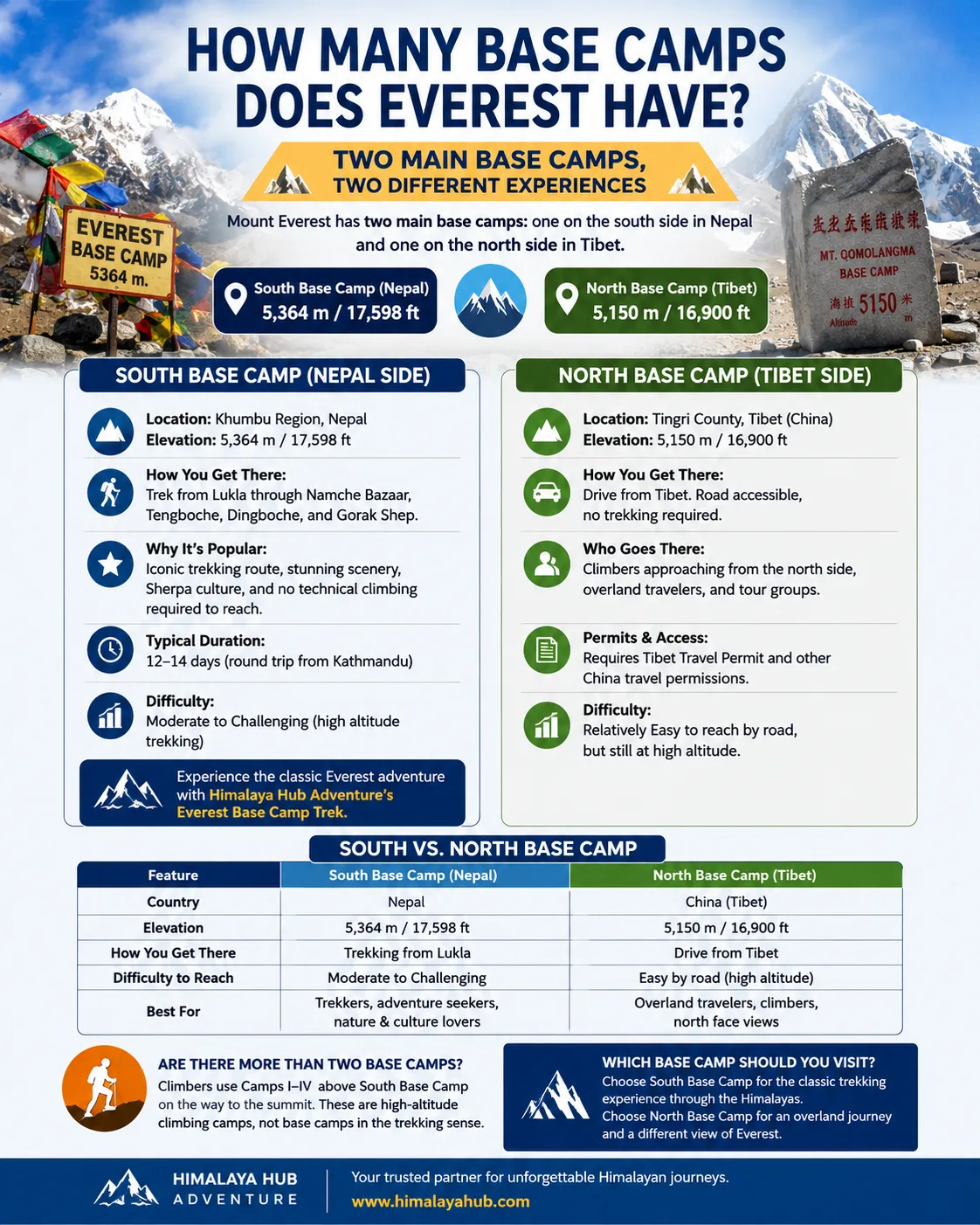
Mount Everest has two main base camps: the South Base Camp in Nepal and the North Base Camp in Tibet. The South Base Camp sits at about 5,364 meters (17,598 feet), while the North Base Camp is around 5,150 meters (16,900 feet). Both are starting points for Everest expeditions, but they offer very different experiences for travelers.
For most trekkers, the South Base Camp is the more popular choice because it can be reached on foot through Nepal's famous Everest Base Camp Trek. The North Base Camp, on the other hand, is reached from the Tibetan side and has different travel and permit requirements.
South Base Camp (Nepal Side)
The South Base Camp is the base camp most people mean when they talk about trekking to Everest Base Camp. It lies in Nepal's Khumbu region at an elevation of about 5,364 meters (17,598 feet).
The standard trekking route begins around Lukla and passes through famous mountain villages such as Namche Bazaar, Tengboche, Dingboche, and Gorak Shep before reaching Everest Base Camp.
The journey is not simply about reaching a point on a map. The trail takes trekkers through Sherpa villages, Buddhist monasteries, suspension bridges, rhododendron forests, high mountain valleys, and some of the world's most famous Himalayan scenery.
How Do You Reach South Base Camp?
A typical route follows this pattern:
Lukla → Phakding → Namche Bazaar → Tengboche → Dingboche → Lobuche → Gorak Shep → Everest Base Camp
Most trekkers spend several days on the trail so their bodies can adjust to the increasing altitude. The gradual pace is an important part of the journey because the trail climbs from the lower Khumbu region to more than 5,000 meters.
Why Is South Base Camp So Popular?
The biggest reason is accessibility for trekkers.
You do not need technical mountaineering skills to trek to South Base Camp. You need good preparation, suitable equipment, and a sensible approach to high-altitude trekking, but you are not climbing Everest itself.
This makes the South Base Camp Trek attractive to first-time Himalayan trekkers, experienced hikers, adventure travelers, and people who want to experience Everest without attempting a summit.
The route also has a well-developed trekking network, with teahouses, guides, porters, and established trails along much of the journey.
For travelers planning their first Everest adventure, a guided Everest Base Camp Trek with Himalaya Hub Adventure can provide a structured way to experience the route while managing logistics and daily trekking plans.
How Long Does the South Base Camp Trek Take?
The exact length depends on the itinerary, acclimatization days, starting point, and whether flights or road transfers are affected by weather.
A classic Everest Base Camp itinerary generally takes around two weeks or more from Kathmandu and back. Longer itineraries allow more time for acclimatization and can include side trips or additional viewpoints.
The important point is not to choose an itinerary only because it is shorter. At high altitude, a steady pace and proper acclimatization are more important than rushing to the destination.
North Base Camp (Tibet Side)
The North Base Camp is located on the Tibetan side of Mount Everest, within China. It sits at approximately 5,150 meters (16,900 feet).
Unlike the South Base Camp, which is reached by a long trekking route from Lukla, the North Base Camp can be approached by road from the Tibetan side. This makes the physical journey to the base camp very different.
The North Base Camp also gives travelers a different perspective of Everest, including views toward the mountain's north face.
How Do You Reach North Base Camp?
Travelers approach Everest from Tibet rather than Nepal. The route involves traveling across the Tibetan Plateau before continuing toward the Everest region.
One major difference is that the North Base Camp is road-accessible, making it possible to get much closer by vehicle than on the Nepal side.
However, this does not mean that independent travel is as simple as driving there on your own. Travel to Tibet involves Chinese/Tibetan travel regulations and the required permits and arrangements. Requirements can also change, so travelers should confirm the latest rules before planning their trip.
Who Visits the North Base Camp?
The North Base Camp attracts several types of visitors:
- Travelers interested in seeing Everest from the Tibetan side
- Overland travelers exploring Tibet
- Organized tour groups
- Mountaineering teams approaching Everest from the north
For someone who wants the classic trekking experience, however, the Nepal side is usually the more natural choice.
South vs. North Base Camp , Which Is Different?
FeatureSouth Base CampNorth Base CampCountryNepalChina/TibetElevationAbout 5,364 m / 17,598 ftAbout 5,150 m / 16,900 ftAccessTrekking route from the Khumbu regionRoad access from the Tibetan sideMain approachLukla and Everest regionTibetan PlateauBest forTrekkers and climbersOverland travelers and climbersMain mountain viewEverest and surrounding Khumbu peaksEverest's north faceTravel requirementsTrekking permits and local arrangementsChinese/Tibet travel permits and organized arrangementsThe biggest difference is the type of journey. South Base Camp is a trekking adventure through the Khumbu Valley. North Base Camp is more of a high-altitude road journey across the Tibetan side.
Are There More Than Two Base Camps?
This is where Everest terminology can become confusing.
Everest has two main base camps, but climbers also establish additional camps higher on the mountain. These are usually called Camp I, Camp II, Camp III, and Camp IV on the South Col route.
They are not additional base camps in the same sense as the South and North Base Camps.
On the Nepal side, the climbing route rises from Base Camp toward several higher camps:
South Base Camp → Camp I → Camp II → Camp III → Camp IV → Summit
Camp I is located above the Khumbu Icefall. Camp II is in the Western Cwm and is often called an Advanced Base Camp. Camp III is on the Lhotse Face, while Camp IV is at the South Col and serves as the final major camp before the summit push.
These camps are part of a technical mountaineering expedition, not the normal Everest Base Camp trekking route.
So, if someone asks, "How many base camps does Mount Everest have?", the simplest and most accurate answer is two main base camps: South Base Camp and North Base Camp.
Which Everest Base Camp Should You Visit?
For most travelers, the decision comes down to the type of experience they want.
Choose South Base Camp if:
- You want a classic Himalayan trekking experience.
- You want to walk through Sherpa villages and mountain valleys.
- You want to experience the famous Everest Base Camp Trek.
- You enjoy hiking and want the journey itself to be part of the adventure.
- You want access to popular viewpoints such as Kala Patthar.
Consider North Base Camp if:
- You want to see Everest from the Tibetan side.
- You prefer an overland journey rather than a long trek.
- You are interested in the Tibetan Plateau and north face of Everest.
- You are comfortable arranging the required Tibet/China travel permits.
For first-time Everest visitors who specifically want a trekking adventure, South Base Camp is usually the better fit. The route offers much more than the final destination: the villages, monasteries, trails, valleys, and mountain views are all part of the experience.
Can You Visit Both Everest Base Camps?
Yes, it is possible to visit both sides, but it is not a simple single trek.
The two base camps are in different countries and are approached through completely different travel routes. Visiting both requires planning around border access, transportation, permits, and the rules that apply to travel in Tibet.
For most travelers, visiting one side is enough for a complete Everest experience. If you have more time and want to see the mountain from two very different perspectives, visiting both can create a much broader Himalayan journey.
Do You Need Climbing Experience to Reach South Base Camp?
No. You do not need to be an Everest climber to trek to South Base Camp.
The Everest Base Camp Trek is a high-altitude trekking route rather than a technical Everest climbing expedition. However, it is still a demanding trek because of the altitude, long walking days, changing weather, and remote mountain environment.
Good physical preparation and a well-planned itinerary are important.
How Long Does the Everest Base Camp Trek Take?
A typical Everest Base Camp Trek takes about two weeks or longer, depending on the itinerary.
The total time can change because of acclimatization days, weather, flight schedules, side trips, and the starting and ending points.
A well-designed itinerary should leave enough time for altitude adjustment rather than trying to complete the trek as quickly as possible.
Is North Base Camp Open to Tourists?
The North Base Camp area can be visited by tourists under the applicable Tibetan/Chinese travel arrangements, but access is controlled and requirements can change.
Travelers should check the latest permit, tour, and access rules before booking. Unlike a normal independent trek in Nepal, travel in Tibet generally requires organized arrangements and the appropriate permissions.
Which Base Camp Has Better Views?
There is no single answer because the views are different.
South Base Camp gives you the classic Khumbu experience, with dramatic Himalayan landscapes and the famous approach through Nepal's Everest region.
North Base Camp provides a different perspective, including views toward Everest's north face.
If your priority is the complete trekking experience, South Base Camp is usually the stronger choice. If your priority is seeing Everest from the Tibetan side, North Base Camp offers something very different.
Can You Trek From Nepal's Base Camp to Tibet's Base Camp?
No, not as a normal continuous trek.
The two base camps sit on opposite sides of Everest and are separated by an international border. A traveler cannot simply walk from South Base Camp around the mountain to North Base Camp without dealing with border, permit, route, and travel restrictions.
If you want to experience both, plan them as separate parts of a larger Nepal-and-Tibet journey.
Conclusion:
Mount Everest has two main base camps: South Base Camp in Nepal and North Base Camp in Tibet.
South Base Camp, at about 5,364 meters, is the famous destination of the Everest Base Camp Trek and is the better-known option for trekkers. North Base Camp, at about 5,150 meters, offers a different experience from the Tibetan side and can be approached by road.
The camps higher on Everest,Camp I, Camp II, Camp III, and Camp IV,should not be counted as separate base camps. They are high-altitude camps used by mountaineering teams during summit expeditions.
For travelers who want to walk through the Himalayas, experience Sherpa culture, and stand beneath the world's highest mountain, the South Base Camp route remains the classic choice.