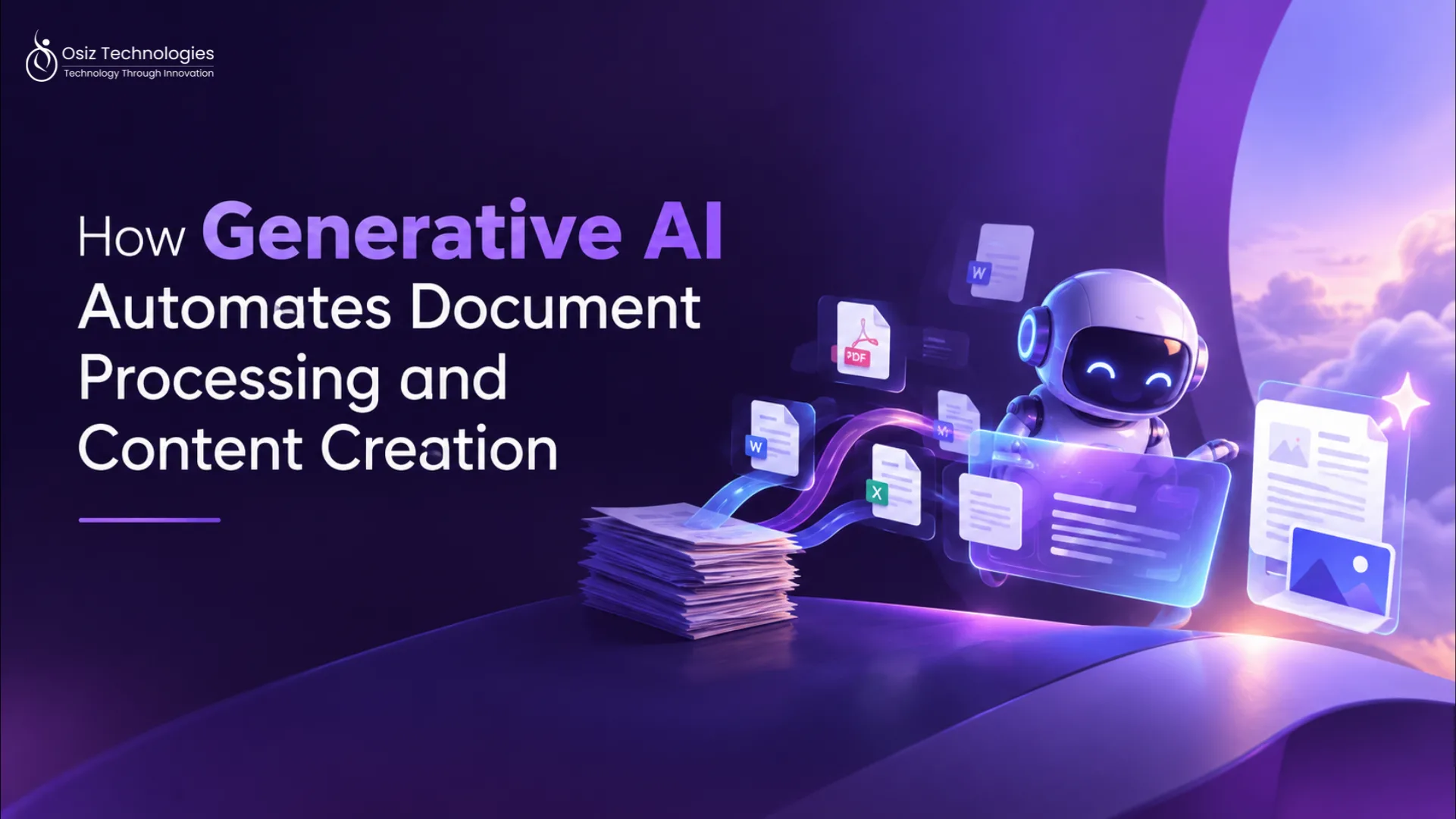
Businesses handle large volumes of documents and content, from contracts and invoices to reports, blogs, and marketing materials. Processing these materials manually can consume significant time and resources. Generative AI offers a way to automate repetitive tasks, extract useful information, summarize lengthy documents, and create content based on specific requirements. Generative AI Development enables businesses to incorporate these capabilities into their existing workflows and build applications that support document management and content production.
How Generative AI Automates Document Processing
Generative AI automates document processing by interpreting text, identifying relevant information, and generating structured outputs from different document formats. It can summarize reports, extract key details from contracts, categorize incoming files, and transform unstructured information into usable data. When connected with document management systems, databases, and business applications, AI can also transfer extracted information into existing workflows. Human review remains important for sensitive documents and decisions requiring accuracy or regulatory compliance.
Document Processing Tasks Generative AI Can Automate
Document Classification and Information Extraction
Generative AI can classify documents according to their content, purpose, or category. It can identify important fields in invoices, applications, contracts, and forms, including dates, names, amounts, and terms. Extracted information can then be organized into structured formats for further processing.
Document Summarization and Data Analysis
AI models can summarize lengthy reports, identify key points, compare information across documents, and explain complex content in simpler language. Businesses can use these capabilities to review research materials, analyze operational reports, and locate relevant information more efficiently.
Document Drafting and Transformation
Generative AI can draft documents using provided instructions and source material. It can also rewrite content, translate text, adjust tone, standardize formatting, and convert information into different document formats. These capabilities help employees prepare first drafts while retaining control over final approval.
How Generative AI Automates Content Creation
Blog Posts and Marketing Content
Generative AI can assist with blog outlines, article drafts, social media posts, email campaigns, and advertising copy. Based on a topic, audience, and tone, it can generate initial content that marketing teams refine for accuracy, originality, brand consistency, and search intent.
Product Descriptions and Business Documents
Businesses can use AI to generate product descriptions, proposals, internal reports, meeting summaries, and business correspondence. By using approved product details and organizational guidelines, AI applications can produce consistent drafts across large content collections.
Personalized Content Generation
Generative AI can adapt content to different audiences, customer preferences, and communication channels. For example, a business can create variations of a marketing email for different customer segments. Personalization should follow applicable privacy requirements and use only appropriately authorized customer information.
Technologies Behind AI-Powered Document Processing and Content Creation
Large Language Models (LLMs)
Large language models interpret prompts, understand contextual relationships, summarize information, and generate text. They can power document assistants, content generation tools, and conversational interfaces integrated with business applications.
Natural Language Processing (NLP) and OCR
Natural Language Processing supports tasks such as text classification, entity recognition, and language analysis. Optical Character Recognition (OCR) converts scanned documents and images into machine-readable text, allowing AI systems to process information that would otherwise require manual transcription.
Retrieval-Augmented Generation (RAG)
Retrieval-Augmented Generation combines information retrieval with AI-generated responses. It retrieves relevant material from approved documents or knowledge bases before generating an answer. This approach can improve relevance and ground outputs in business-specific information, although the retrieved sources and generated responses still require appropriate validation.
How Businesses Integrate Generative AI Into Document and Content Workflows
Integration With Existing Business Applications
Generative AI can connect with content management systems, CRM platforms, document repositories, and enterprise software through APIs and integration layers. This enables users to generate or process content within familiar applications.
Connecting AI With Enterprise Data Sources
AI applications can retrieve relevant information from databases, internal documents, product catalogs, and approved knowledge bases. Access permissions and data controls help ensure that the system uses appropriate information for each task.
Human Review and Workflow Automation
Businesses can configure workflows in which AI processes incoming documents, prepares drafts, or routes outputs for approval. Human reviewers can verify important details before information is published, stored, or used for consequential decisions.
Benefits and Challenges of Generative AI Automation
Generative AI can reduce repetitive work, accelerate document review, improve content production speed, and support consistent information handling. However, businesses must address inaccurate outputs, data privacy, copyright considerations, integration complexity, and inconsistent source information. Clear instructions, reliable data sources, access controls, and human validation help organizations use automation responsibly.
Why Choose Osiz Technologies for Generative AI Development?
Osiz Technologies is a Generative AI Development Company that builds AI-powered solutions for document processing, content generation, workflow automation, and enterprise application integration. Our approach focuses on business-specific requirements, relevant data sources, and practical implementation. From LLM-powered document assistants to RAG-based knowledge systems and automated content workflows, Osiz Technologies develops generative AI solutions designed to fit existing business processes.