Introduction
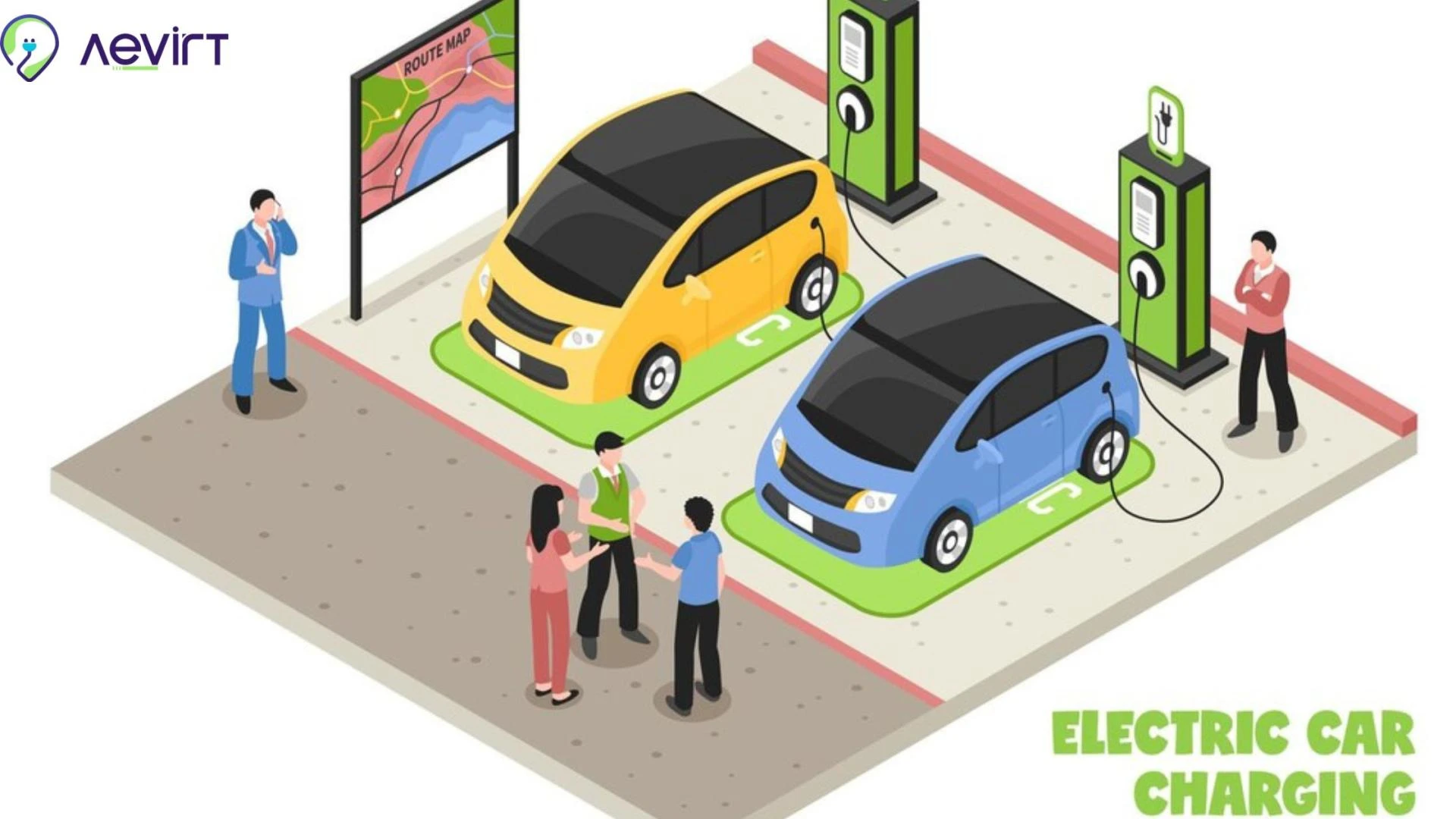
Electric vehicles (EVs) are becoming increasingly popular, leading to a rising demand for reliable EV car charging stations. Understanding how these stations function helps drivers make informed decisions about charging options. With advanced technologies, an EV charging app simplifies the charging experience by locating stations, processing payments, and monitoring charging sessions in real time.
This blog covers how EV car charging stations operate, the different charging levels, and the importance of selecting a trusted charging provider like Aevirt.
Types of EV Car Charging Stations
Not all charging stations operate at the same speed. Charging levels vary based on power output and charging time.
Level 1 Charging
- Uses a standard 120V household outlet.
- Provides approximately 2 to 5 miles of range per hour.
- Suitable for overnight home charging but not ideal for long trips.
Level 2 Charging
- Requires a 240V outlet, similar to what is used for household appliances like dryers.
- Offers 10 to 60 miles of range per hour.
- Found in homes, workplaces, and public locations.
- Compatible with an EV charging app for scheduling and monitoring.
DC Fast Charging
- Uses high-power DC chargers (typically 400V or more).
- Delivers up to 80% charge in 20-40 minutes.
- Available along highways and in commercial areas for quick refueling.
- Works best with an EV charging app to check station availability.
How EV Car Charging Stations Work
The process of charging an EV involves multiple steps:
Identifying a Charging Station
- Drivers use an EV charging app to locate nearby charging points.
- Apps provide information on station availability, charging speed, and cost.
Plugging in the Vehicle
- EV owners connect their vehicles to the charger using the appropriate cable.
- Most modern EVs communicate with the charging station to confirm a secure connection.
Power Conversion and Distribution
- EV car charging stations draw power from the grid and convert it into a suitable voltage for the EV battery.
- The vehicle’s onboard charger regulates the flow of electricity.
Monitoring the Charging Session
- Many stations integrate with an EV charging app for real-time updates.
- Users can track progress, receive notifications, and stop charging remotely.
Payment and Session Completion
- Most public stations accept payments via an EV charging app, credit card, or membership account.
- Once the session is complete, the driver disconnects the charger and continues their journey.
The Role of an EV Charging App
An EV charging app simplifies the charging experience by offering:
- Real-time Station Locator – Helps find available EV car charging stations nearby.
- Reservation Feature – Allows users to book a charging spot in advance.
- Session Monitoring – Displays charging progress and estimated completion time.
- Payment Integration – Processes payments securely through the app.
- Usage History – Provides insights into charging habits and energy consumption.
Brands like Aevirt integrate advanced technology into their EV charging app, improving accessibility and efficiency.
Key Components of EV Car Charging Stations
To function efficiently, EV car charging stations consist of several essential components:
- Power Source – Supplies electricity to the station, either from the grid or renewable energy.
- Charging Connector – Connects the EV to the charger and ensures compatibility with different vehicle types.
- Onboard Charger – Converts AC power to DC, which is stored in the EV battery.
- Control System – Manages power distribution and ensures safety protocols.
- Network Communication – Enables remote monitoring via an EV charging app for seamless user experience.
The Importance of Choosing the Right Charging Network
Selecting a reliable charging provider is crucial for EV owners. Key factors to consider include:
- Coverage Area – The network should have widespread EV car charging stations for convenient access.
- Charging Speed – Faster charging options reduce downtime.
- Compatibility – Stations should support multiple EV models.
- Reliability – A trusted network minimizes downtime and operational issues.
Aevirt: A Trusted Name in EV Charging
Aevirt is known for delivering high-quality EV car charging stations and a user-friendly EV charging app. Here’s why many EV drivers trust Aevirt:
- Extensive Charging Network – Multiple stations in key locations for easy access.
- Fast and Reliable Charging – Supports Level 2 and DC fast charging for reduced wait times.
- Advanced EV Charging App – Seamless navigation, payment processing, and real-time tracking.
- Sustainable Solutions – Commitment to renewable energy sources for eco-friendly charging.
Whether you need home charging or access to a public network, Aevirt makes EV charging more convenient.
Future of EV Car Charging Stations
The EV industry continues to advance, leading to innovations in EV car charging stations. Future trends include:
- Ultra-Fast Charging – Newer technologies will reduce charging time to under 15 minutes.
- Wireless Charging – Inductive charging pads will allow for cable-free operation.
- AI-Driven Optimization – Smart grid integration will balance power distribution efficiently.
- Wider Adoption of Renewable Energy – More stations will be powered by solar and wind energy.
Companies like Aevirt are actively investing in these advancements to improve charging infrastructure.
Conclusion
EV car charging stations are an essential part of the growing electric vehicle ecosystem. With different charging levels, smart connectivity, and the convenience of an EV charging app, EV drivers can easily charge their vehicles anytime, anywhere. Aevirt stands out as a trusted brand, offering reliable solutions and an expanding network of charging stations. As technology evolves, the future of EV charging looks promising, with faster and more efficient solutions on the horizon.
FAQs
1. How long does it take to charge an EV?
Charging time depends on the level of the charging station. Level 1 takes several hours, Level 2 takes a few hours, and DC fast chargers can charge up to 80% in 20-40 minutes.
2. Can I use any charging station for my EV?
Most EV car charging stations support standard connectors, but it’s important to check compatibility with your vehicle before charging.
3. How do I locate an EV car charging station?
An EV charging app helps find nearby stations, check availability, and process payments.
4. Is home charging better than public charging?
Home charging is convenient for daily use, while public EV car charging stations are ideal for long trips and quick refueling.
5. Why should I choose Aevirt for EV charging?
Aevirt offers a reliable network, fast charging options, and an efficient EV charging app for seamless user experience.