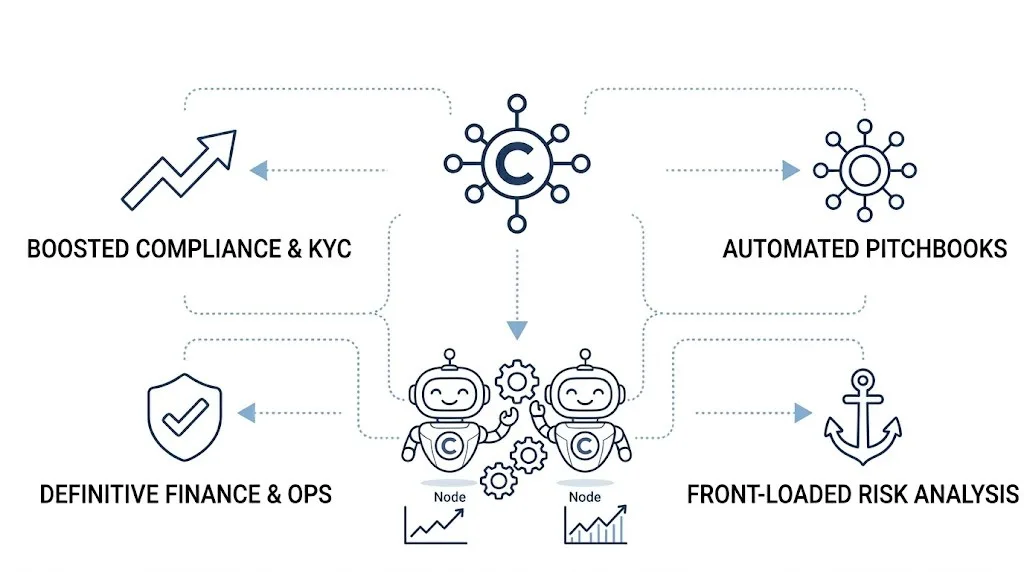
Claude Opus 4.7 currently leads the Vals AI Finance Agent benchmark at 64.37%, setting a new standard for AI in regulated industries. To leverage this, Anthropic released ten ready-to-run financial agent templates that automate tasks like pitchbook creation and KYC screening.
Engini bridges the gap between these models and the operational reality of banking. Putting Claude to work in core operations requires hands-on engineering and the governance that regulated institutions demand.
The Shift to Agentic Banking
By 2024, banking agents moved beyond simple scripts. Institutions like BNY and Goldman Sachs deployed "digital employees" capable of multi-step analysis.
Aman Mahapatra, CSO at Tribeca Softtech, notes the real challenge: integrating these models without creating permanent vendor dependencies. Unlike typical tools, Engini deploys AI Workers that execute workflows with error recovery, adding the policy-aware orchestration that regulated environments demand.
The Human Factor & "FDE" Dependency
Forward-deployed engineers (FDEs) from Anthropic embed inside teams to co-design agents. FIS listed Bank of Montreal (BMO) as an early deployer of this model.
However, Gartner analyst Alex Coqueiro predicts that 70% of enterprises will abandon agentic AI solutions by 2028 due to high costs and lack of internal skills. Engini addresses this by enabling institutions to build lasting capability rather than temporary, expensive projects.
Anthropic’s 10 Finance Templates
These templates function as Claude Managed Agents, providing long-running sessions and full audit logs.
1. Research and Client Coverage
- Pitch Builder: Creates target lists and drafts pitchbooks.
- Earnings Reviewer: Updates models from transcripts and filings.
- Market Researcher: Synthesizes broker research for credit reviews.
2. Finance and Operations
- KYC Screener: Reviews source documents for compliance.
- Month-End Closer: Runs close checklists and produces journal entries.
- Statement Auditor: Reviews financial statements for audit readiness.
Spanning the Office Suite
Claude works directly inside Microsoft Excel, PowerPoint, Word, and Outlook. The critical advantage is persistent context transfer. An analyst starting a model in Excel does not need to re-explain the work when moving to PowerPoint. Claude carries knowledge between apps, eliminating context loss across data modeling and presentation.
Human Accountability: The Final Gate
Andrew Altfest, President of Altfest Personal Wealth Management, argues that AI savings should flow into deeper client engagement, not headcount reduction.
“The line is accountability. AI can surface insights, but a human must own the decision.” — Brian Green, CPO, Merit Financial Advisors
Anthropic’s policy is firm: users stay in the loop. No agent produces client-facing output without human sign-off. Engini enforces this through policy-aware AI Workers that require human checkpoints for all sensitive outputs.
FAQ: Quick Hits
- How is compliance handled? Engini uses policy-aware AI Workers with mandatory audit trails and human-in-the-loop (HITL) gates.
- What is an FDE? A specialist who embeds in your team. Engini reduces long-term dependency on these experts.
Why are these "agents"? Unlike bots, agents reason, take multi-step actions, and adapt to changing contexts autonomously.
The Bottom Line: Organizations that invest in knowledge transfer and clear decision-rights will build lasting capability. To see how Engini’s AI Workers can deliver decision-ready output for your team, book a demo today.