Most online sellers can remember the exact moment they realised their spreadsheet had stopped working. For some it's an order they had to cancel because the item sold out on another platform ten minutes earlier. For others it's a Sunday night spent counting stock and retyping numbers into three dashboards.
It usually starts small. One product, one channel, one tidy sheet. Then you add a second marketplace, a few more SKUs, a busy sale season, and the sheet becomes a part-time job nobody applied for.
This is what inventory management software is really for. It doesn't make your business more exciting. It takes the repetitive, error-prone work off your plate so you can do the parts only you can do.
Where the time actually goes
A 2025 Marketplace Seller Trends survey by ChannelEngine, covering 470 ecommerce leaders in the US and Europe, found that sellers were active on an average of six marketplaces. Over a third sold on seven or more. The same report found teams spend about 36% of their working week, nearly two full days, on manual updates like fixing listings, updating inventory and handling returns. And 52% were still managing listings and inventory with spreadsheets or internal tools.
That lines up with what many small sellers feel. Nobody sits down to "do inventory." It is a hundred small jobs: check the count, update Shopee, update Lazada, fix the listing someone flagged, reconcile at month end.
1. One number instead of five
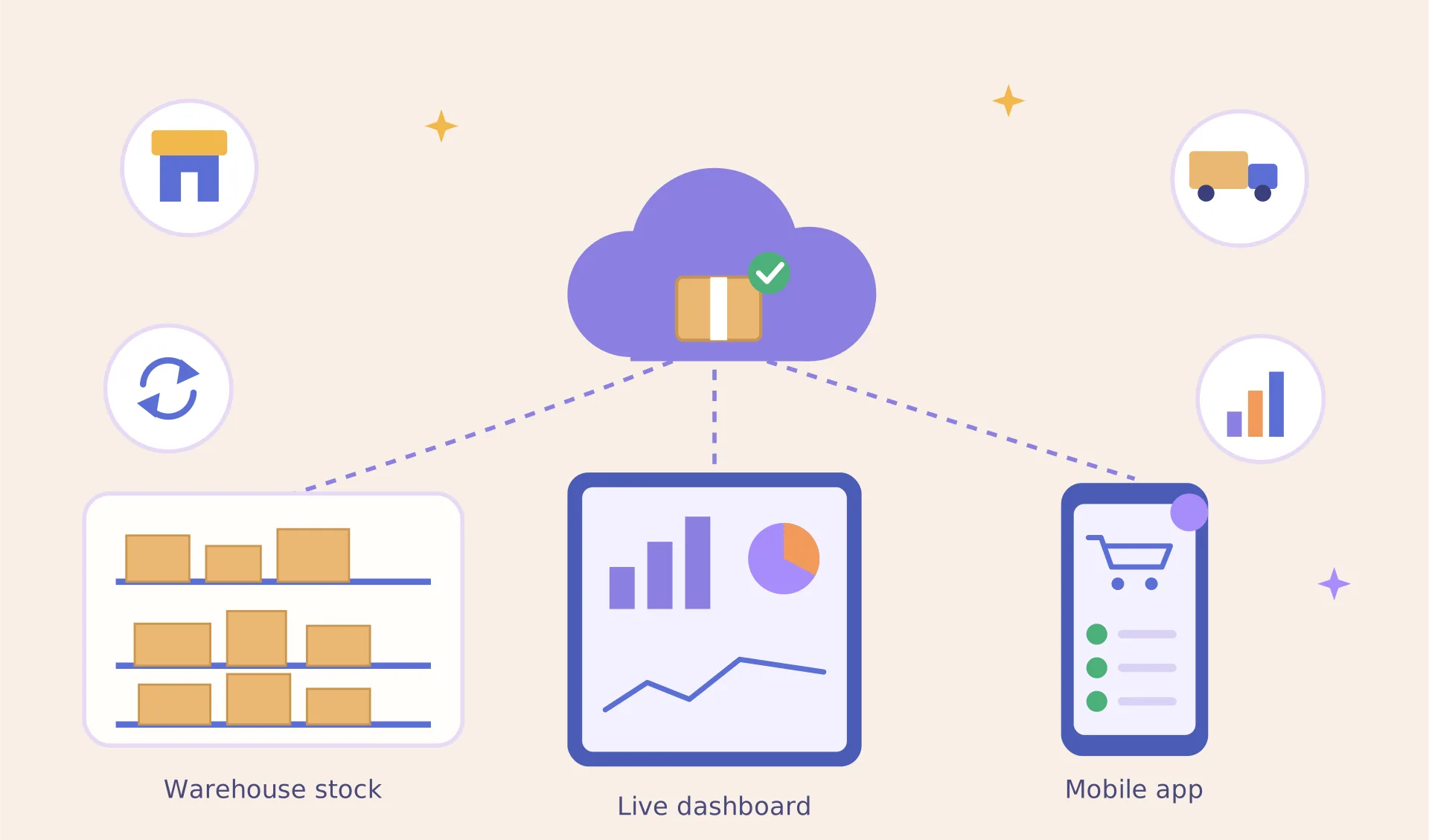
The first big saving is also the simplest. Inventory software keeps one central stock count and updates every channel from it. When a unit sells on one platform, the others change within moments, without you doing anything.
This matters more in Southeast Asia than almost anywhere. Momentum Works reported that platform ecommerce in the region reached US$157.6 billion in 2025, up 22.8% on the year, and that Shopee, Lazada and TikTok Shop, including Tokopedia, together account for about 98.8% of it. If you want to reach shoppers, you are probably on at least two of those three. That is two sets of numbers to keep honest.
2. Fewer oversells, fewer apologies
Overselling is what happens in the gap between a sale and the moment you manually update the other channels. In that gap, the same last unit gets sold twice.
The cost isn't just a refund. It is the awkward message to the customer, the hit to your shop rating, and the time spent sorting it out. A June 2025 survey of 200 small US retailers by Global Payments found that 23% only discovered an item was out of stock when a customer tried to buy it. A similar share reported permanently losing some customers after a poor stockout experience.
Automatic syncing doesn't remove every stock problem, but it shuts the most common door.
3. Counting that doesn't eat your weekend
The same Global Payments survey found that 57% of retailers still rely on manual inventory counts. Manual counting isn't wrong, but it is slow, and every typed number is a chance for a mistake.
With software, each order, return and delivery adjusts the count as it happens. You still do the occasional physical check, but you are verifying a number that is mostly right, not building one from scratch.
4. Orders in one place
Switching between platform dashboards to process orders is a quiet time drain. Pulling orders from every channel into a single list means you pick, pack and ship from one screen, and you stop hunting for a Lazada order in the middle of a TikTok Shop rush.
5. Less guessing about what to reorder
Running out of a bestseller costs sales. Overbuying costs cash. IHL Group research estimated that inventory distortion, meaning overstocks and out-of-stocks together, will cost global retail around US$1.7 trillion in 2026, equal to about 6.2% of worldwide retail sales. Out-of-stocks account for almost two-thirds of that.
Software can't predict the future, but it can show you what sells fast, what sits, and how long your stock will last at the current rate. Many tools now add demand forecasting on top of this. Even basic low-stock alerts beat finding out from an angry message.
6. It frees your money, not just your time
For most small retailers, stock is a big slice of working capital. Global Payments found 70% of the retailers it surveyed had between 20% and 60% of their business capital tied up in inventory. Better visibility helps you buy closer to what you will actually sell, which keeps more cash available for everything else.
What to look for when choosing software
Sellers sometimes pick a tool for the longest feature list and regret it. These questions matter more:
- Does it connect to the channels you actually sell on? If you sell on Shopee, Lazada and TikTok Shop, check those exact integrations, plus your own store platform.
- How fast does stock update? Real-time and "every few hours" are very different when a product is selling quickly.
- Is it easy to learn? Global Payments found cost (45%) and training time (28%) were the main reasons retailers hadn't adopted better inventory tools. If the setup is painful, your team will quietly go back to the spreadsheet.
- Can it grow with you? Look at what happens when you add a warehouse, a new marketplace or a few thousand SKUs.
- What support do you get? A real person who answers matters during a sale event.
If you want to see what this looks like in practice, the features of Syncingabout's inventory management software cover real-time inventory sync, order management and demand forecasting across the main Southeast Asian marketplaces and store platforms.
When it's not worth it yet
If you sell a handful of products on one channel and a spreadsheet takes you ten minutes a week, you probably don't need software yet. A rough rule: when you spend hours a week on updates, sell on two or more channels, or have started overselling, it is time.
A simple way to start
- Track your time for one week. Write down every minute spent on stock counts, listing updates and order entry.
- Note how many oversells or cancellations you had in the last month.
- Shortlist two or three tools that connect to your channels, and book a demo of each.
- Start with SyncingAbout one channel and your top products, then expand once you trust the numbers