
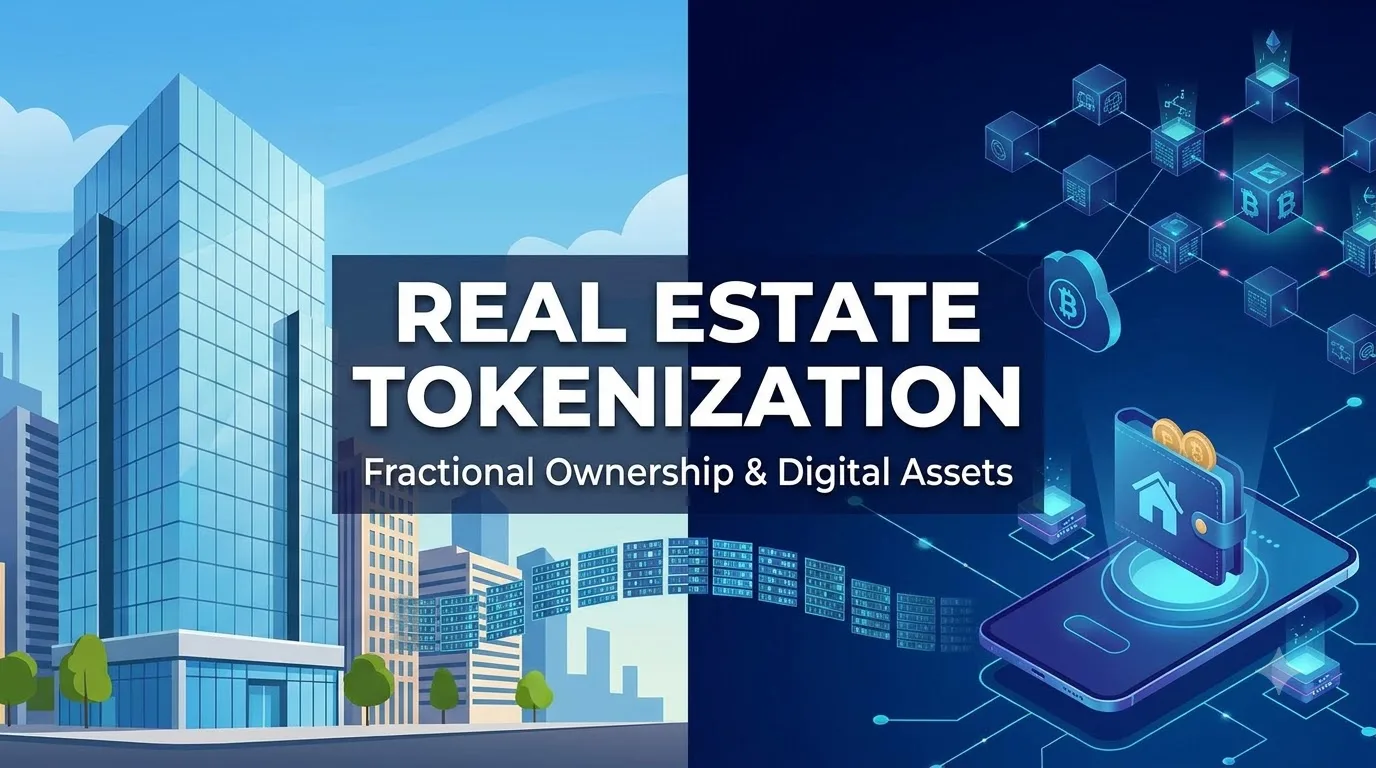
Real estate has traditionally been considered a stable and valuable investment, but entering the market often requires substantial capital, extensive paperwork, intermediaries, and long transaction cycles. Blockchain technology is introducing a different approach through real estate tokenization, a process that converts economic or ownership interests in properties into digital tokens recorded on a blockchain.
Instead of requiring investors to purchase an entire property, tokenization can divide an asset into smaller digital units, allowing eligible investors to gain fractional exposure. Deloitte estimates that the global tokenized real estate market could reach approximately $4 trillion by 2035, compared with less than $0.3 trillion in 2024.
However, real estate tokenization is not simply a matter of putting property information on a blockchain. A successful model requires legal structuring, asset verification, token design, smart contracts, investor compliance, custody, and an appropriate marketplace. Understanding how these components work together is essential for anyone exploring tokenized real estate.
What Is Real Estate Tokenization?
Real estate tokenization is the process of representing ownership rights, economic interests, debt claims, fund interests, or other legally defined interests connected to real estate through blockchain-based digital tokens.
A common structure involves placing a property or portfolio of properties into a legal entity, such as a special-purpose vehicle (SPV). The entity holds the underlying real estate, while blockchain tokens represent an economic or ownership interest in that structure. Therefore, the token does not necessarily mean that the blockchain itself becomes the property's legal deed.
This distinction is important. Research on current real-world asset systems shows that many tokenization models use a hybrid architecture in which blockchain manages token issuance, transfers, compliance controls, and related processes, while legal ownership and investor rights remain connected to off-chain legal structures.
In practical terms, imagine a commercial property valued at $10 million. Instead of finding one investor willing to purchase the entire asset, the ownership structure could potentially be divided into 100,000 digital tokens representing defined interests in the property. An investor could then purchase a smaller number of tokens, subject to the applicable legal and regulatory framework.
How Does Real Estate Tokenization Work?
Although implementation varies according to jurisdiction, asset type, and investment structure, the process generally follows several interconnected stages.
1. Selecting and Evaluating the Real Estate Asset
The process begins with identifying a suitable property or real estate portfolio. This could include residential buildings, commercial properties, hotels, warehouses, rental properties, development projects, or real estate-backed debt.
Before tokenization, the asset needs to undergo detailed due diligence. Developers and financial professionals may examine the property's title, valuation, ownership structure, existing loans, rental income, taxes, insurance, operating expenses, and legal restrictions.
This stage is critical because blockchain cannot eliminate risks associated with the underlying property. If a property is overvalued, poorly managed, or legally disputed, putting it on a blockchain does not automatically make the investment safer.
2. Establishing the Legal Ownership Structure
Once the property is selected, the next step is determining what the tokens legally represent.
One widely used approach is creating an SPV that owns the property. Investors then receive tokens representing an interest in the SPV or another legally established investment vehicle.
The legal structure should define important investor rights, including ownership or economic rights, income distribution, voting rights, redemption conditions, transfer restrictions, and procedures for selling or liquidating the underlying asset.
This is one of the most important parts of tokenization because the technological representation must correspond with enforceable legal rights.
3. Determining the Token Model
After the legal structure is established, the project team determines how many tokens will be issued and what each token represents.
For example, a $5 million property might be represented by 50,000 tokens with an initial reference value of $100 each. The actual structure could differ depending on valuation, fees, reserves, investor rights, and the type of security being offered.
Token economics may also determine how rental income, capital appreciation, voting rights, or other benefits are distributed.
The token should therefore be designed around the investment structure rather than simply created as a technical asset.
4. Choosing the Blockchain Network
The project then selects a suitable blockchain network based on factors such as transaction costs, scalability, security, ecosystem support, interoperability, compliance capabilities, and wallet compatibility.
Ethereum is one established option, but other networks can also be considered depending on project requirements. The objective is not simply to select the most popular blockchain. The network needs to support the project's expected transaction volume, investor experience, compliance model, and long-term operational requirements.
For larger institutional projects, interoperability and integration with existing financial infrastructure can be particularly important.
5. Developing and Auditing Smart Contracts
Smart contracts form the technical foundation of many tokenized real estate platforms. They can automate token issuance, ownership records, transfer rules, distributions, whitelisting, and other predefined processes.
For example, a smart contract could restrict token transfers to verified investors or automatically calculate distributions according to token balances.
Security is essential at this stage. A vulnerability in a smart contract could potentially create financial losses or disrupt token operations. Consequently, smart contract testing and independent security auditing should be treated as core parts of development rather than optional additions.
6. Conducting KYC and Investor Compliance
Tokenization does not eliminate financial regulations. Depending on the jurisdiction and structure, tokenized real estate offerings may be subject to securities, property, tax, anti-money-laundering, and investor-protection requirements.
Investors may therefore need to complete Know Your Customer (KYC) and Anti-Money Laundering (AML) checks before purchasing or transferring tokens.
Compliance rules can also be programmed into the platform. For example, a token may only be transferable between approved wallets, helping the platform enforce eligibility requirements at the transaction level.
7. Issuing the Real Estate Tokens
After the legal, financial, technical, and compliance components are prepared, the tokens can be issued.
The issuance process records the token supply on the selected blockchain and connects the tokens with the defined legal and economic rights. Investors may then purchase tokens through a compliant offering platform or marketplace.
At this stage, the platform effectively connects traditional real estate infrastructure with blockchain-based ownership and transaction systems.
8. Managing Rental Income and Other Returns
One major attraction of tokenized real estate is the potential to automate income distribution.
Suppose a tokenized apartment building generates rental income. After operating expenses and other obligations are accounted for, the eligible portion of the income can be distributed to token holders according to the terms of the investment.
Smart contracts can assist with calculating and recording these distributions, although real-world processes such as property management, banking, tax reporting, and accounting still need to operate alongside the blockchain system.
This illustrates an important principle: tokenization automates selected financial and administrative processes, but it does not replace the physical management of real estate.
9. Enabling Secondary Trading
Traditional real estate can be difficult to sell quickly because transactions often involve brokers, negotiations, financing, legal documentation, and property transfers.
Tokenization can create the possibility of secondary markets where eligible investors can trade their tokenized interests. However, tokenization alone does not guarantee liquidity.
A 2025 academic study analyzing 1.1 million blockchain transactions involving 408 tokenized properties on RealT found that secondary-market activity remained relatively limited despite the potential advantages of tokenization.
This is an important reality for investors and platform developers. A token can be technically transferable while still having few buyers. Genuine liquidity requires sufficient investor participation, regulatory compatibility, reliable valuation, market infrastructure, and demand.
Real-World Example of Tokenized Real Estate
RealT provides a practical example of how tokenized real estate can be structured. Its platform offers fractional, tokenized interests connected to U.S. properties, with individual property offerings represented through blockchain-based tokens. Its listings demonstrate how investors can gain exposure to individual properties without purchasing the entire asset directly.
The broader market is also moving toward institutional adoption. Deloitte has identified tokenized private real estate funds, tokenized real estate loans and securitizations, and tokenized development projects as important areas of future growth.
These examples demonstrate that tokenization is developing beyond the idea of simply dividing a property into digital pieces. It is increasingly being considered as infrastructure for investment distribution, asset servicing, settlement, and financial-market access.
Key Benefits of Real Estate Tokenization
The strongest value proposition of tokenization comes from combining fractional ownership with programmable digital infrastructure.
Fractional investment: Investors may be able to access smaller interests in assets that would otherwise require substantial capital.
Greater transparency: Blockchain can provide an auditable record of token transactions and ownership changes.
Operational efficiency: Smart contracts can automate selected processes such as transfers, compliance checks, and distributions.
Potentially broader investor access: Depending on local regulations, tokenized structures can make certain investment opportunities available to a wider pool of eligible investors.
Programmability: Tokenized assets can incorporate rules concerning ownership, transfers, distributions, and investor eligibility directly into their infrastructure.
Challenges and Risks to Consider
Despite its potential, real estate tokenization is not a shortcut around conventional investment risks.
Regulatory uncertainty remains one of the biggest challenges because tokenized interests can fall under different legal classifications depending on the jurisdiction and structure. Legal enforceability must also be clearly established between blockchain records and real-world ownership rights.
Liquidity is another major concern. A tokenized property may be easier to transfer technically, but that does not guarantee an active secondary market.
There are also cybersecurity risks, smart contract vulnerabilities, valuation concerns, property-management risks, custody issues, and potential technology-integration problems. Investors must evaluate the underlying property and legal structure just as carefully as the blockchain technology.
How Businesses Can Build a Real Estate Tokenization Platform
Businesses planning to enter this market typically require a platform that combines blockchain infrastructure with traditional financial and real estate systems.
A comprehensive platform may include property onboarding, asset verification, investor registration, KYC/AML integration, token issuance, wallet management, smart contracts, investment dashboards, payment processing, compliance controls, reporting, and secondary-market functionality.
Organizations seeking to build such infrastructure may work with specialized providers offering Real estate tokenization development services. For businesses requiring a complete ecosystem covering token creation, investor management, marketplace functionality, smart contracts, and blockchain integration, Real estate tokenization platform development services can provide a more comprehensive approach.
The most effective development strategy is to begin with the legal and economic model before finalizing the technical architecture. This ensures that the blockchain solution supports actual business and regulatory requirements rather than becoming technology without a clearly defined investment framework.
Conclusion
Real estate tokenization is transforming how property-related investment can be structured by combining fractional ownership, blockchain-based records, smart contracts, and digital investment platforms. From property selection and legal structuring to token issuance, compliance, income distribution, and potential secondary trading, the process requires coordination across real estate, finance, law, and technology. Although challenges such as regulation, liquidity, security, and legal enforceability remain, the growing interest from investors and financial institutions demonstrates the potential of this model. Businesses looking to enter this emerging market can work with Blockchain App Factory, which provides best real estate tokenization services and supports businesses in building secure, scalable, and feature-rich tokenization solutions tailored to their requirements.
FAQs
1. What is real estate tokenization?
Real estate tokenization is the process of representing ownership or economic interests in real estate through blockchain-based digital tokens.
2. How does real estate tokenization work?
It generally involves selecting a property, creating a legal ownership structure, designing tokens, developing smart contracts, completing compliance checks, issuing tokens, and managing investor transactions.
3. Does tokenization mean owning the physical property directly?
Not necessarily. In many models, tokens represent an interest in an SPV, fund, security, or other legal structure connected to the underlying property.
4. Is tokenized real estate more liquid?
It can potentially improve transferability and create secondary-market opportunities, but liquidity is not guaranteed. Market demand and regulatory restrictions remain important factors.
5. What are the main benefits of real estate tokenization?
Key benefits can include fractional investment, transparent blockchain records, programmable transactions, automated processes, and potentially broader access to eligible real estate investments.