
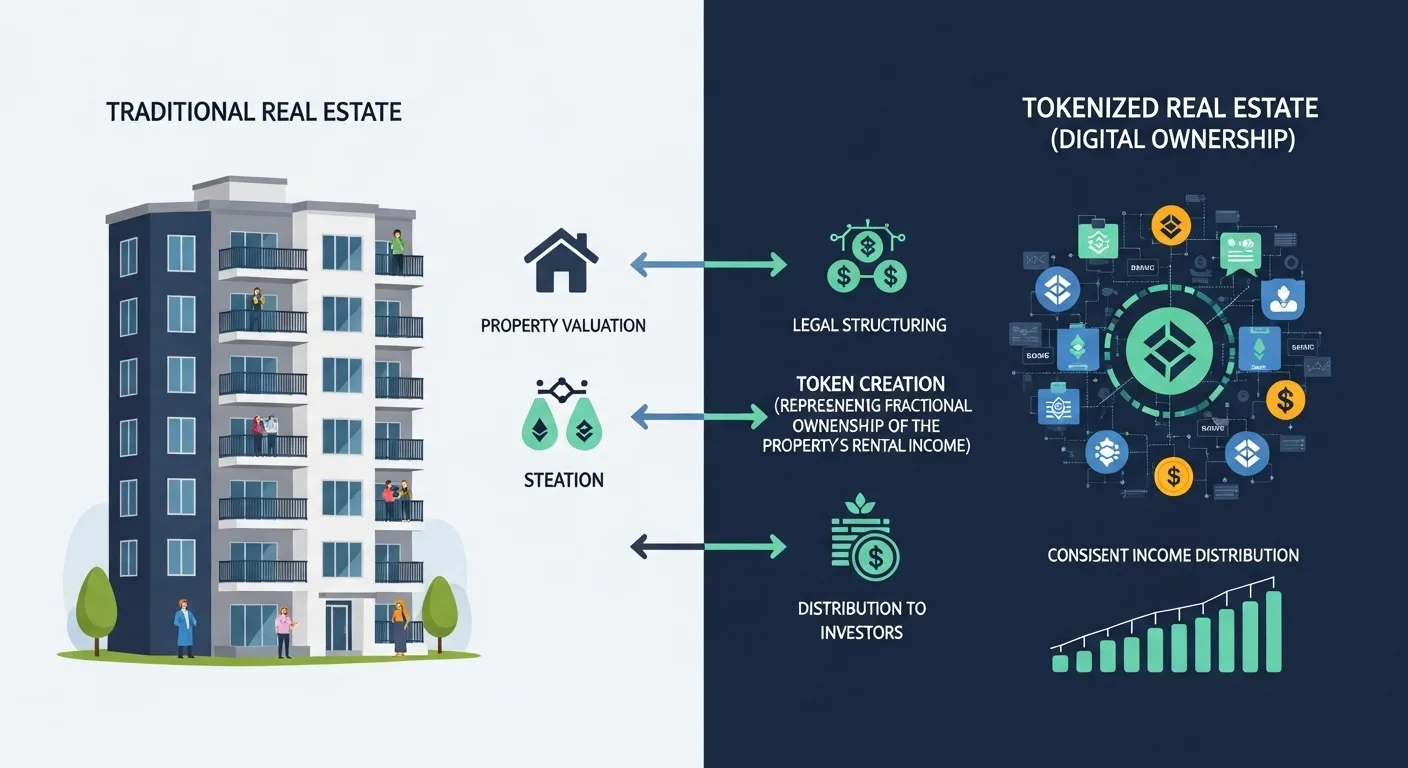
The real estate market has always been a preferred option for investors looking for steady income and long-term value. Rental income, in particular, attracts individuals who want predictable cash flow. However, traditional property investment often requires large capital, involves complex ownership structures, and limits access for smaller investors. This is where real estate asset tokenization is gaining attention in 2026 as a practical way to rethink how rental income models operate.
This blog explains how Real Estate Tokenization works within rental income structures, the methods behind it, and how businesses and investors interact with tokenized property assets.
Understanding Real Estate Asset Tokenization
Real estate asset tokenization refers to the process of converting ownership rights of a physical property into digital tokens recorded on a blockchain. Each token represents a fraction of the property, allowing multiple investors to own a share without purchasing the entire asset.
Instead of one landlord owning a rental building, ownership is divided among token holders. These token holders are entitled to a share of rental income based on the number of tokens they own.
A Real Estate Tokenization company typically manages the process from asset selection to token issuance. They also provide Real Estate Tokenization Services such as legal structuring, compliance, and platform integration.
How Rental Income Models Work in Traditional Real Estate
Before understanding tokenized models, it is useful to look at how rental income works in a traditional setup.
A property owner purchases real estate and leases it to tenants. The rent collected becomes income, which is used to cover expenses such as maintenance, taxes, and loan payments. The remaining amount is the owner’s profit.
This model has several limitations:
- High entry barriers due to capital requirements
- Limited liquidity since properties cannot be easily sold in parts
- Management responsibilities resting on a single owner or entity
These limitations are what real estate asset tokenization aims to address.
The Structure of Tokenized Rental Income Models
In a tokenized environment, rental income is distributed differently. The property is first acquired and legally structured, often under a special purpose vehicle (SPV). This entity holds ownership of the asset.
Through real estate tokenization development, digital tokens are issued to represent shares in the SPV. Investors purchase these tokens, effectively owning a portion of the property.
When tenants pay rent, the income flows into the SPV. After deducting operational expenses, the remaining amount is distributed to token holders based on their ownership percentage.
A Real Estate Tokenization Development company designs and manages this system, ensuring that the income distribution is accurate and compliant with regulations.
Step-by-Step Process of Tokenizing Rental Income
1. Property Selection and Evaluation
The process begins with identifying a suitable rental property. This could be residential apartments, commercial buildings, or mixed-use developments. The property is evaluated for rental yield, location, occupancy rates, and long-term value.
A Real Estate Tokenization company conducts due diligence to ensure the asset meets investment criteria.
2. Legal Structuring
Once the property is selected, it is placed under a legal entity such as an SPV. This entity holds the title of the property and becomes the issuer of tokens.
Legal frameworks define investor rights, income distribution rules, and governance mechanisms. Real Estate Tokenization Services often include handling regulatory approvals and compliance checks.
3. Token Creation
Through real estate tokenization development, digital tokens are created on a blockchain. Each token represents a fraction of ownership in the SPV.
For example, a property worth $1 million can be divided into 100,000 tokens, each representing a small share. Investors can buy as many tokens as they want based on their budget.
A Real Estate Tokenization Development company ensures the tokens are programmed with rules related to ownership and income distribution.
4. Investor Onboarding
Investors register on a platform and complete identity verification processes. Once approved, they can purchase tokens using fiat currency or digital assets.
Real Estate Tokenization Platform Development focuses on creating user-friendly interfaces where investors can track their holdings, earnings, and property performance.
5. Rental Income Collection
Tenants continue to pay rent as usual. The collected rent is deposited into the SPV’s account.
Operational costs such as maintenance, property management fees, and taxes are deducted. The remaining income becomes distributable profit.
6. Income Distribution
The net rental income is distributed among token holders. Payments are made periodically, such as monthly or quarterly, depending on the structure.
Smart contracts developed during real estate tokenization development handle the distribution process. They calculate each investor’s share and transfer funds accordingly.
7. Secondary Trading
One of the advantages of real estate asset tokenization is liquidity. Token holders can sell their tokens on secondary markets instead of waiting to sell the entire property.
This allows investors to exit partially or fully based on their needs.
Methods Used in Tokenized Rental Income Models
Different approaches are used depending on the property type and investment strategy.
Fractional Ownership Model
This is the most common method. Ownership is divided into tokens, and each token represents a proportional share of rental income.
Investors benefit from passive income without managing the property directly.
Income-Only Token Model
In this method, tokens represent rights to rental income rather than ownership of the property. Investors receive income distributions but do not hold direct ownership rights.
This model is sometimes used to simplify legal structures.
Hybrid Model
A hybrid approach combines ownership and income rights. Token holders receive rental income and may also benefit from property appreciation when the asset is sold.
A Real Estate Tokenization Development company often designs hybrid models to suit different investor preferences.
Role of Technology in Rental Income Distribution
Technology plays a major role in making tokenized rental income models work efficiently.
Smart Contracts
Smart contracts automate income distribution. They follow predefined rules, ensuring that payments are made accurately and on time.
Blockchain Records
All transactions, including token ownership and income payments, are recorded on a blockchain. This creates a reliable record that can be verified by participants.
Digital Platforms
Real Estate Tokenization Platform Development focuses on creating dashboards where investors can monitor their investments, view income history, and access reports.
Benefits for Investors
Tokenized rental income models offer several advantages compared to traditional real estate investment.
Lower Investment Entry
Investors can participate with smaller amounts, making real estate more accessible.
Regular Income
Rental income is distributed periodically, providing a steady income stream.
Diversification
Investors can spread their funds across multiple properties instead of investing in a single asset.
Liquidity Options
Tokens can be traded, offering flexibility that traditional real estate lacks.
Benefits for Property Owners and Developers
Tokenization is not only beneficial for investors but also for property owners.
Access to Capital
Property owners can raise funds by selling tokens instead of relying solely on loans or large investors.
Wider Investor Base
Real estate asset tokenization allows participation from global investors, increasing funding opportunities.
Efficient Fundraising
The process of issuing tokens can be faster compared to traditional financing methods.
Challenges in Tokenized Rental Models
While the concept is promising, there are challenges that need to be addressed.
Regulatory Uncertainty
Different countries have varying rules regarding digital assets and property ownership. Compliance is necessary to avoid legal issues.
Market Adoption
Although awareness is growing, many investors are still unfamiliar with tokenized real estate.
Platform Reliability
The success of tokenized models depends on the reliability of the platform. A trusted Real Estate Tokenization Development company plays a significant role here.
Property Management
Even in tokenized models, properties need to be maintained and managed efficiently to generate consistent rental income.
Use Cases of Tokenized Rental Income
Tokenized rental income models are being applied in various segments.
Residential Properties
Apartments and housing units are commonly tokenized to provide regular rental income to investors.
Commercial Real Estate
Office spaces and retail properties generate higher rental yields, attracting institutional and individual investors.
Vacation Rentals
Short-term rental properties are also being tokenized, offering income based on occupancy rates.
The Role of Service Providers
A complete tokenized rental income model involves multiple stakeholders.
- A Real Estate Tokenization company manages asset selection and token issuance
- Real Estate Tokenization Services handle compliance and legal frameworks
- A Real Estate Tokenization Development company builds the technical infrastructure
- Real Estate Tokenization Platform Development ensures user interaction and investment tracking
Each of these roles contributes to the functioning of the system.
Future Outlook in 2026
In 2026, real estate asset tokenization is gaining momentum as more platforms and investors enter the space. Rental income models are becoming more structured, with improved legal clarity and better technology integration.
As awareness grows, more property owners are considering tokenization as an alternative way to raise capital. Investors, on the other hand, are attracted by the possibility of earning rental income without owning entire properties.
Conclusion
Real estate asset tokenization introduces a different way of managing rental income by dividing property ownership into digital tokens. This approach allows multiple investors to participate in income-generating assets without large capital commitments.
Through real estate tokenization development, properties are converted into digital shares, and rental income is distributed using automated systems. A Real Estate Tokenization Development company, along with Real Estate Tokenization Services, plays an important role in setting up and maintaining these models.
While there are challenges such as regulatory concerns and market adoption, the concept continues to gain traction in 2026. For investors seeking alternative ways to earn rental income and for property owners looking for new funding methods, Real Estate Tokenization offers a structured and accessible approach.
As the ecosystem grows, Real Estate Tokenization Platform Development will continue to improve user experience and expand participation, making tokenized rental income models more practical in the years ahead.