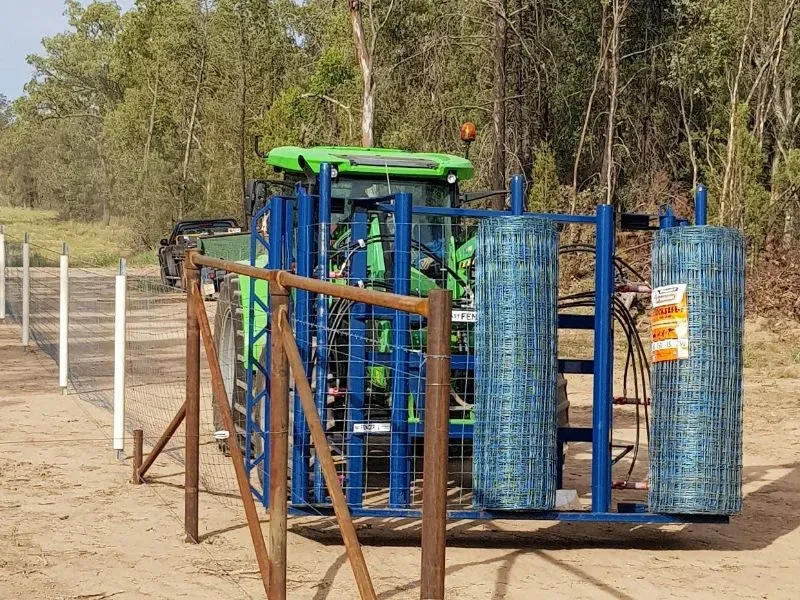
Fencing across hilly or rocky paddocks presents unique challenges for farmers and contractors. Equipment often shifts, snags, or becomes unstable when faced with slopes and uneven surfaces. The Fast Fencer addresses these issues through its base design, which maintains stability during unrolling operations on difficult terrain.
Why Uneven Ground Creates Fencing Problems
Slopes and irregular surfaces disrupt standard fencing workflows. Machines tip sideways under load, wheels catch on rocks, and netting drags across bumps, causing tears or requiring constant manual adjustments.
Common terrain challenges include:
- Side slopes that lift one side of equipment
- Rocks and ruts that halt wheel movement
- Soft patches where machines sink or slide
- Contour changes requiring frequent repositioning
Without proper base stability, these conditions slow progress and increase worker fatigue.
Engineering Principles Behind Base Stability
The Fast Fencer base uses a wide footprint to distribute weight evenly across uneven surfaces. This low center of gravity prevents tipping when carrying heavy netting rolls up to 250m long.
Key structural features work together:
- Reinforced steel frame resists bending under load
- Broad stance maintains balance on moderate slopes
- Smooth undercarriage reduces snagging on rocks
- Heavy construction provides natural anchoring
These elements ensure the machine stays planted while navigating contours.
How Wide Footprint Prevents Tipping
A Fast Fencer for sale typically spans 2.4m or more across its base, creating stability similar to heavy machinery. This width counters the torque created when loaded rolls shift during turns or slope traversal.
On side hills, the design keeps all contact points grounded. Operators can follow natural fence lines without stopping to rebalance equipment every few meters. The elevated roll carriage maintains netting clearance above rocks and ruts.
Weight Distribution Across Terrain Types
Hard Rocky Ground
Rocks create high points that lift narrow equipment. The Fast Fencer base bridges these obstacles with its extended footprint and smooth bottom plate. Weight spreads across multiple contact points rather than concentrating on single rocks.
This prevents the "see-saw" effect common with shorter wheelbases. Netting rolls remain level as the machine spans irregularities up to several inches high.
Soft or Wet Conditions
In muddy pastures, narrow equipment sinks unevenly. The broad base spreads pressure over larger surface area, preventing deep wheel ruts. Galvanised construction resists corrosion from wet conditions.
Operators report maintaining steady progress through spring conditions where lighter carriers become stuck.
Steep Contour Changes
Vertical drops challenge roll tensioning. The base design allows controlled descent while keeping rolls elevated. Hydraulic systems maintain consistent pressure regardless of terrain angle changes.
Load Handling Capacity Affects Performance
Empty Fast Fencer units weigh 500-800kg depending on model size. When loaded with multiple netting rolls, total weight reaches over 1 tonne. This mass becomes an advantage on slopes.
Heavier bases naturally resist sliding sideways. The low roll position keeps the center of gravity within the footprint boundaries. Operators can make tighter turns without stability loss.
Comparison to Traditional Fencing Methods
Manual wire rolling requires constant ground contact, snagging on every obstacle. Basic carriers with small wheels bounce across ruts, making tensioning impossible.
Forklift attachments work on flat yards but struggle with slope angles. Their high center of gravity creates tip risks when extending loaded forks.
The Fast Fencer for sale combines carrier stability with unrolling automation. No ground dragging, no manual tensioning, no constant repositioning.
Practical Terrain Navigation Techniques
Following Natural Contours
Rather than fighting terrain, operators steer with existing slope patterns. The stable base allows straight-line unrolling along hill contours without lateral drift.
Gradual steering inputs prevent sudden weight shifts. Netting tension remains consistent through minor elevation changes.
Managing Sharp Grade Changes
Steep drops require slowing to walking pace. The base design absorbs vertical impacts without bouncing rolls loose. Hydraulic clamps hold netting securely during descent.
For upward climbs, momentum carries the loaded unit over minor rises. Operators avoid digging in by maintaining forward pressure.
Sidehill Travel Limits
Most models handle 15-20 degree cross slopes safely. Beyond this, operators make short runs and reset position. The wide stance provides clear visual feedback when approaching limits.
Construction Materials and Durability
Galvanised steel construction prevents rust on exposed lower sections. Thick plate undercarriages shrug off rock impacts that would dent lighter equipment.
Welded stress points handle repeated flexing from terrain changes. Smooth edges reduce netting snags during loading operations.
Maintenance for Rough Terrain Use
Daily checks focus on:
- Hydraulic line connections after heavy vibration
- Base plate for rock dents or wear
- Wheel bearings after extended slope work
- Fork receiver alignment
Simple cleaning prevents mud buildup that affects balance. Annual weld inspections extend service life on rough properties.
Real Farm Applications Across Regions
Contractors report success across:
- Tableland properties with shallow rock layers
- River flats prone to wet seasons
- Hill country requiring contour fencing
- Cleared development sites with construction rubble
The design translates equally well across soil types and climate zones. Operators adapt techniques based on local conditions while relying on base stability.
Choosing Equipment for Your Terrain
Assess your property's worst fencing areas first. Measure steepest slopes and largest obstacles. Match Fast Fencer capacity to typical roll weights and terrain severity.
Larger models suit exclusion netting over long distances. Compact units excel in tight access areas with frequent turns.
Why Base Design Matters Most for Uneven Work
Effective fencing equipment starts with ground contact. Poor bases create problems that no other feature can compensate for. The Fast Fencer prioritises this foundation, letting operators focus on fence quality rather than machine wrestling.
QuikFence engineering reflects practical farm needs, building equipment that handles real-world terrain without constant babysitting. Farmers facing challenging ground find this stability transforms fencing from frustration to routine work.