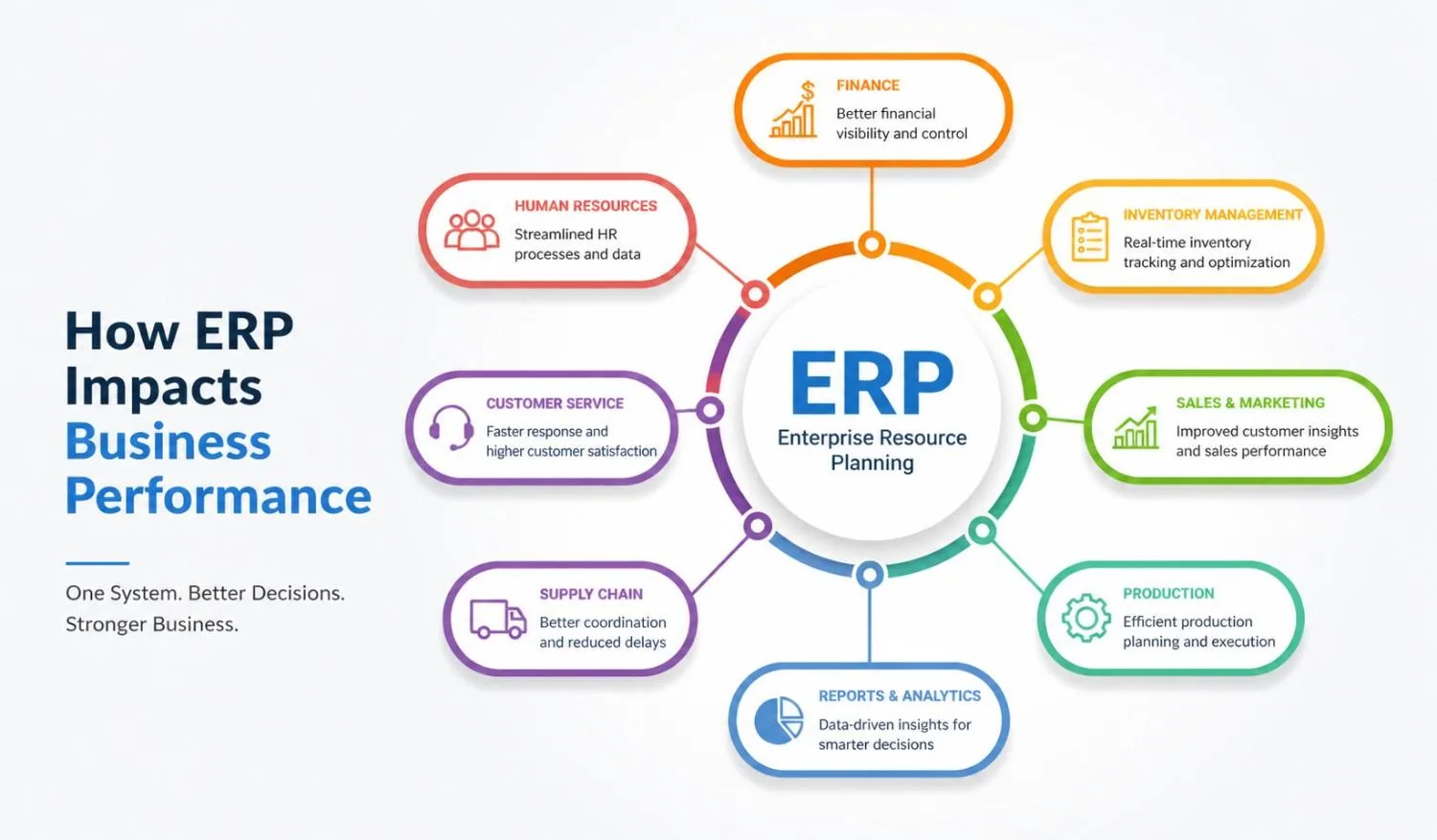
Businesses often run on a surprising mix of spreadsheets, emails, and temporary processes that somehow become permanent fixtures. We’ve all seen that one file named final_v7_revised. Performance, in such environments, feels less like a strategy and more like a gamble. This is where ERP steps in—quietly, methodically, and with a touch of order that most teams didn’t know they needed. Companies exploring ERP software development services usually start with a simple goal: bring clarity to chaos. What follows, however, is something far more impactful—measurable improvements across operations, decisions, and long-term growth.
What Is ERP and Why Should Businesses Care?
Enterprise Resource Planning (ERP) systems serve as a centralized platform that connects various business functions—finance, HR, inventory, sales, and more. Instead of juggling disconnected tools, everything operates within a unified system. The real advantage lies in visibility and coordination, where departments no longer operate in isolation. Businesses begin to notice fewer delays, better communication, and stronger alignment. ERP developers often tailor these systems to match unique workflows, ensuring relevance rather than rigidity. And here’s the interesting part—once everything is connected, performance stops being reactive and starts becoming intentional.
Centralized Data: The End of Spreadsheet Chaos
Data scattered across tools and teams creates confusion, delays, and the occasional heated debate over “which number is correct.” ERP eliminates this by establishing a single source of truth. Information flows into one centralized system, accessible in real time by authorized users. This shift alone transforms decision-making—no more guesswork, no more outdated reports. Teams spend less time verifying data and more time using it. The quiet beauty of centralized data is its simplicity; everything just… aligns. And surprisingly, those long meetings spent reconciling numbers begin to disappear (a small but meaningful victory).
Improved Operational Efficiency (a.k.a. Doing More with Less Stress)
Efficiency is often promised but rarely delivered—until automation enters the picture. ERP systems streamline repetitive tasks such as data entry, order processing, and reporting. Workflows become faster, errors decrease, and employees focus on higher-value activities. One observation stands out: businesses frequently underestimate the time lost to manual processes until ERP removes the friction. Suddenly, tasks that once took hours are completed in minutes. And yes, stress levels tend to follow the same downward trend. Efficiency, it turns out, isn’t about working harder—it’s about removing what slows everything down.
Real-Time Insights for Smarter Decisions
Decisions based on outdated data are, at best, educated guesses. ERP changes that dynamic by offering real-time dashboards and analytics. Leaders gain immediate access to performance metrics, financial data, and operational trends. This enables faster, more informed decisions—often before problems escalate. Custom dashboards, often built through ERP software development services, allow businesses to track exactly what matters most. There’s a subtle shift that happens here: decision-making becomes proactive rather than reactive. And in competitive markets, that difference is not just helpful—it’s critical.
Enhanced Collaboration Across Teams
Departments working in silos tend to create more friction than progress (sales promises, operations scrambles, finance questions everything). ERP systems break down these barriers by providing shared access to data and processes. Teams collaborate more effectively because everyone operates from the same information. Communication improves naturally—fewer emails, fewer misunderstandings, fewer surprises. Sales and inventory, for example, finally align in ways that feel almost revolutionary. It’s not magic, of course, but it often feels like it. When systems connect, people tend to follow.
Financial Management and Cost Control
Financial clarity is one of ERP’s strongest contributions to business performance. From budgeting and forecasting to expense tracking, everything becomes more structured and transparent. Businesses gain better control over cash flow and can identify unnecessary costs more easily. Automated reporting reduces errors and saves valuable time during audits or reviews. There’s also a noticeable shift in confidence—financial decisions are backed by accurate, up-to-date data. And yes, this is typically the point where finance teams start to breathe a little easier (sometimes even smile, though rarely admitted).
Customer Experience Gets a Quiet Upgrade
Customer experience rarely improves through one dramatic change—it evolves through consistent, reliable interactions. ERP supports this by ensuring accurate order processing, timely responses, and better access to customer data. Teams can respond faster and with greater precision, which customers tend to notice (even if they don’t explicitly say it). The system works behind the scenes, aligning operations to deliver smoother experiences. It’s a quiet upgrade, but a powerful one. After all, customers may not see the ERP system—but they certainly feel its impact.
Scalability: Growing Without Breaking Things
Growth is exciting—until systems struggle to keep up. ERP platforms are designed with scalability in mind, allowing businesses to expand operations without losing control. New modules, users, and functionalities can be added as needed. ERP developers play a key role here, ensuring the system evolves alongside the business rather than holding it back. There’s a certain relief in knowing that growth won’t require rebuilding everything from scratch. Instead, the system adapts, supports, and scales—quietly ensuring that success doesn’t become its own bottleneck.
Compliance and Risk Management
Regulations, audits, and data security requirements are rarely simple, and manual systems often increase the risk of errors. ERP helps manage compliance by maintaining accurate records, audit trails, and standardized processes. Businesses can track activities, generate reports, and ensure adherence to industry regulations more efficiently. This reduces the likelihood of costly mistakes or penalties. Risk management becomes less reactive and more structured. While compliance may not be the most exciting aspect of business, having it under control brings a level of stability that’s hard to ignore.
Challenges of ERP Implementation (Because It’s Not All Sunshine)
ERP implementation comes with its share of challenges—initial costs, system complexity, and the ever-present need for employee training. Change management often becomes the biggest hurdle, as teams adjust to new workflows and processes. There’s also the reality that even the most advanced system requires proper planning and execution. Some disruptions are inevitable during the transition phase. However, these challenges tend to be temporary, while the benefits are long-term. In other words, the journey may be demanding—but the destination usually justifies the effort.
How to Maximize ERP Performance Impact
Getting the most out of ERP requires more than just implementation—it demands strategy. Choosing the right solution aligned with business goals is the first step. Collaboration with experienced ERP developers ensures the system is tailored effectively. Ongoing training and optimization keep the system relevant as the business evolves. There’s also value in continuous evaluation—identifying areas for improvement and refining processes over time. Simply put, ERP is not a “set it and forget it” solution. Its true impact comes from consistent and thoughtful use.
A Real-World Observation (Anecdote Section)
A mid-sized company once managed inventory through spreadsheets and manual updates (with predictable results—delays, errors, and occasional panic). After implementing ERP, processes became structured, and data accuracy improved significantly. What stood out most was not just efficiency, but confidence. Teams no longer second-guess information or decisions. There was a noticeable shift in how work felt—less chaotic, more controlled. It wasn’t an overnight transformation, but the difference was undeniable. Sometimes, the biggest change isn’t just performance—it’s peace of mind.
Future of ERP in Business Performance
ERP systems continue to evolve, integrating advanced technologies like artificial intelligence and cloud computing. Businesses can expect smarter automation, predictive analytics, and greater flexibility in operations. Cloud-based ERP solutions, in particular, are making systems more accessible and scalable. The future points toward systems that not only manage processes but also anticipate needs. As technology advances, ERP’s role in business performance will only grow stronger. It’s no longer just a tool—it’s becoming a strategic foundation for innovation and growth.
Conclusion
ERP systems may not solve every business challenge, but they come remarkably close to transforming how organizations operate. From improving efficiency and collaboration to enabling smarter decisions, the impact is both broad and measurable. Businesses that invest in ERP often discover something unexpected—clarity. And with clarity comes confidence, better performance, and sustainable growth. The journey may involve effort, adjustments, and a few learning curves, but the outcome tends to speak for itself. When systems work seamlessly, everything else has a way of falling into place.
FAQs
1. How does ERP improve business performance?
ERP improves performance by centralizing data, automating processes, and providing real-time insights. This leads to better decision-making, increased efficiency, and reduced operational errors.
2. Is ERP suitable for small businesses?
Yes, ERP systems are scalable and can be tailored to suit businesses of all sizes. Small businesses benefit from improved organization and streamlined processes.
3. How long does ERP implementation take?
Implementation timelines vary depending on complexity, customization, and business size. It can range from a few months to over a year.
4. What are the main costs of ERP systems?
Costs typically include development, customization, licensing, training, and ongoing maintenance.
5. Can ERP be customized for specific industries?
Yes, ERP systems can be customized to meet industry-specific requirements, ensuring better alignment with business processes.