Agentic AI represents a new generation of artificial intelligence designed to move beyond simple responses. Instead of waiting for commands, it understands goals, plans actions, and executes tasks with a level of autonomy. In simple terms, it behaves more like a proactive assistant than a reactive tool.
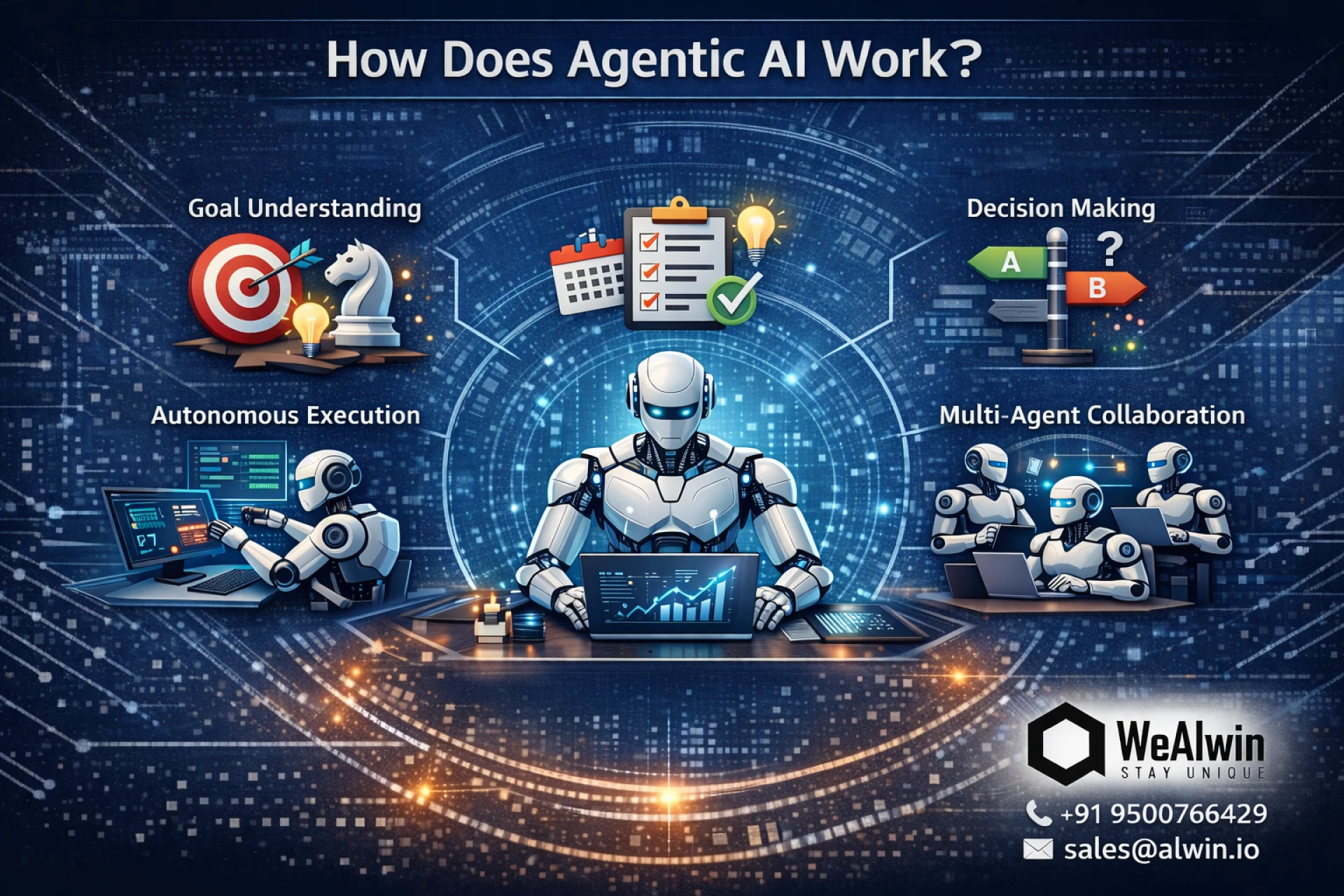
Goal Understanding:
Agentic AI begins by identifying and interpreting the objective it is given. Rather than focusing only on the immediate instruction, it tries to grasp the broader intention behind the request. For example, if asked to “improve sales performance,” it recognizes this as a strategic goal rather than a single-step task.
Intelligent Planning:
Once the goal is clear, the AI creates a structured plan. It breaks complex objectives into smaller, manageable steps. This planning stage allows the system to determine what actions, data, and tools are required before execution begins, similar to how humans outline a strategy before starting work.
Decision Making:
During execution, Agentic AI continuously evaluates situations and makes decisions. If something unexpected happens, such as missing information or changing priorities, it adjusts its approach. This ability to reason and choose alternatives makes it far more flexible than traditional rule-based systems.
Autonomous Execution:
Agentic AI can perform tasks independently after planning. It may retrieve data, run processes, generate outputs, or interact with digital tools without needing constant human intervention. The AI is not just suggesting actions, it is actively carrying them out.
Multi-Agent Collaboration:
In advanced setups, multiple AI agents work together, each specializing in different functions. One agent might handle research, another analysis, and another communication. These agents coordinate like a digital team to complete complex workflows efficiently.
Feedback & Improvement:
Agentic AI systems monitor results and learn from outcomes. By analyzing what worked and what didn’t, the system refines its future actions. This feedback loop helps improve accuracy, efficiency, and decision quality over time.
What Makes Agentic AI Different?
Traditional AI typically reacts to prompts, delivering outputs based on direct instructions. Agentic AI development solution however, operates with goal-oriented autonomy. It plans, decides, acts, and adapts, making it suitable for dynamic, real-world business and operational environments.
Why Does An Agentic AI System Matter for the Enterprise?
Agentic AI systems matter for the enterprise because they move beyond rigid, rule-based automation to deliver goal-driven intelligence. Instead of simply executing predefined tasks, these systems can understand objectives, plan actions, make decisions, adapt to changing conditions, and operate autonomously across complex workflows. This enables organizations to improve efficiency, accelerate decision-making, reduce operational costs, enhance employee productivity, and respond more effectively to dynamic business environments. In essence, Agentic AI enterprise operations from static processes into intelligent, adaptive systems that continuously optimize performance.
Final Thought:
Agentic AI is a passive responder into an intelligent, autonomous problem-solver capable of understanding goals, planning actions, making decisions, and continuously improving.
Looking ahead, Agentic AI Development is expected to change how businesses and industries operate. It will enable fully autonomous workflows, hyper-personalized customer experiences, and real-time decision ecosystems. Enterprises may rely on AI agents to manage operations, optimize strategies, and coordinate across departments with minimal human intervention. As these systems evolve, organizations can expect greater efficiency, faster innovation cycles, and new business models driven by AI-led intelligence. Ultimately, Agentic AI is not just enhancing automation; it is redefining the future of work and productivity.