
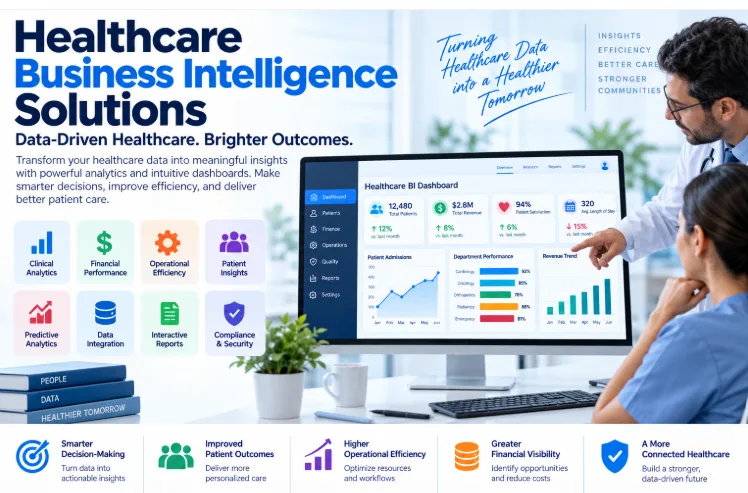
Healthcare organizations manage information across clinical systems, financial platforms, electronic health records (EHRs), billing applications, and administrative workflows. Making sense of this information is essential for improving performance, controlling costs, and planning future operations. Business intelligence (BI) helps transform complex healthcare data into meaningful reports, dashboards, and insights that support informed decision-making.
Understanding Healthcare Business Intelligence
Healthcare business intelligence solutions use data integration, reporting, visualization, and analytical tools to help healthcare organizations understand their performance. These platforms consolidate information from different sources and present it in formats that clinical leaders, administrators, and financial teams can use.
Healthcare BI can support a wide range of activities, including patient care analysis, revenue cycle monitoring, resource utilization, operational planning, and financial performance evaluation. By providing a consistent view of organizational data, BI helps teams identify patterns, recognize inefficiencies, and evaluate improvement initiatives.
Key Capabilities of Healthcare BI Solutions
Modern healthcare bi solutions bring together several capabilities to support data-driven healthcare operations.
- Data integration: Consolidates information from EHRs, practice management systems, claims platforms, and other applications.
- Interactive dashboards: Displays key performance indicators (KPIs), operational metrics, and financial trends in accessible visual formats.
- Clinical reporting: Helps monitor patient outcomes, readmission trends, treatment patterns, and quality indicators.
- Financial analysis: Tracks revenue, claims, reimbursement, denials, and operating expenses.
- Operational reporting: Provides insights into appointment scheduling, patient flow, staffing, and resource utilization.
Predictive insights: Uses historical data and analytical models to support forecasting and planning.
These capabilities help healthcare organizations move from disconnected reports toward a more consistent approach to performance management.
Benefits of Business Intelligence Solutions for Healthcare
Implementing Business Intelligence Solutions for Healthcare can improve visibility across clinical, financial, and administrative functions.
More informed decisions: Consolidated dashboards help leaders evaluate performance using consistent and relevant data.
Improved operational efficiency: Reporting can reveal bottlenecks in scheduling, patient flow, staffing, and administrative processes.
Better financial oversight: BI tools help organizations monitor reimbursement patterns, claims performance, revenue trends, and financial indicators.
Enhanced clinical performance monitoring: Healthcare teams can evaluate quality measures and patient outcome trends to identify areas requiring attention.
Effective resource planning: Historical utilization data can help organizations estimate capacity requirements and allocate resources more efficiently.
Greater organizational transparency: Role-based dashboards give authorized teams access to relevant performance information while maintaining appropriate data controls.
The Role of Healthcare Business Intelligence Software
Healthcare business intelligence software provides the technical foundation for collecting, processing, analyzing, and visualizing healthcare information. These platforms may include data warehouses, reporting engines, visualization tools, automated data pipelines, and configurable dashboards.
Integration with EHRs, billing systems, claims applications, and other healthcare platforms helps establish a unified reporting environment. APIs, HL7 interfaces, and FHIR-based data exchange may support interoperability, depending on the systems and data requirements.
Data governance is equally important. Standardized metric definitions, data validation, access controls, and audit trails help maintain reporting consistency and protect sensitive healthcare information.
Choosing Business Intelligence Software in Healthcare
Selecting appropriate business intelligence software in healthcare requires understanding an organization's reporting needs, data sources, and operational goals.
Healthcare organizations should evaluate integration capabilities, dashboard flexibility, scalability, data security, reporting speed, and ease of use. The platform should also support different user roles, allowing clinical, financial, and administrative teams to access the information relevant to their responsibilities.
A structured implementation process should include data source assessment, KPI definition, data mapping, dashboard configuration, testing, and user training. Ongoing monitoring helps ensure that reports remain accurate as systems and organizational requirements change.
Building a Data-Driven Healthcare Organization
Business intelligence helps healthcare organizations turn fragmented information into a clearer picture of performance. By connecting data sources and presenting meaningful insights through accessible dashboards, organizations can strengthen operational oversight, support financial planning, and monitor clinical performance.
A well-designed BI strategy combines reliable data integration, consistent reporting, secure access, and practical analytical tools. This creates a foundation for continuous improvement and more informed healthcare management.