
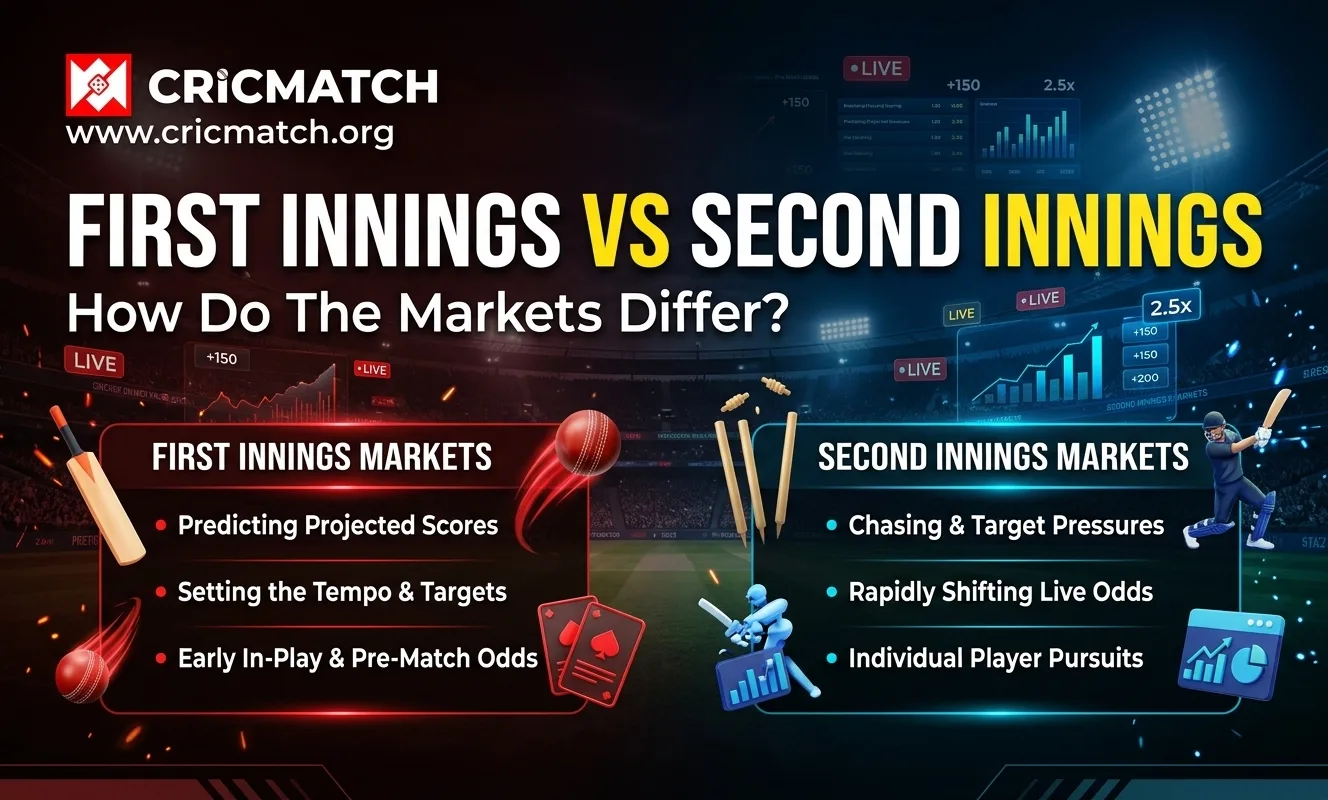
Understanding innings-based markets requires more than looking at the final score. On CricMatch, users may come across different options related to the first and second innings, each reflecting a separate stage of a cricket match. Although both involve the same teams, the conditions, objectives, and available information can change considerably between innings. Knowing these differences helps readers understand how each market works and what factors influence its underlying statistics.
What Are First Innings Markets?
First innings markets relate to events and outcomes during the opening innings of a match. At this stage, the batting team aims to establish a competitive total, while the bowling side tries to restrict scoring and take wickets.
These markets generally focus on factors such as:
- Total runs scored during the innings
- Number of wickets lost
- Runs scored within specific overs
- Individual batting contributions
- Team scoring milestones
For example, a first-innings total focuses on the number of runs accumulated before the batting side completes its innings. The result depends on factors such as pitch conditions, batting approach, bowling quality, and the number of available overs.
What Are Second Innings Markets?
Second innings markets cover events during the remaining innings, when the opposing team takes its turn to bat. Unlike the opening innings, the batting side may have a specific target to chase, which can influence its approach.
The nature of these markets depends on the match format and the situation at the start of the innings. Important considerations include the required run rate, wickets remaining, overs available, and the opposition's bowling strength.
For instance, a team chasing a challenging total may adopt a more aggressive approach, while a smaller target could encourage a controlled start.
Key Differences Between First and Second Innings Markets
Although both innings involve scoring runs and taking wickets, their objectives and match conditions are different.
| Comparison Factor | First Innings | Second Innings |
|---|---|---|
| Main objective | Establish a total | Chase or respond to a target |
| Batting approach | Build an innings | Adjust according to the target |
| Score reference | No previous innings total | Previous innings total available |
| Run-rate context | Based on scoring progress | Often linked to required run rate |
| Match situation | Establishes the initial score | Determines the match outcome |
These differences explain why the same team can approach each innings differently. The first innings establishes the scoring benchmark, while the second develops around the total already recorded.
Which Factors Influence First Innings Performance?
Several conditions can influence how a team performs during its opening innings. Understanding these factors provides useful context when reviewing available match information on the Cricmatch platform.
Pitch conditions: A dry surface, fresh grass, or uneven bounce can affect how comfortably batters score runs.
Opening partnership: The first few overs can establish the innings' direction. A stable partnership may provide a foundation for later scoring.
Bowling combination: Fast bowlers and spinners can create different challenges depending on the surface and match conditions.
Batting order: The placement of experienced batters and aggressive players can influence the team's scoring approach.
These factors should be considered together rather than treating one performance indicator as conclusive.
What Makes Second Innings Analysis Different?
Second innings analysis involves additional information because the first innings has already established a total. The chasing team's approach often changes according to the size of the target and the remaining overs.
Consider these important factors:
- Required run rate: Shows how quickly the batting side needs to score.
- Wickets in hand: Indicates how many batting resources remain.
- Overs remaining: Determines the time available to reach the target.
- Bowling changes: Fresh bowling combinations can influence scoring opportunities.
- Match pressure: A demanding target or early wickets can change the batting approach.
The relationship between these factors provides a clearer picture of the second innings than the score alone.
How Do Match Conditions Change Between Innings?
Conditions do not always remain identical throughout a cricket match. Weather, moisture, dew, and pitch deterioration can influence how the ball behaves during the second innings.
For example, evening dew may make the ball difficult for bowlers to grip, while a worn surface can create different challenges for batters. However, these effects depend on the venue and actual playing conditions.
Users exploring the Cricmatch app should distinguish between confirmed match information and assumptions about how conditions might change.
How Should You Compare Both Innings?
A useful comparison begins with the first-innings total and continues with the chasing team's response. Instead of examining each innings separately, consider how the two performances relate.
For a balanced assessment, review:
- The opening team's scoring pattern.
- Wickets lost at different stages.
- The final first-innings total.
- The chasing team's required run rate.
- Changes in bowling and batting combinations.
This approach helps explain how one innings creates the conditions for the next. It also prevents readers from drawing conclusions from isolated statistics.
For readers researching different match formats, concepts such as both teams to score can also be useful when comparing how scoring expectations differ across cricket and football.
Conclusion
First and second innings markets differ mainly in their objectives, available information, and match conditions. The opening innings establishes a total, whereas the second innings develops around the target and the remaining resources. Understanding scoring patterns, wickets, required run rates, pitch conditions, and batting approaches makes these differences easier to recognise. Comparing both innings together provides a more complete understanding of how a cricket match progresses.