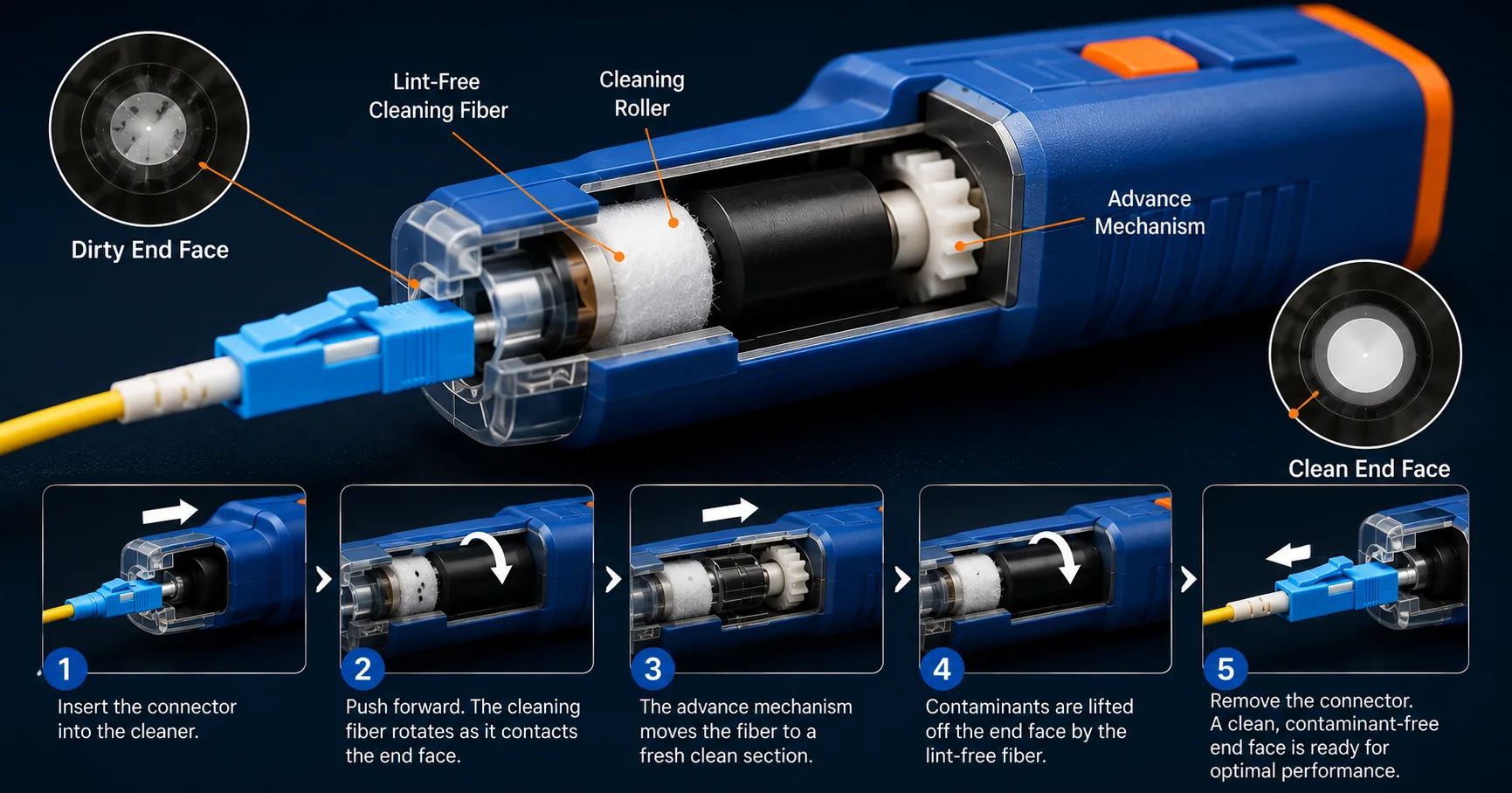
A fiber cleaner works by pressing a fresh strip of dry, lint-free fabric against a connector end face and sweeping it across the ferrule so contamination is carried off the glass instead of smeared across it. Inside a one-click pen, a spring-loaded plunger drives a take-up spool that advances unused fabric while a cam rotates the cleaning tip through a partial turn. Every actuation therefore delivers controlled pressure and a surface the fiber has never touched.
That mechanism matters because the working surface is tiny. A single-mode core measures roughly 9 microns across inside a 125 micron cladding, so a dust particle a few microns wide can sit squarely in the light path. Cleaning exists to remove that particle before it scatters light, drives up insertion loss, or burns into the glass under optical power.
Why Contamination Is the Problem Fiber Cleaning Solves
Dirt on an end face causes trouble in three ways at once. It blocks transmitted light, scatters part of it back toward the source, and holds two mating ferrules apart. Blocked light raises insertion loss, backscatter degrades return loss, and the resulting air gap reflects again at both glass surfaces.
Permanent damage is the second cost. Mating a contaminated connector under active power lets the particle absorb energy, heat, and pit the glass, and no later cleaning repairs a pit. The reference point is IEC 61300-3-35, which grades an end face by zone with separate limits for the core, cladding, adhesive, and contact areas.
Typical contaminants a technician meets on a live plant include:
- Airborne dust and lint shed by clothing or a generic cloth
- Skin oils and fingerprints from handling an unprotected ferrule
- Buffer gel, adhesive film, and index-matching compound
- Drying residue left by low-purity fiber cleaning alcohol
How Do Fiber Cleaner Works Inside a One-Click Pen
A one-click cleaner is purely mechanical, with no battery and no fluid reservoir. Pushing the barrel forward compresses an internal spring that pulls a fresh section of woven cleaning fabric across the tip, while a cam rotates that tip a fraction of a turn. The combination of linear feed and rotation wipes the end face in an arc rather than a straight line, which is what lifts debris out of the contact zone instead of dragging it across the core.
Tip geometry decides what the tool can reach. A 1.25 mm tip enters LC and MU adapters, a 2.5 mm tip serves SC, FC, ST, and E2000, and an MPO tip is shaped flat to sweep a rectangular multi-fiber ferrule. Because a guide tube centres the tip inside the alignment sleeve, the same fiber cleaner tool can clean a connector still seated in a patch panel, not only a loose patch cord.
- One push equals one clean, and most fiber optic cleaner pens are rated for several hundred actuations before the reel is spent
- Past the rated count a pen stops feeding fresh fabric and starts putting debris back, so the count is worth tracking
Dry Versus Wet, and What Fiber Cleaning Alcohol Really Does
Dry cleaning is the default because it is fast, alcohol free, and leaves nothing behind, and a pen or cassette dragging dry fiber cleaning cloth across the ferrule lifts loose particulate in one pass. One category defeats it, and that category is anything oily. Fingerprints, gel, and adhesive films smear under a dry wipe and spread across the core instead of leaving with the cloth.
Those films need a solvent to break them, then an immediate dry pass before the residue sets into a streak, a sequence technicians call wet-to-dry. Fiber cleaning alcohol means 99 percent or higher isopropyl, because isopropyl is hygroscopic and the 70 percent first aid grade already carries close to a third of water by volume. That water evaporates slowly and leaves a haze plus dissolved minerals sitting on the end face.
An engineered fiber cleaning solution is formulated to avoid that behaviour. These fluids are non-hygroscopic, flash off faster than alcohol, and lift both ionic and non-ionic residue without leaving a drying ring. Paired with lint-free fiber optic cleaning wipes, the fluid goes onto one corner of the wipe and the ferrule is drawn from the damp area into the dry area in one continuous stroke.
Four habits separate a clean end face from a streaked one:
- Apply solvent to the wipe, never to the connector and never into an adapter port
- Move in one direction only, damp zone to dry zone, and never track back over the same path
- Use each section of the fiber cleaning wipes once, then fold to fresh material
- Let the end face dry fully before mating, since trapped solvent vapourises under power
Matching the Fiber Cleaner Tool to the Connector
Cleaning tools are sized to ferrules, not to connector brand names. The installed base resolves into three geometries, so a crew carrying all three can clean any port it meets in a working day. Buying by ferrule size also stops a store cupboard filling with duplicates.
Reach decides the rest. A tip has to travel down an adapter sleeve and land square on the ferrule, so guide tube tolerance matters as much as the fabric. Tools that do not centre properly clean the bevel and miss the core, which reads as a pass by eye and a fail under a scope.
1.25 mm Ferrules
This size covers LC and MU connectors, which dominate modern patch fields and transceiver ports. Density is high, so a slim pen body is worth more than extra features.
2.5 mm Ferrules
SC, FC, ST, and E2000 all use the 2.5 mm ferrule, which still fills much of the outside plant and legacy racks. One tip therefore serves four connector families.
MPO and MTP Ferrules
Multi-fiber ferrules present a flat rectangular face carrying 8, 12, 16, or 24 fibers in a row. A round tip cannot cover that array or reach the guide pin holes where debris collects, so a flat cleaning head is required.
What Belongs in a Working Fiber Cleaning Kit
A fiber cleaning kit exists so nobody is forced into the wrong method because the right one is back in the van. A usable kit covers both cleaning modes and all three ferrule geometries. Kits built around one connector type get abandoned the first time a crew opens an MPO cassette.
Consumable planning is the other half of kit design. Pens carry a fixed click budget, cassettes carry a fixed number of swipes, and wipes with solvent run out faster than either. A well specified fiber optic cleaning kit prints those counts on the case so a supervisor restocks before a crew is stranded mid shift.
- Dry cleaner pens in 1.25 mm, 2.5 mm, and MPO tips
- A cassette-style cleaner for bench and high volume work
- Lint-free wipes plus a sealed dispenser of cleaning fluid
- An inspection probe or scope, so results are verified rather than assumed
The Inspect, Clean, Inspect Loop
Cleaning without inspection is guesswork, because the contamination that matters is invisible at arm’s length. The discipline is a loop: inspect under a probe, clean if any zone fails, then inspect again to confirm it worked. A second pass is normal, and a third is a signal to check the tool rather than the connector.
The loop also catches what cleaning cannot fix. Scratches, pits, and cracked epoxy survive every wipe, and a scope says to re-terminate instead of spending fifteen minutes on a lost cause. Saving the pass image turns cleaning into evidence, which is what an acceptance test asks for.
A connector and its bulkhead port are a mated pair, so cleaning the cord while leaving the port dirty just transfers dirt on first insertion. The other habits that quietly undo a good clean:
- Reusing a wipe section, which redistributes what was just removed
- Reaching for a cotton swab, tissue, or shop cloth, all of which shed fibers
- Leaving a cleaned connector uncapped on a bench while other work continues
- Using canned air with a propellant that deposits residue of its own
Building Cleaning Into the Routine
Cleaning is the cheapest step in a fiber build and the first one dropped under time pressure. A pen in the pocket, wipes and fluid in the case, and a scope to confirm the result cost far less than a return visit to a link that missed its loss budget. Standardising those three items removes the variable behind most avoidable failures.
Count the clicks left on the pens your crew carries this week, check that wipes and fluid are still sealed, and compare the tips on hand against the ferrule types on your network. Close any gap before the next install window opens, not after a test set says the loss budget was missed.
Frequently Asked Questions
How often should fiber connectors be cleaned?
Every connector should be cleaned immediately before every mating, including new components straight from the bag. Factory dust caps keep gross debris out but do not guarantee a clean end face, and a cap can shed particulate itself. Cleaning as a mating step rather than a troubleshooting response prevents most contamination faults outright.
Can I use 70 percent isopropyl alcohol on fiber?
No, 70 percent isopropyl is not suitable for fiber end faces. Close to a third of the volume is water, which evaporates slowly and leaves a haze plus dissolved minerals. Use 99 percent or higher alcohol or a purpose-made optical fluid, always applied wet-to-dry.
How do fiber cleaner works on a connector inside a bulkhead adapter?
A one-click pen uses a guide tube that centres the cleaning tip inside the adapter alignment sleeve. The tip travels down the sleeve to the ferrule, and the click mechanism rotates the tip and feeds fresh fabric in one motion. Nothing has to be unracked, which is why the method suits live patch panels.
How many cleans does one fiber cleaner pen deliver?
Most one-click pens are rated in the hundreds of cleans, commonly in the range of 400 to 800 actuations. The figure comes from the fabric length on the internal reel divided by the feed distance per click. A spent pen keeps clicking without advancing material, so track the count and retire the tool on schedule.
Is dry cleaning enough on its own?
Dry cleaning handles loose particulate, which is most everyday contamination, and it leaves no residue. It does not remove oils, gels, or adhesive films, which smear rather than lift. Crews carrying both methods and inspecting before deciding hit a first-pass result far more often.
What does IEC 61300-3-35 cover?
IEC 61300-3-35 defines visual inspection acceptance criteria for fiber optic connector end faces. It divides the face into concentric zones and sets separate limits on the number and size of scratches and defects in each. Automated probes apply those limits to return a pass or fail instead of leaving the call to individual judgement.
Can a dirty connector damage transmission equipment?
A contaminated end face can permanently damage the connector and disturb the link it feeds. Under optical power a trapped particle absorbs energy and can pit or fuse into the glass, leaving a defect no cleaning removes. High reflectance from the same dirt also sends light back toward the transmitter, which can destabilise the source.