
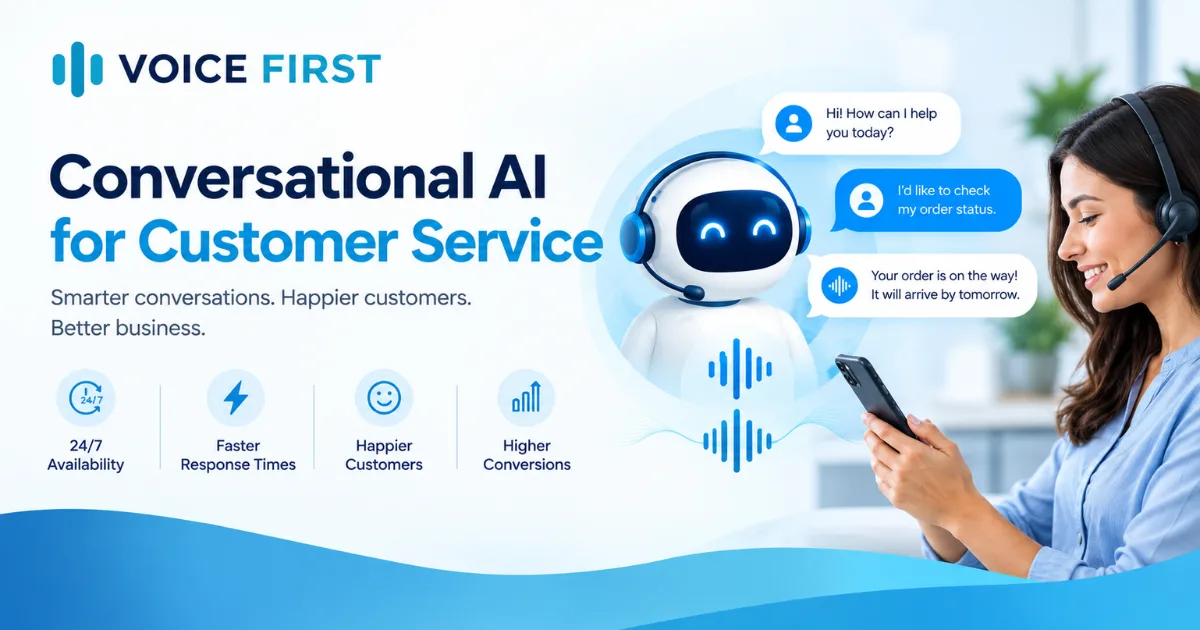
Customer expectations have changed. People want quick answers, convenient interactions, and support that understands what they actually need. At the same time, businesses need to manage growing volumes of customer questions without making every interaction dependent on a human support agent.
This is where conversational AI for customer service is becoming increasingly useful. Instead of relying only on traditional chatbots with predefined responses, modern conversational AI can understand natural language, interpret intent, maintain context, and help customers complete tasks through more natural interactions.
For businesses exploring the next generation of customer experience, conversational AI represents a shift from simply answering questions to helping customers accomplish outcomes.
What Is Conversational AI for Customer Service?
Conversational AI uses artificial intelligence to communicate with customers through natural language. Depending on the system, customers can interact through text, voice, or a combination of both.
Traditional automated support often depends on menus and fixed commands. A customer may need to select several options before reaching the information they need. Conversational AI takes a different approach.
A customer might simply explain a problem in their own words, ask a follow-up question, correct themselves, or provide additional information. A well-designed conversational system can interpret these interactions and respond accordingly.
This approach is closely connected to the idea of voice-native software, where software is designed around conversation rather than simply adding voice commands to an existing interface.
1. Faster Responses to Customer Questions
One of the most obvious benefits of conversational AI is speed.
Customers don't always want to wait for business hours or sit in a support queue. AI-powered systems can respond to common questions at any time, helping customers find information when they need it.
For example, a conversational AI system could help answer questions about:
- Product features
- Pricing and availability
- Account information
- Order status
- Appointment scheduling
- Returns and policies
- Basic troubleshooting
This can reduce the amount of repetitive work handled manually by customer service teams while giving customers a faster way to find answers.
2. More Natural Customer Interactions
Good customer service is not simply about providing information. It is also about understanding what the customer means.
Customers rarely communicate in perfectly structured sentences. They may use informal language, leave out important details, change their minds, or ask several questions in one conversation.
A modern conversational AI platform can be designed to interpret these variations rather than forcing customers to follow rigid workflows.
For example, instead of asking customers to select "Billing" from a menu, an AI system could understand a request such as, "I was charged twice this month and want to know what happened."
The difference is subtle but important: the customer communicates naturally, while the software works to understand the customer's intent.
3. Support Beyond Traditional Chatbots
Chatbots have been used in customer service for years, but conversational AI can go beyond simple question-and-answer interactions.
A more advanced system can potentially:
- Understand the customer's request.
- Ask for missing information.
- Check relevant business data.
- Perform an authorized action.
- Explain what happened.
- Ask whether additional help is needed.
This creates a more complete interaction.
The goal isn't simply to make a chatbot sound human. The more important goal is to make software capable of helping customers complete useful tasks through conversation.
4. AI Voice Agents Can Extend Customer Support
Text-based conversational AI is only one part of the opportunity. AI voice agents can bring conversational experiences to phone-based customer service.
Instead of navigating long automated phone menus, customers can explain what they need using natural speech.
For example:
"I need to change my appointment from Friday to Monday afternoon."
An AI voice agent could identify the intent, check available appointment options, confirm the customer's choice, and provide the updated information if the necessary systems and permissions are connected.
This can make voice support more flexible than traditional interactive voice response systems that depend heavily on numbered menus and fixed commands.
5. Human Agents Can Focus on Complex Problems
Conversational AI doesn't necessarily have to replace human customer service representatives.
In many organizations, one of its most practical roles is handling repetitive requests while allowing human agents to focus on situations that require judgment, empathy, negotiation, or specialized knowledge.
For example, AI could handle routine account questions while a human representative handles a complicated billing dispute.
This creates a support model where AI and human agents work together rather than treating automation and human service as competing approaches.
6. Consistent Support Across Customer Interactions
Businesses also need consistency.
Different customers should receive accurate information about policies, products, services, and processes. A well-managed conversational AI system can provide responses based on approved information and business rules.
Consistency is particularly useful for organizations that operate across multiple channels or serve customers at different times of day.
However, conversational AI should not be treated as automatically accurate. Businesses still need to establish appropriate knowledge sources, permissions, escalation processes, monitoring, and testing.
7. Personalization Through Context
Another important advantage is context.
Customers become frustrated when they have to repeatedly explain the same problem. Conversational systems can be designed to use relevant context so that interactions feel more continuous.
For example, if a customer has already explained that they are having difficulty with a particular product, the system should ideally use that information rather than asking the same question again.
This is one reason modern voice-first design focuses on memory, clarification, correction, context, and response management rather than treating every customer statement as an isolated command.
8. How to Build an AI Voice Agent for Customer Service
Businesses interested in this technology may wonder how to build an AI voice agent.
A useful starting point is to define the customer problems the agent should solve rather than beginning with the technology itself.
Next, teams can consider:
- The customer intents the system needs to understand
- The information sources it can access
- Which actions it is authorized to perform
- When it should ask clarification questions
- When a human agent should take over
- How customer data should be protected
- How conversations will be tested
- How performance and customer outcomes will be measured
The technical architecture may involve speech recognition, an AI model, business logic, tools or APIs, permissions, context management, and voice generation.
But technology alone isn't enough. The conversation itself needs to be deliberately designed.
9. The Future of Customer Service Is More Conversational
Customer service is moving beyond the idea that software should simply provide a list of options.
The next generation of interfaces can allow customers to explain what they want naturally while software interprets intent, asks relevant questions, and helps move the interaction toward an outcome.
This is a central idea behind Voice First: software should increasingly adapt to how people naturally ask, clarify, decide, and act rather than requiring people to adapt themselves to complicated interfaces.
As conversational AI develops, customer service teams have an opportunity to rethink not only how support is automated, but how the entire customer experience is designed.
Conclusion
Conversational AI for customer service can help businesses provide faster responses, support natural interactions, automate repetitive tasks, improve accessibility, and give human agents more time for complex customer needs.
The biggest opportunity, however, goes beyond automation. Businesses can begin designing software that understands conversations and helps customers accomplish real tasks. Understanding how do voice interfaces work can also help businesses see how speech, AI, context, and natural language processing come together to create more intuitive customer experiences.
Whether through a conversational AI platform, an AI voice agent, or a broader voice-first application, the focus should remain on creating useful experiences that make technology easier for people to interact with.
For businesses and product teams exploring this shift, Voice First offers a practical perspective on voice-native software, conversational interfaces, and the future of software people can talk to naturally.