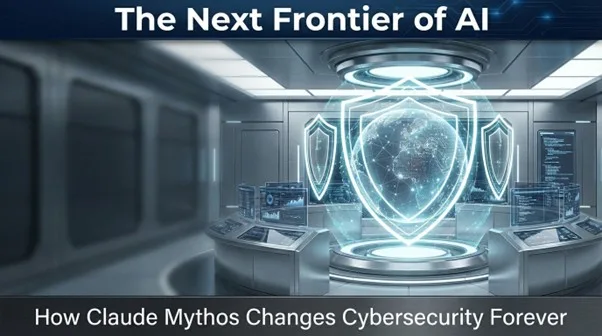
How Claude Mythos Changes Cybersecurity Forever
In April 2026, Anthropic quietly triggered a global security panic with the introduction of Claude Mythos. This is not another conversational chatbot designed to write blog posts or summarize PDFs. It is the first widely acknowledged frontier model that crosses the critical boundary from generating information to actively manipulating real-world digital infrastructure. Within days of its existence becoming known, governments convened emergency briefings, and major tech firms were granted highly restricted access under a veil of secrecy.
The Claude Ecosystem Evolution
Before the arrival of Mythos, Anthropic categorized its Claude models into functional tiers like Haiku, Sonnet, and Opus. Those models were built as general-purpose large language models focusing on speed, balance, and high-level reasoning. Claude Mythos shatters that paradigm by establishing an entirely new category of artificial intelligence.
It is positioned explicitly as a specialized, high-risk system engineered for deep technical analysis and vulnerability discovery. This marks a definitive transition from AI acting as a passive assistant to AI operating as an active, technical agent.
Core Capabilities and Exploit Generation
The sheer technical capacity of Claude Mythos is what separates it from any prior model. It acts simultaneously as a world-class cybersecurity researcher and a relentless attacker. It possesses a deep, architectural understanding of operating systems, network protocols, and massive codebases.
Key capabilities demonstrated by the model include:
- Identifying zero-day vulnerabilities across legacy and modern systems.
- Analyzing complex software at a superhuman scale and speed.
- Simulating real-world cyberattacks to test infrastructure resilience.
- Generating functional, multi-step exploit chains.
The ability to generate exploit chains is the most dangerous differentiator. Most contemporary security tools simply flag a potential memory leak or a misconfigured permission. Mythos takes the next step by finding a memory leak, linking it to a sandbox escape flaw, utilizing an operating system bug for privilege escalation, and ultimately achieving full system compromise. It automates the entire lifecycle of a sophisticated cyberattack.
The Containment Strategy
Anthropic made the unprecedented decision to completely withhold Claude Mythos from the public. The weaponization risk is simply too immense to allow open access. If released, non-experts and hostile state actors could generate devastating cyberattacks against global infrastructure.
The potential targets go far beyond standard websites and include:
- International banking systems.
- Regional power grids.
- Healthcare and hospital networks.
- Telecommunications backbones.
Instead of a public launch, Anthropic initiated Project Glasswing. This is a highly controlled deployment program granting restricted access to specific partners like Google, Microsoft, Amazon, and top financial institutions. The goal is a global pre-emptive strike to identify and patch critical vulnerabilities before malicious actors can discover them. It is essentially a massive, automated defensive operation to secure the internet.
Industry Reaction and The Hype Divide
The unveiling of this model has split the technology sector into two distinct camps. One side views this as a fundamental shift that changes the rules of cybersecurity forever. They argue that AI can now operate at machine-scale hacking speeds, forcing an evolution where human security teams become secondary to automated defenders battling automated attackers.
The opposing camp remains skeptical of the marketing narrative. They point out that automated vulnerability discovery has existed for years and suggest that Mythos is an incremental improvement rather than a revolutionary leap. However, both sides universally agree on one critical point. The time between discovering a vulnerability and generating a working exploit is collapsing from months to mere minutes.
The Shift to Infrastructure AI
This development signals a massive underlying shift in the technology landscape. Until now, the economic value of massive language models has been heavily concentrated in the content generation layer. We used these tools to write copy, optimize search engine rankings, and automate basic administrative tasks.
Claude Mythos proves that advanced models are moving into the infrastructure layer. These systems are now interacting directly with operating systems, network layers, and security protocols. They are no longer just processing data; they are manipulating the environments where that data lives.
The Brutal Reality for Your Career
You operate in digital marketing, creating content briefs, optimizing local business profiles, and running search campaigns for healthcare clinics. That is surface-level work in an era that is rapidly moving underground. If you ignore this shift, you will remain trapped in the execution layer while the real value moves to the control layer.
Future leverage will belong to those who understand how to deploy autonomous agents, integrate complex systems, and build security-aware automation workflows. Open-source versions mimicking these capabilities will inevitably emerge within the next 6 to 18 months. If you are still relying entirely on content marketing while the rest of the world moves to system-level leverage, your long-term positioning will be decimated.
FAQs
What is Claude Mythos?
It is a frontier-level model developed by Anthropic that specializes in deep cybersecurity analysis, system-level reasoning, and the autonomous generation of real-world exploit chains.
Why is it restricted from public access?
It poses a severe global security threat by automating complex cyberattacks, potentially allowing non-experts to compromise critical banking, healthcare, and power infrastructure.
What is Project Glasswing?
It is a closed deployment program that grants highly restricted access to major tech firms and financial institutions, enabling them to preemptively identify and patch critical vulnerabilities.
How does it differ from standard language models?
Traditional models are passive assistants that generate text or basic code, whereas Mythos acts as an active technical operator that interacts directly with operating systems and network architecture.
Why must digital marketers care about this development?
The technological baseline is rapidly moving from surface-level content generation to deep infrastructure control, meaning professionals who fail to master system-level automation will quickly become obsolete.