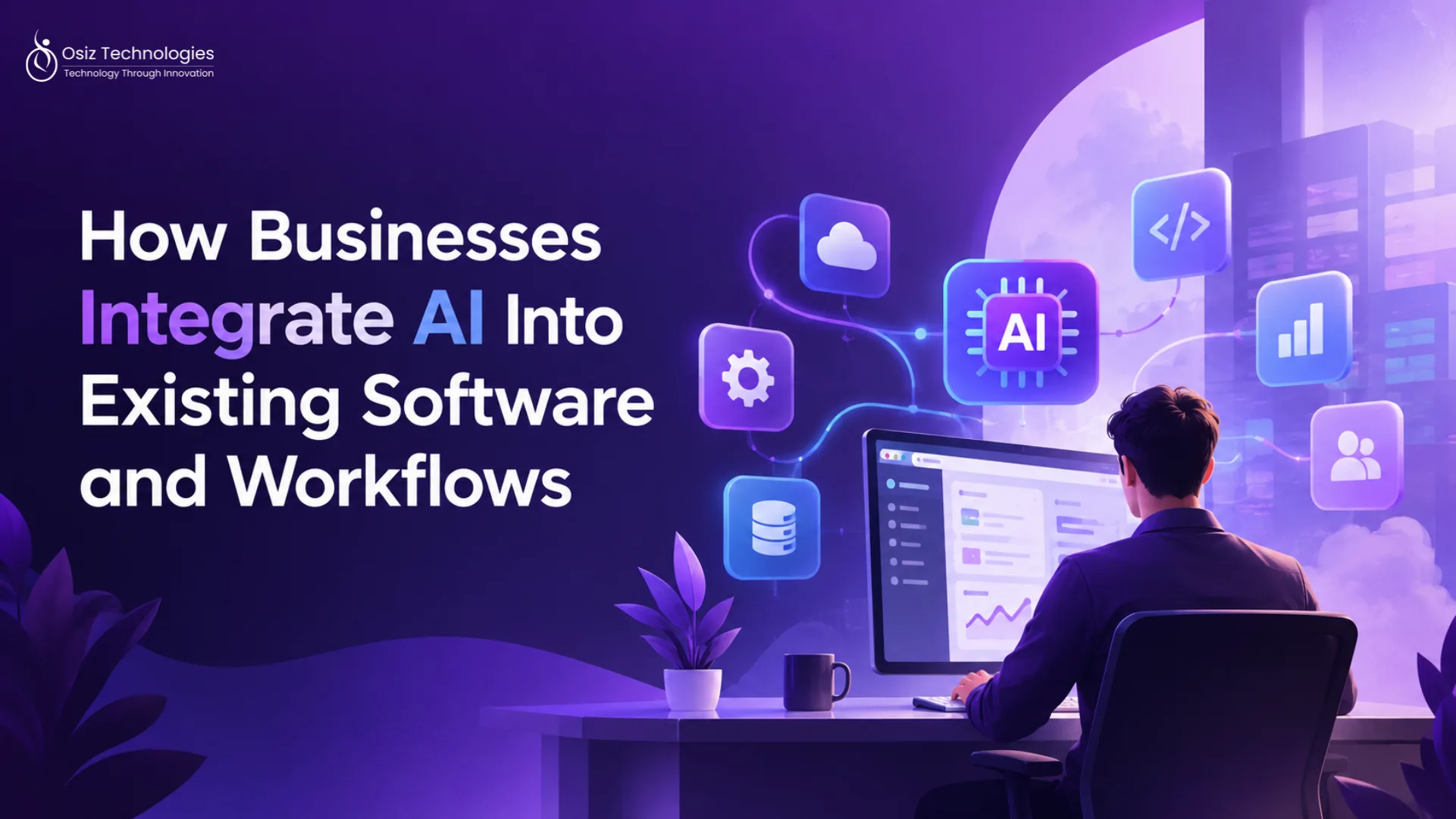
Businesses increasingly use AI to add intelligent capabilities to software they already rely on rather than replacing their entire technology stack. Existing applications can be connected with AI models, agents, and data sources to automate tasks, generate insights, understand customer requests, and support business processes. AI Integration Services enable organizations to connect these capabilities with existing applications while maintaining established workflows, data structures, and user experiences.
How AI Integration Works With Existing Software
AI integration typically connects an AI model or intelligent service with an application's existing data, functionality, and workflows. APIs, webhooks, databases, and integration platforms can transfer information between the AI layer and business software.
For example, an AI system integrated with a CRM can analyze customer conversations, identify sales opportunities, and update relevant records. The AI does not need to replace the CRM; instead, it adds intelligence to the existing system and enables users to interact with business functions more efficiently.
Business Systems That Can Be Integrated With AI
CRM and Customer Management Systems
AI can integrate with CRM systems to analyze customer data, summarize interactions, qualify leads, recommend follow-up actions, and update customer records. This allows sales teams to use AI capabilities without changing their existing CRM environment.
ERP and Business Management Software
ERP systems contain information related to inventory, finance, procurement, orders, and operations. AI integration can help retrieve relevant information, identify patterns, automate repetitive processes, and provide conversational access to business data.
E-Commerce and Marketplace Platforms
AI can be connected to e-commerce platforms to support product recommendations, customer queries, order tracking, product discovery, and personalized interactions. Integration with inventory and order systems can also allow AI applications to provide current information.
Marketing and Customer Support Platforms
Marketing and support platforms can use AI to analyze customer interactions, generate content, categorize requests, identify customer intent, and automate routine support activities. Connected systems can share customer context across marketing and service workflows.
Business Workflows That AI Integration Can Automate
Sales and Lead Management
AI can analyze incoming inquiries, identify qualified prospects, extract lead information, and transfer relevant details into CRM systems. It can also trigger follow-up tasks based on predefined business rules and customer interactions.
Customer Support and Service
AI integration can automate frequently requested support activities such as answering questions, retrieving account information, classifying tickets, and checking service status. Complex requests can be routed to human agents with the relevant conversation context.
Data Processing and Document Workflows
AI can extract information from invoices, contracts, forms, emails, and other documents and transfer structured information into existing applications. This reduces repetitive manual processing and allows employees to focus on tasks requiring human judgment.
How Businesses Connect AI With Existing Applications
API-Based AI Integration
APIs provide a structured way for software applications to exchange data and functionality. Businesses can use APIs to connect AI models with CRM platforms, databases, ERP systems, websites, mobile applications, and other software.
AI Integration Through Webhooks
Webhooks enable applications to send real-time notifications when specific events occur. For example, a new lead, completed purchase, support ticket, or customer interaction can trigger an AI-powered workflow automatically.
Database and Data Integration
AI applications can connect with approved databases and data repositories to retrieve relevant information. Proper data mapping, validation, permissions, and security controls help ensure that AI systems access appropriate business information.
AI Technologies Used for Software Integration
Generative AI and Large Language Models
Large language models enable applications to understand natural language, generate responses, summarize information, classify content, and process business communications. They can be integrated into existing software through APIs and application-specific workflows.
AI Agents and Intelligent Automation
AI agents can perform multi-step tasks by interacting with business systems, using available tools, retrieving information, and executing defined actions. This makes them suitable for workflows that require more than simple text generation.
Retrieval-Augmented Generation (RAG)
RAG connects AI models with external knowledge sources so they can retrieve relevant information before generating a response. Businesses can use RAG with internal documents, knowledge bases, databases, and approved content repositories to provide more context-specific answers.
Benefits of Integrating AI Into Existing Software
Integrating AI into existing software can extend application capabilities without requiring complete system replacement. Businesses can automate repetitive work, improve access to information, accelerate customer responses, support employees, reduce manual data processing, and create more intelligent workflows. Integration also allows organizations to build AI capabilities around their existing technology investments and gradually expand automation as business requirements evolve.
Why Choose Osiz Technologies for AI Integration Services?
Osiz Technologies is an AI Integration Services provider that connects AI capabilities with existing business applications, software platforms, databases, APIs, and operational workflows. Our approach focuses on understanding the existing technology environment before designing the integration architecture. From generative AI and AI agents to RAG, API connectivity, workflow automation, and secure data integration, Osiz Technologies builds AI-powered solutions designed to work within existing software ecosystems.