
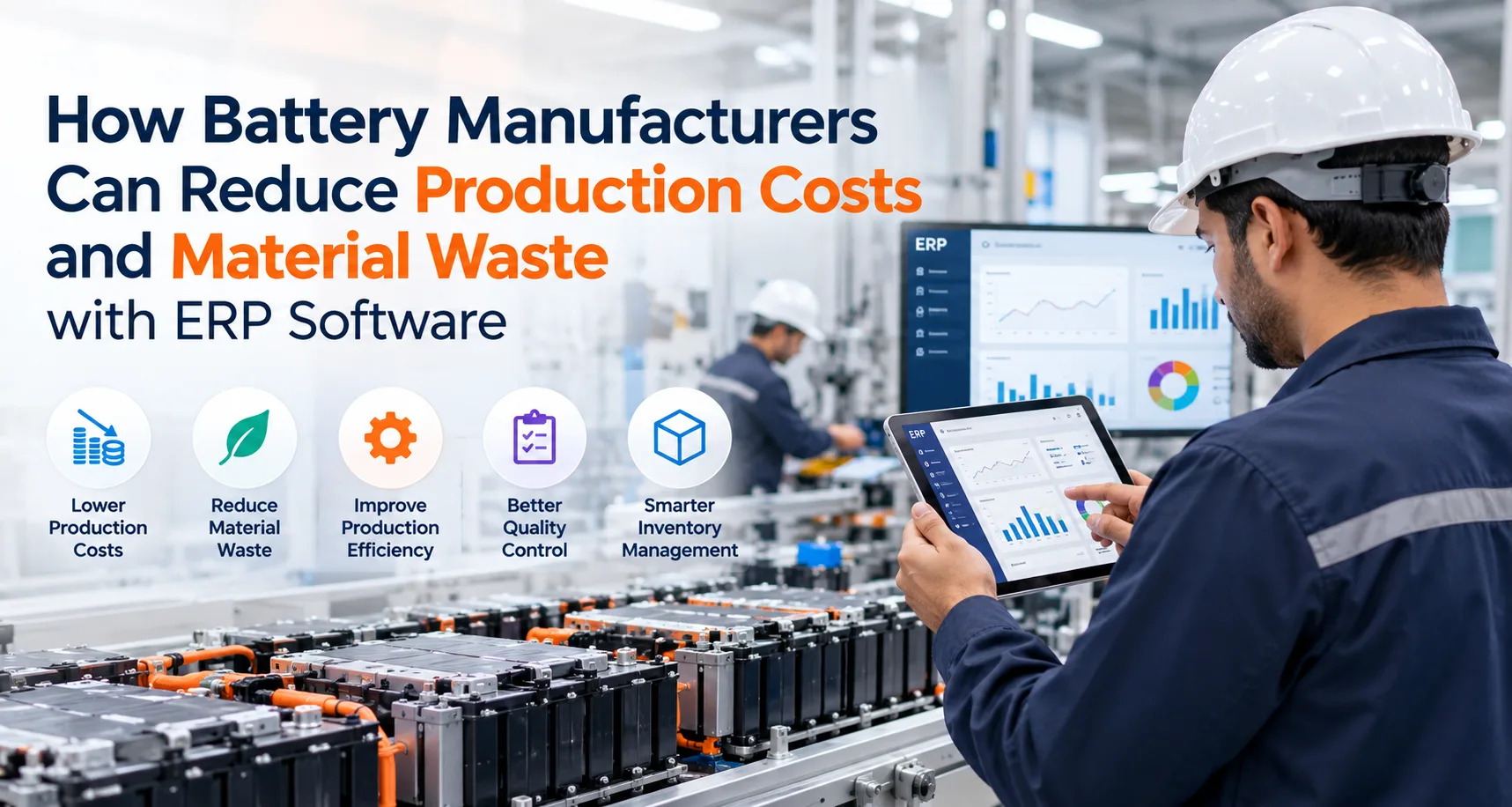
The battery manufacturing industry is growing rapidly as demand increases across electric vehicles, renewable energy storage, consumer electronics, and industrial applications. However, manufacturers face several operational challenges, including rising raw material costs, production inefficiencies, inventory management issues, and material waste.
Battery production requires careful management of materials such as lithium, nickel, graphite, and other components. Even small errors in material planning, production scheduling, or quality control can lead to unnecessary expenses and reduced profitability.
For manufacturers looking to improve efficiency and maintain consistent product quality, Enterprise Resource Planning (ERP) software can play an important role. By connecting production, inventory, purchasing, quality control, and financial operations, ERP helps businesses gain better visibility into their processes and make more informed decisions.
Let's explore how ERP software can help battery manufacturers reduce production costs, minimize material waste, and improve overall operational performance.
1. Improve Raw Material Planning and Inventory Management
Raw materials represent a significant portion of battery manufacturing costs. Managing these materials without accurate inventory data can result in overstocking, shortages, and unnecessary purchasing expenses.
For example, if a manufacturer orders more raw materials than required, excess inventory can increase storage costs and tie up working capital. On the other hand, insufficient inventory can delay production and affect delivery schedules.
ERP software helps manufacturers maintain better control over their inventory by providing real-time visibility into stock levels, material consumption, and purchase requirements.
With an integrated ERP system, manufacturers can:
- Monitor raw material availability across warehouses.
- Track material usage throughout production.
- Set minimum and maximum stock levels.
- Identify slow-moving and excess inventory.
- Plan purchases based on production requirements.
- Reduce the risk of stockouts and overstocking.
The business benefit: Better inventory planning helps manufacturers control purchasing costs, reduce unnecessary stock accumulation, and ensure materials are available when production requires them.
2. Reduce Material Waste Through Better Production Planning
Material waste is a major concern in battery manufacturing. Inefficient production processes, inaccurate material measurements, defective components, and poor planning can increase scrap rates and operational costs.
Without accurate production data, it can be difficult to identify where materials are being wasted or which production stages require improvement.
ERP software connects production planning with bills of materials (BOMs), inventory records, and manufacturing operations. This allows manufacturers to plan material requirements more accurately and compare actual consumption with planned usage.
For example, if a production order requires a specific quantity of materials, the ERP system can help calculate the required quantities based on the product's bill of materials. Actual consumption can then be compared with expected usage to identify discrepancies.
Manufacturers can use these insights to:
- Identify production stages with higher material consumption.
- Monitor scrap and rejection rates.
- Improve material allocation.
- Standardize production processes.
- Investigate material usage variances.
- Make data-driven decisions to reduce avoidable waste.
ERP software does not eliminate waste automatically. However, it provides the operational data manufacturers need to understand waste patterns and take corrective action.
3. Optimize Production Scheduling and Resource Utilization
Production delays can increase labor costs, reduce equipment utilization, and affect customer commitments. These problems often occur when production schedules are disconnected from inventory availability, machine capacity, and customer demand.
ERP software helps manufacturers coordinate production activities by connecting production orders, material availability, work centers, and delivery schedules.
With better planning, production teams can identify potential material shortages before production begins, allocate resources more effectively, and prioritize orders according to business requirements.
An ERP system can help manufacturers:
- Plan production based on available materials.
- Coordinate production orders and delivery deadlines.
- Monitor work-in-progress inventory.
- Identify production bottlenecks.
- Improve visibility into machine and labor utilization.
- Reduce avoidable production interruptions.
For battery manufacturers operating multiple production lines, these capabilities can improve coordination between departments and help managers respond more quickly to operational challenges.
The result is a more organized production process with better resource utilization and fewer preventable delays.
4. Strengthen Quality Control and Reduce Defective Products
Quality control is essential in battery manufacturing because product performance, reliability, and safety depend on consistent production standards.
Defective components, inconsistent material quality, and process variations can lead to rejected products, rework, additional testing, and financial losses.
ERP software can support quality management by connecting inspection records with purchasing, inventory, production, and finished goods.
Depending on the system and its configuration, manufacturers can establish quality checkpoints at different stages of production, record inspection results, and prevent nonconforming materials from being used or dispatched without the required approval.
Important capabilities may include:
- Incoming material inspections.
- In-process quality checks.
- Finished product inspections.
- Defect and rejection tracking.
- Supplier quality performance monitoring.
- Nonconformance records and corrective actions.
For example, if a batch of incoming materials fails a quality inspection, an integrated ERP workflow can help identify the affected inventory and restrict its use according to the configured quality procedures.
Why it matters: Identifying quality problems earlier can reduce rework, material losses, and the cost of handling defective products.
5. Improve Traceability Across Materials and Production Batches
Traceability is particularly important for battery manufacturers because raw materials and components may pass through several production stages before becoming finished products.
When batch information is maintained across disconnected spreadsheets or systems, investigating quality issues can become time-consuming.
ERP software can help maintain traceability by connecting supplier details, material batches, production orders, inspection records, and finished goods.
Depending on the system's capabilities, manufacturers can track:
- Raw material batches received from suppliers.
- Material consumption against production orders.
- Production and inspection records.
- Finished goods and warehouse locations.
- Relevant quality documentation.
This information can help businesses investigate production issues, identify potentially affected batches, and support internal quality reviews.
Better traceability also helps improve accountability because teams can access more consistent records instead of searching through separate systems.
6. Control Purchasing Costs and Improve Supplier Management
Raw material prices can fluctuate significantly, making purchasing decisions an important part of cost management for battery manufacturers.
Purchasing materials without clear visibility into inventory, supplier performance, and production demand can result in unnecessary orders or missed opportunities to negotiate better terms.
ERP software connects purchasing activities with inventory requirements, production schedules, supplier records, and financial information.
This enables purchasing teams to make decisions based on actual business requirements rather than relying entirely on manual estimates.
Manufacturers can use ERP systems to:
- Compare supplier pricing and delivery performance.
- Monitor purchase order status.
- Track material lead times.
- Identify recurring supplier quality issues.
- Coordinate purchasing with production requirements.
- Review historical purchasing costs.
An ERP system can also help manufacturers analyze purchasing trends and identify opportunities to improve procurement processes.
The goal is not simply to purchase materials at the lowest price. It is to balance cost, quality, availability, and supplier reliability to support efficient production.
7. Gain Better Visibility into Manufacturing Costs
Manufacturing costs involve more than raw materials. Labor, machine operations, energy consumption, packaging, overheads, and quality-related expenses can all influence the final cost of a battery.
When cost information is distributed across different systems, managers may struggle to understand the actual cost of producing each product or batch.
ERP software helps connect operational and financial information to provide a clearer view of manufacturing expenses.
Depending on the system and the level of implementation, manufacturers can monitor:
- Material costs against production orders.
- Planned versus actual production costs.
- Work-in-progress and finished goods.
- Labor and manufacturing overheads.
- Scrap, rework, and quality-related expenses.
- Product profitability and cost variances.
For example, if actual material consumption consistently exceeds the planned quantity, managers can investigate whether the issue is related to production methods, material quality, inaccurate BOMs, or recording errors.
These insights help businesses identify the underlying causes of higher costs and prioritize improvements that can deliver measurable financial benefits.
8. Use Real-Time Reports to Make Better Business Decisions
Manufacturers need reliable information to make decisions about production, purchasing, inventory, and financial performance.
However, when departments maintain separate records, preparing reports can involve manual data collection and reconciliation. By the time reports are ready, some information may already be outdated.
An integrated ERP system provides a more connected view of business operations by bringing relevant information into a common platform.
Managers can use dashboards and reports to monitor:
- Production performance.
- Inventory availability and valuation.
- Material consumption and wastage.
- Quality issues and rejection rates.
- Order fulfillment and delivery performance.
- Manufacturing costs and financial results.
These insights can help management identify emerging problems, compare performance over time, and take corrective action before small inefficiencies become larger operational issues.
For manufacturers planning to expand production capacity, better reporting can also support more informed decisions about resources, purchasing, and process improvements.
9. Why Choosing the Right ERP System Matters
Not every ERP solution provides the same manufacturing capabilities. Battery manufacturers should evaluate their operational requirements before selecting a system.
Important considerations include:
Manufacturing management: The system should support production planning, bills of materials, work orders, and work-in-progress tracking appropriate to the manufacturing process.
Inventory and procurement: Look for material tracking, warehouse management, purchase planning, and supplier management capabilities.
Quality management: Evaluate whether the system supports the required inspection workflows, quality records, and nonconformance processes.
Traceability: Assess support for batch or lot tracking and the ability to connect raw materials with production records and finished goods.
Financial management: The system should help connect manufacturing activities with cost accounting, financial reporting, and profitability analysis.
Integration and scalability: Consider whether the ERP system can integrate with existing business applications, manufacturing equipment, or specialized production systems where required.
Solutions such as Odoo ERP and Microsoft Dynamics 365 can support different manufacturing and business management requirements, depending on the specific product, configuration, and implementation.
The right choice depends on production complexity, company size, existing processes, budget, integration requirements, and future growth plans.
10. How to Measure the Impact of ERP on Manufacturing Efficiency
Implementing ERP software is only one part of improving manufacturing performance. Businesses must also establish clear targets and monitor whether operational improvements are delivering the expected results.
Battery manufacturers should measure key performance indicators (KPIs) before and after implementation.
Useful metrics include:
- Material waste rate: The proportion of material input that becomes scrap or otherwise unusable waste.
- Material cost per unit: The material cost associated with producing a defined unit of output.
- Production cost per unit: The total relevant manufacturing cost allocated to each unit produced.
- Inventory turnover: How efficiently inventory is used and replenished.
- Production schedule adherence: The percentage of production orders completed according to plan.
- First-pass yield: The percentage of products that meet quality requirements without rework.
- Rejection rate: The proportion of output that fails specified quality requirements.
- On-time delivery rate: The percentage of customer orders delivered by the agreed date.
Manufacturers should establish baseline values, set realistic improvement targets, and review performance regularly.
For accurate results, these metrics must be defined consistently, supported by reliable data, and reviewed alongside factors such as production volume, product mix, and material prices.
This approach helps businesses determine whether ERP-supported process improvements are actually reducing costs and waste.
Conclusion
Battery manufacturers operate in a competitive environment where material efficiency, product quality, and production costs directly influence profitability.
Managing these areas through disconnected systems and manual processes can make it difficult to identify inefficiencies, control inventory, and respond quickly to operational challenges.
ERP software helps bring manufacturing, inventory, procurement, quality, and financial processes together. With better visibility into material consumption, production performance, supplier activity, and manufacturing costs, businesses can identify opportunities to reduce waste and improve operational control.
However, the greatest benefits come when ERP technology is supported by accurate data, well-defined processes, employee training, and continuous performance measurement.
For battery manufacturers looking to improve efficiency and prepare for future growth, investing in the right ERP solution can be an important step toward more connected, transparent, and cost-effective manufacturing operations.
Looking to Improve Your Battery Manufacturing Operations?
Discover how a manufacturing-focused ERP solution can help your business improve inventory visibility, production planning, material tracking, and cost control.
Explore Cloudmonte's Battery Manufacturing ERP System to learn more about ERP capabilities for battery manufacturers and identify opportunities to improve your manufacturing processes.