
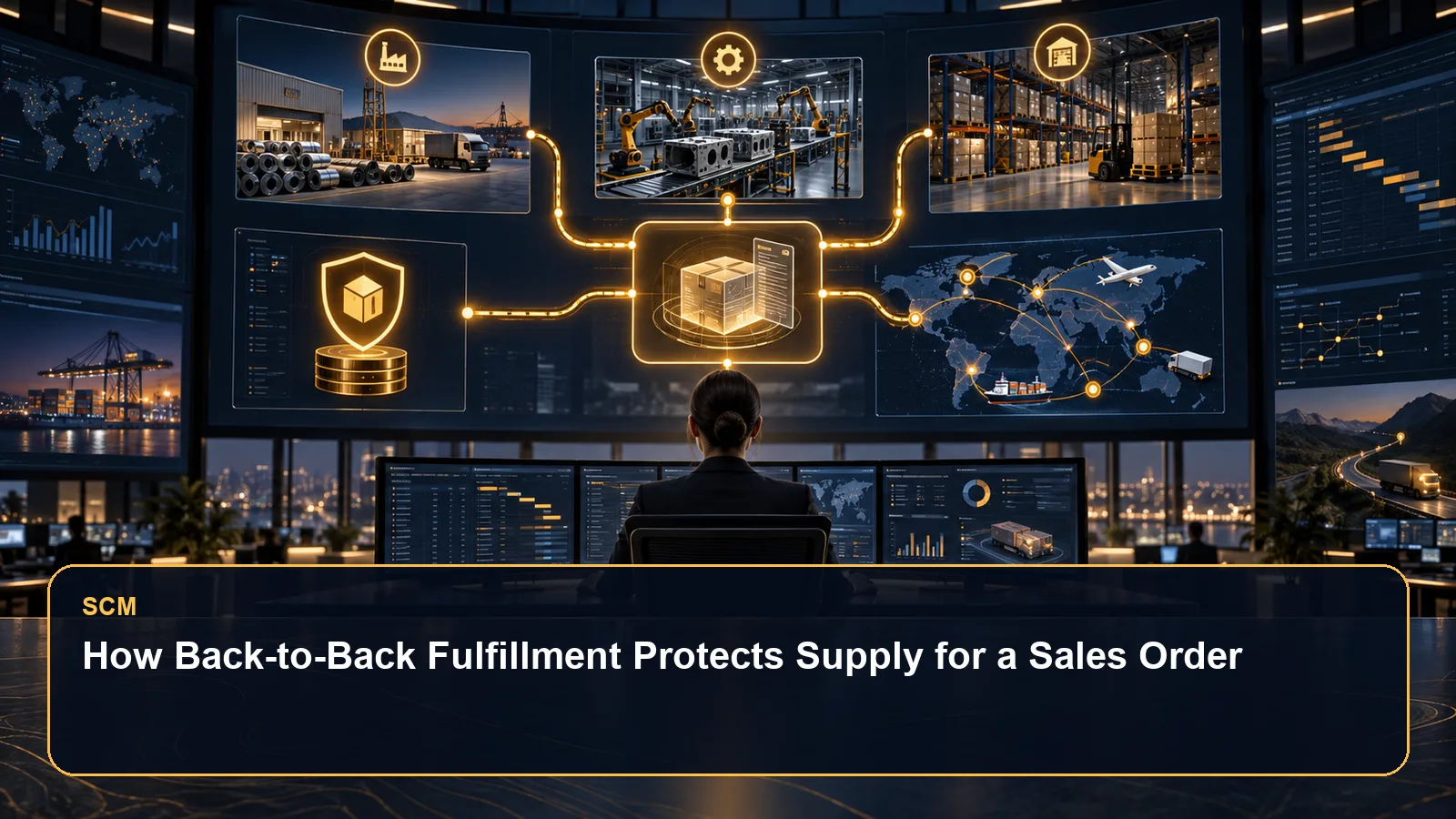
A confirmed sales order is not protected merely because someone can see expected supply on a screen. The real test is whether the supply created for that demand remains connected to it through purchasing, manufacturing, transfer, receipt, reservation, and shipment. Readers comparing a course listed as Oracle SCM Online Training should expect it to explain why back-to-back fulfillment is less about skipping inventory than about preserving that connection while several applications do different parts of the work.
Consider a laboratory that orders one customized refrigeration cabinet for delivery in six weeks. The distributor does not stock it because it is expensive, bulky, and rarely ordered. A supplier can build it, another warehouse may occasionally hold a suitable unit, and an internal plant can make a related configuration. If planners treat all three possibilities as ordinary uncommitted supply, another order could consume the selected unit or capacity. Back-to-back fulfillment addresses that allocation risk by creating supply in response to scheduled demand and maintaining a firm link between the demand and its supply document.
The Protection Is a Document Relationship
In a back-to-back flow, the sales order provides the demand signal and a purchase order, work order, or transfer order provides the supply response. Oracle describes the link between those documents as firm. Its purpose is practical: supply intended for one demand should not be diverted to another demand simply because it will arrive at the same warehouse. The link therefore gives the fulfillment team a defensible answer to the question, “Which incoming supply belongs to this customer line?”
That protection does not mean the item bypasses the fulfillment organization in every case. Back-to-back fulfillment gets the required goods into the warehouse, after which order orchestration handles customer delivery. It also differs from a normal stocked-order flow. With stock already present, the process can reserve, ship, and invoice. With back-to-back demand, the process must request supply, wait while that supply is bought, made, or transferred, and only then proceed to shipment and invoicing.
Scheduling Comes Before the Supply Request
Order Promising schedules the sales order before Supply Chain Orchestration creates the supply request. Promising applies available-to-promise and sourcing rules to determine where supply should come from and how the requested delivery date can be met. The rules can consider availability, supplier capacity, distance, profitability, and a buy, make, or transfer route. Weak sourcing rules can undermine an otherwise sound flow: orchestration executes the route it receives, but that route must reflect operational reality.
For the refrigeration cabinet, promising might recommend buying from the specialist supplier. Supply Chain Orchestration then creates a supply order and sends the request to Purchasing, which creates the purchasing document. If the internal plant becomes the better source for a different cabinet, the recommendation can instead drive a work order. When a matching unit is available elsewhere, a transfer order can move it to the shipping warehouse or support shipment from the location that has it. The three routes differ operationally, yet each begins with demand and creates traceable supply for that demand.
Orchestration Coordinates Without Replacing Execution
A useful boundary is that orchestration manages the flow while execution applications perform the work. Purchasing creates and manages procurement documents, Manufacturing carries out production, Inventory Management supports receipts and transfers, and Shipping dispatches the item. Supply Chain Orchestration creates and manages the supply order, sends the appropriate request, tracks statuses and updates, and passes relevant progress to Order Management. It closes the supply order after Order Management ships the item.
The distinction prevents a common troubleshooting mistake. If a purchase order was never approved, the remedy is not to assume that the sales order lost its demand. Teams should inspect the supply order and orchestration steps, then follow the linked execution document to find where action stopped. In its page titled Oracle Help Center: Use Supply Chain Orchestration in Your Back-to-Back Flows, Oracle explains this division between supply orchestration, which gets goods into the warehouse, and order orchestration, which fulfills and delivers the sales order. That separation creates clearer ownership without breaking end-to-end visibility.
Reservations Make Allocation Operational
A relationship between documents is essential, but warehouse execution still needs a reservation discipline. Once supply is available for the demand, the reservation helps ensure that material handling respects the intended allocation. Users should not casually alter linked quantities or substitute supply outside the controlled process. A local shortcut may make one shipment look successful while leaving the original supply order, exception status, and remaining demand inconsistent.
Suppose the supplier delivers the cabinet alongside two visually similar units for stock. Receiving should identify the document and item correctly, and the reservation should preserve the cabinet for the laboratory order. A warehouse employee who selects solely by proximity can defeat the business intent even when the system relationship is correct. The control therefore depends on sound receiving, labeling, reservation, and picking practices as well as orchestration setup. System protection works when physical execution follows the same identifiers and quantities.
Exceptions Reveal Where the Promise Is at Risk
Back-to-back fulfillment does not eliminate late suppliers, production shortfalls, canceled documents, or quantity changes. It makes them easier to place in context. Because the supply order tracks the route and its steps, a planner can distinguish a request that has not produced an execution document from a purchase order that exists but is delayed. Status alone should lead to the linked document, responsible team, current quantity, and date before anyone changes the customer promise.
Date and quantity changes deserve particular care. A customer may reduce the order after the supplier has begun work, or production may complete fewer units than requested. Teams need explicit rules for canceling, rescheduling, handling excess, and escalating exceptions. They should also avoid creating an unrelated replacement order while the original supply remains active. Otherwise, the business may solve an apparent shortage by creating duplicate supply and future excess. The safest response is to understand the existing orchestration state before intervening.
Design Controls Around the Customer Promise
A strong design begins by deciding which items genuinely should not be stocked and enabling those items for back-to-back use. Next come sourcing and promising rules that represent feasible suppliers, plants, organizations, lead times, and capacities. Test scenarios should cover all permitted routes rather than proving only the easiest buy flow. They should also include a delayed source, a partial quantity, a cancellation, and a changed requested date so users can recognize the resulting supply and order states.
Operational measures should connect customer performance with supply execution. Useful questions include how often scheduled dates are revised, how long exceptions remain unresolved, whether linked supply is received but not reserved, and whether canceled demand leaves open supply. These measures expose handoff failures that a simple on-time shipment percentage may hide. They also keep the design focused on the real objective: producing or obtaining the right item for a specific order without carrying unnecessary general stock or allowing another demand to consume it.
Conclusion
Back-to-back fulfillment protects a sales order by translating scheduled demand into a managed supply order and maintaining a firm connection to the purchase, work, or transfer document that creates supply. For practitioners taking Fusion SCM Online Training , the useful test is whether the course makes that chain visible from promise through receipt, reservation, shipment, and closure, while showing where each execution team takes responsibility. This works when organizations pair correct setup with disciplined exception handling across operations.