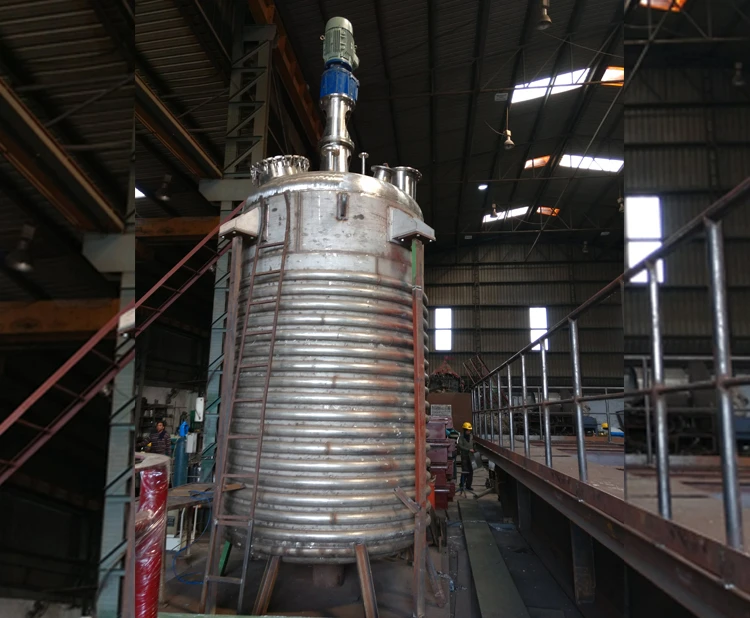
In today’s fast-paced industrial landscape, efficiency, precision, and safety are more important than ever. For industries like pharmaceuticals, chemicals, food processing, and specialty manufacturing, Chemical Reactors are the heart of production. They enable complex reactions, mass transfers, and product synthesis, but their performance has traditionally depended on human monitoring and manual controls.
Thanks to advancements in automation and sensor technology, modern Chemical Reactors are now smarter, safer, and more efficient than ever. These technologies are revolutionizing how plants operate, reducing risks, improving yield, and enabling better process control.
🔹 The Role of Automation in Modern Chemical Reactors
Automation in Chemical Reactors refers to the integration of control systems, programmable logic controllers (PLCs), and computer-based monitoring to manage processes with minimal human intervention. Key benefits include:
- Precise Control Over Reaction Conditions
- Temperature, pressure, pH levels, and reactant flow rates can be maintained automatically, ensuring that reactions occur under optimal conditions. This leads to better product consistency and higher yields.
- Reduced Human Error
- Manual operation can result in deviations in reaction conditions, potentially causing safety hazards or production losses. Automated systems minimize human intervention, ensuring stable operation.
- Enhanced Productivity
- Automation allows continuous operation without fatigue or errors, enabling higher throughput in the same timeframe.
🔹 How Sensors Are Enhancing Chemical Reactor Performance
Sensors play a critical role in modern Chemical Reactors by providing real-time data about every aspect of the reaction. Common sensor types and their benefits include:
- Temperature Sensors: Maintain precise thermal conditions for sensitive reactions.
- Pressure Sensors: Prevent overpressure scenarios that can lead to equipment failure.
- Flow Sensors: Ensure reactants are delivered at the correct rate.
- Level Sensors: Monitor liquid levels in tanks to prevent overflows or shortages.
- pH and Conductivity Sensors: Critical for chemical processes where acidity or ionic content impacts the reaction.
By constantly monitoring these parameters, sensors enable instant adjustments, maintaining safe and efficient operation at all times.
🔹 Benefits of Smart Chemical Reactors
Integrating automation and sensors in Chemical Reactors delivers several key advantages:
- Improved Safety
- Automated monitoring reduces the risk of accidents and exposure to hazardous chemicals.
- Higher Product Quality
- Consistent conditions mean fewer defective batches and more uniform output.
- Energy Efficiency
- Optimal control of temperature, pressure, and flow reduces energy consumption.
- Data-Driven Insights
- Sensors provide valuable operational data that can be analyzed for process optimization.
- Scalability
- Automated reactors are easier to scale up for increased production without compromising safety or quality.
🔹 Real-World Applications
Smart Chemical Reactors are used across multiple industries:
- Pharmaceuticals: For synthesizing active pharmaceutical ingredients (APIs) with precise reaction control.
- Food & Beverage: For chemical processing in flavor, additive, and preservative manufacturing.
- Specialty Chemicals: In petrochemicals, polymers, and fine chemicals production.
- Research & Development: For pilot plants and scale-up studies using controlled automated reactors.
🔹 Why Modern Plants Can’t Ignore Automation
In competitive industrial sectors, plants that rely solely on manual operation are at a disadvantage. Automated Chemical Reactors reduce operational costs, minimize errors, and enhance compliance with safety and quality standards. By integrating sensors, operators gain real-time insights, allowing proactive decision-making rather than reactive troubleshooting.
Automation and sensor technology are no longer optional — they are the standard for modern, efficient, and safe chemical processing.
🔹 Conclusion
The combination of automation and sensors is transforming Chemical Reactors from simple vessels into intelligent, self-regulating systems. This shift ensures better safety, higher quality output, energy efficiency, and scalability. Industries investing in smart reactors are not only improving operational performance but also future-proofing their manufacturing facilities for next-generation production demands.
Modern chemical plants that adopt these technologies gain a competitive edge — safer, faster, and more efficient operations that meet today’s industrial challenges.