How Artificial Intelligence Is Transforming Durable Medical Equipment Operations
The durable medical equipment (DME) industry is undergoing a significant transformation as healthcare providers face increasing administrative workloads, growing patient expectations, and more complex reimbursement requirements. From processing orders and managing insurance documentation to coordinating deliveries and maintaining patient communication, DME providers must handle numerous interconnected processes while ensuring accuracy and operational efficiency.
Traditional workflows often rely on manual data entry, repetitive phone calls, paper-based documentation, and disconnected software systems. Although these approaches may work for smaller operations, they become increasingly difficult to maintain as businesses expand their patient populations, add new locations, and process higher order volumes.
Artificial intelligence offers a practical way to address these challenges. By automating repetitive tasks, analyzing operational data, and supporting communication between patients and healthcare teams, AI can help DME providers improve productivity without compromising service quality.
The Growing Complexity of DME Operations
Running a successful DME business requires coordination across several departments. Intake specialists collect patient information, billing teams verify insurance coverage, warehouse employees manage inventory, and delivery personnel ensure equipment reaches patients on time.
Each department depends on accurate information from the others. When systems operate independently, even minor communication problems can create delays throughout the organization.
For example, incomplete patient documentation may prevent an order from moving forward. An incorrect insurance detail can result in claim rejection, while poor inventory visibility may delay equipment fulfillment.
These problems become more expensive when they occur repeatedly.
Enterprise DME organizations face additional challenges, including:
- Managing large volumes of patient orders across multiple locations.
- Maintaining consistent processes between branches.
- Coordinating billing, intake, inventory, and delivery teams.
- Meeting payer-specific documentation requirements.
- Monitoring order status and operational performance.
- Maintaining regular communication with patients.
- Reducing administrative costs without increasing staffing.
Addressing these challenges requires more than isolated automation tools. Providers need connected systems capable of supporting entire operational workflows.
How AI Automation Improves DME Workflows
Artificial intelligence can support different stages of the DME operational process. Rather than replacing every existing system, AI technologies can complement established workflows by reducing repetitive work and helping employees make faster decisions.
1. Automating Patient Intake
Patient intake is one of the most documentation-intensive activities in the DME industry.
Before an order can be fulfilled, staff members may need to collect patient demographics, insurance information, prescriptions, physician documentation, and other supporting records.
Manual processing creates several opportunities for errors. Employees may enter information incorrectly, overlook missing documents, or spend valuable time transferring data between systems.
AI-powered automation can help streamline these activities by:
- Extracting relevant information from incoming documents.
- Organizing patient records.
- Identifying missing information.
- Supporting data validation.
- Reducing repetitive administrative entry.
Automated intake workflows allow employees to spend less time handling routine documentation and more time resolving complicated cases.
2. Improving Insurance Verification and Prior Authorization
Insurance verification is another essential component of DME operations. Providers must determine whether patients have active coverage, understand applicable benefits, and identify authorization requirements before proceeding with certain orders.
The process can become particularly complicated when organizations work with numerous insurance companies and manage different equipment categories.
AI-supported workflows can help employees organize insurance information, identify potential documentation gaps, and prioritize cases requiring additional attention.
Automation can also reduce unnecessary back-and-forth communication between administrative teams and patients.
However, automated systems should operate alongside established payer rules and human review processes. Insurance eligibility, coverage decisions, and authorization approvals must still follow the applicable requirements.
3. Streamlining Medical Documentation
DME providers frequently receive documentation through different channels, including fax, email, electronic health records, and other communication systems.
Handling these documents manually can consume substantial administrative resources.
Intelligent document processing can recognize document types, extract relevant information, and organize records according to established workflows.
For example, an automated system may help identify a prescription, locate patient details, and route the document to the appropriate department.
This approach can improve document visibility and reduce the likelihood of records being overlooked.
It is particularly valuable for organizations handling thousands of documents across multiple facilities.
AI-Powered Patient Communication and Resupply Management
Patient communication represents another area where automation can deliver significant operational benefits.
DME suppliers often need to contact patients to confirm equipment needs, coordinate resupply orders, collect missing information, and arrange deliveries.
These interactions are important, but manually managing every conversation requires considerable staff time.
AI-powered communication systems can support several activities.
Automated Resupply Outreach
Many DME products require recurring resupply, including respiratory supplies, diabetic equipment, and other medically necessary products.
Providers must maintain communication with eligible patients to determine whether additional supplies are needed.
Traditional outreach typically involves phone calls, voicemail messages, and manual follow-ups. When patient volumes increase, keeping track of every interaction becomes difficult.
Automated communication can help providers:
- Send scheduled text and email reminders.
- Initiate automated voice outreach.
- Collect patient responses.
- Provide secure links for completing required steps.
- Identify patients who need additional assistance.
- Track communication outcomes.
This can make resupply operations more organized while reducing repetitive work for administrative employees.
Improving Patient Experience
Automation should not make healthcare communication feel impersonal.
Patients need clear information about their equipment, insurance requirements, delivery schedules, and available support options.
Well-designed AI communication systems can provide timely responses to common questions and direct more complicated requests to human representatives.
For example, an automated assistant might explain how to confirm a resupply request or provide instructions for completing a required form.
When a conversation involves an unusual clinical question or a complicated insurance issue, the system should escalate the interaction appropriately.
The goal is to make communication more accessible, not eliminate human assistance.
The Importance of Connected DME Software
Individual automation tools can improve specific tasks, but disconnected solutions often create new operational problems.
Imagine a DME organization using one application for patient intake, another for inventory, a separate platform for billing, and an independent communication system for resupply.
Employees may need to enter the same information several times. Different departments may also work with outdated records, creating unnecessary delays.
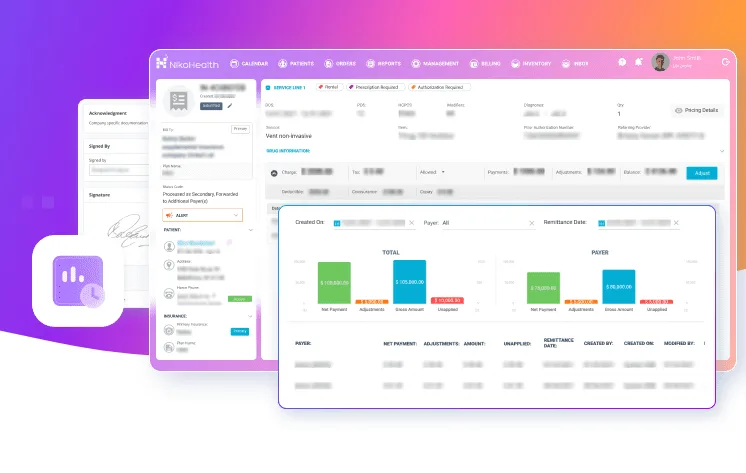
A connected DME software platform provides a more comprehensive approach.
By centralizing operational information, organizations can improve coordination between departments and maintain better visibility into their business activities.
When AI capabilities are integrated into these workflows, automation becomes more useful because it can operate with relevant operational context.
For enterprise providers, this is especially important. A scalable solution should support multiple locations, centralized oversight, standardized processes, and flexible integrations.
Organizations evaluating these technologies should consider several capabilities:
CapabilityBusiness valueCentralized patient recordsBetter information visibilityAutomated intakeLess repetitive administrative workBilling workflow managementMore consistent claim processingInventory managementImproved stock visibilityDelivery coordinationBetter fulfillment organizationAI communicationMore efficient patient outreachReporting and analyticsImproved operational oversightIntegrationsReduced information silosThe combination of these capabilities helps organizations build more consistent operational processes.
Why Enterprise DME Providers Need Scalable Automation
Automation requirements change as a DME company grows.
A small supplier may initially need assistance with a limited number of administrative tasks. A larger organization may manage several warehouses, multiple branches, thousands of active patients, and complex relationships with insurance providers.
At this scale, automation must support more than individual employees.
It must work across departments, locations, and operational processes.
Multi-Location Management
Enterprise organizations need consistent workflows regardless of where employees operate.
Centralized software can help management teams monitor activity across branches, identify bottlenecks, and maintain standardized procedures.
AI-supported reporting can also help identify unusual patterns that may require attention.
Handling Higher Transaction Volumes
As order volumes increase, manual processes become harder to maintain.
Automated workflows can help process routine requests more consistently and reduce administrative bottlenecks.
However, enterprise systems must also be capable of handling peak workloads without compromising performance or data integrity.
Supporting Better Management Decisions
Operational data becomes increasingly valuable as an organization expands.
Managers need to understand order processing times, claim outcomes, inventory availability, delivery performance, and employee workloads.
AI-powered analytics can help transform operational information into actionable insights.
Instead of relying exclusively on manual reports, leadership teams can identify trends and investigate areas where processes may need improvement.
Security and Compliance Considerations
Healthcare automation introduces important responsibilities related to data protection and regulatory compliance.
DME providers routinely handle protected health information, insurance records, prescriptions, and other sensitive patient data.
Any technology used within these workflows must support appropriate safeguards.
Important considerations include:
- HIPAA-aligned security practices.
- Role-based access controls.
- Multi-factor authentication.
- Encryption of sensitive information.
- Audit trails and activity monitoring.
- Secure integrations with external systems.
- Business Associate Agreements where required.
Organizations should also evaluate how AI systems process and retain information.
Automation must not introduce uncontrolled access to patient records or create unnecessary compliance risks.
Human oversight remains essential, particularly when workflows involve clinical documentation, insurance decisions, and other sensitive operational activities.
How to Choose the Right AI Automation Platform
Selecting an automation solution requires a clear understanding of an organization's existing processes and long-term objectives.
A tool that works well for one department may not address the needs of an entire enterprise.
Before investing in new technology, DME providers should evaluate several factors.
Integration capabilities: The platform should connect with relevant business systems and minimize duplicate data entry.
Workflow flexibility: Organizations should be able to configure processes according to their operational requirements.
Scalability: The solution should accommodate growing patient populations, additional locations, and increasing transaction volumes.
Automation coverage: Providers should understand which processes can be automated and where human intervention remains necessary.
Reporting capabilities: Management should have access to reliable information about operational performance.
Implementation requirements: Deployment timelines, employee training, data migration, and ongoing support should be considered before making a decision.
A structured evaluation helps organizations avoid investing in isolated solutions that create additional complexity.
The Future of AI in the DME Industry
Artificial intelligence will likely become an increasingly important part of healthcare operations.
For DME providers, the greatest opportunities are not necessarily associated with replacing entire departments. They involve removing repetitive administrative tasks and creating more connected workflows.
Future developments may include more advanced document recognition, intelligent order routing, predictive inventory planning, automated patient engagement, and improved operational analytics.
These technologies could help organizations identify problems earlier and allocate resources more effectively.
Nevertheless, successful implementation depends on more than the technology itself. Companies need reliable data, well-defined processes, employee training, and appropriate oversight.
The most effective automation strategies will combine intelligent systems with experienced healthcare professionals.
Conclusion
The growing complexity of the DME industry makes operational efficiency increasingly important. Providers must coordinate patient intake, insurance verification, documentation, billing, inventory, deliveries, and recurring resupply while maintaining high standards of service.
AI-powered automation offers an opportunity to simplify these processes, reduce repetitive administrative work, and improve communication across departments.
For organizations evaluating modern solutions, exploring ai dme automation can provide a useful starting point for understanding how intelligent technologies support enterprise-level DME operations.
Ultimately, the future of DME management will depend on combining scalable software, practical automation, secure data management, and human expertise to create more efficient healthcare operations.